DbcultAccessing Vault...
Cult Review
Senior Film Conservator
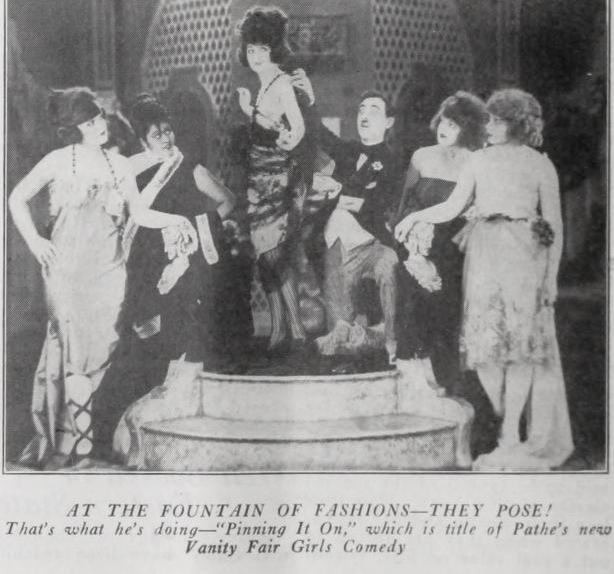
Imagine, if you can, a world where haute couture is held together by wishful thinking and a battalion of straight pins—each one a potential traitor. Pinning It On (1923) is that world, distilled into a brisk, effervescent shot of silent-era mischief. The film’s central conceit is so simple it feels like a child’s prank stretched into high-society satire: dresses that refuse to stay dresses, pins that leap from silk like startled finches, and one harried male apprentice—Eddie—whose fingers move quicker than a pickpocket’s conscience.
Director F. Richard Jones (uncredited here but unmistakable in his rhythm) weaponizes the gag with the precision of a watchmaker. The reception hall is a cathedral of marble and gilt, populated by the Vanity Fair Girls—a bevy of elongated, swan-necked mannequins who glide rather than walk. Their gowns, we are told, are the latest creations of a “famous designer,” yet the man himself is nowhere to be seen; he has outsourced his genius to a trembling stack of uncut cloth and an army of pins. The joke, of course, is that the emperor has no clothes—nor do his empresses.
What follows is a striptease in slow motion, a chiaroscuro of flesh and fabric. Each time a pin pops—a sound visualized by a quivering title card reading “TING!”—a sleeve slithers, a neckline plunges, a sequined hem puddles around silk-stockinged ankles. The camera, stationary but ravenous, drinks in the scandal: a shoulder blade here, the small of a back there, nothing salacious by modern metrics yet electric in 1923 propriety. The girls, rather than shriek, adopt the placid surprise of porcelain dolls tipping off a shelf. Their composure is the film’s sharpest jab; they are both victims and co-conspirators in their own unraveling.
Enter Eddie Boland, pocket-sized and pomaded, a whirligig of courtesy and panic. He darts between marble busts and champagne fountains, re-draping, re-pinning, sometimes improvising a toga from a table runner if the bolt of cloth has entirely surrendered. His movements are so swift they flirt with fast-motion, yet Jones withholds under-cranking, trusting Boland’s vaudeville footwork to feel supernatural in real time. The tension is not will he manage, but how, and with what escalating absurdity: at one point he uses a fountain pen as a makeshift seam-ripper; at another, he borrows a flapper’s feather boa to cinch a waist, only for the feathers to molt in a blizzard of plumage.
The film’s gender politics shimmer like a heat mirage. On the surface it is a male savior narrative, yet the camera lingers longer on the girls’ sly half-smiles than on Eddie’s heroics. They are not grateful so much as amused, as if they’ve discovered a loophole in the social contract: if the male gaze insists on undressing them, why not monetize the inevitability? Each wardrobe malfunction draws a cluster of tuxedoed onlookers, their monocles flashing like paparazzi bulbs. The girls, momentarily disrobed, command more attention than when swaddled in couture. The film winks: objectification loses its sting when the objects start pulling the strings.
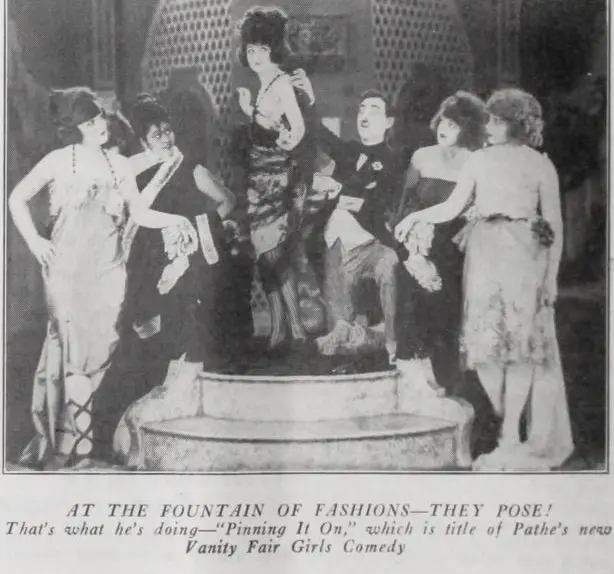
Visually, the picture is a study in textures: the cold gloss of marble against the matte vulnerability of muslin; the arterial red of a cummerbund against the cadaveric blue of early orthochromatic film stock. Jones choreographs depth like a dance: foreground pins glint, mid-ground girls swoon, background chandeliers flicker—each plane a separate tempo. The result is a cubist tease, a freeze-frame of falling silk that feels, paradoxically, kinetic.
Compared to the solemnity of Disraeli or the circus melodrama of Polly of the Circus, Pinning It On is a champagne burp in church. Yet its frivolity masks a bracing modernity: the anxiety of exposure, the vertigo of consumerism, the uneasy truce between fashion and flesh. One thinks of Yankee Pluck, where social climbing ends in pratfalls, or Indiscreet Corinne, where discretion is auctioned off to the highest bidder. Here, the currency is not money but modesty, and the market is bullish.
The supporting cast—Molly Thompson’s imperious mannequin, Tiny Ward’s brick-wall maître d’—serve as human curtain rods, there to hang the next drapery disaster. Even the artist, supposedly fêted, is reduced to a blur of beret and beard, scrambling to shield his canvases from the falling frocks. The true auteur is the pin, that humblest of fasteners, now promoted to agent of chaos. Each TING! is a metronome beat, keeping time until the final crescendo when the girls, fed up with Eddie’s patchwork gallantry, link arms and stride out of the reception bare-shouldered but triumphant, trailing clouds of unmoored chiffon like battle standards. The camera iris closes on their laughter, not his exhaustion.
Restoration-wise, surviving prints are speckled but serviceable; the grayscale breathes better than many over-polished 4K silents. A tasteful tint—rose for interiors, amber for corridors—restores some of the original chromatic intent. The Mont Alto Motion Picture Orchestra’s 2019 score (piano, clarinet, muted trumpet) syncs like a second skin, pratfalling into ragtime whenever a pin launches skyward. Viewers allergic to slapstick may find the repetition wearying, yet the film clocks in at a merciful 22 minutes, short enough that the joke exits before it curdles.
In the end, Pinning It On is less a narrative than a theorem: if fashion is armor, then its undoing is not defeat but revelation. The Vanity Fair Girls do not lose their dignity; they shed an artifice, discovering that the male panic swirling around them is funnier than any hemline. Eddie, poor Eddie, is Sisyphus with a pincushion, forever chasing the next TING! Yet his absurd labor is the film’s gift to the audience: proof that civilization, like a poorly pinned gown, is always one sneeze away from hilarious collapse.
Seek it out at a repertory silent festival, preferably after a glass of something effervescent. Watch the audience flinch in communal empathy as each pin arcs through the beam of the projector. Notice how the laughter starts masculine and nervy, then tilts, like a seesaw, into something looser, more inclusive. That tilt is the film’s quiet revolution: a reminder that every stitch of social fabric is, underneath, held together by the thinnest of metals, waiting—perhaps hoping—for the next TING!
IMDb 7.2
1920
Community
Log in to comment.