DbcultAccessing Vault...
7.9/10
Senior Film Conservator
A definitive 7.9/10 rating for a film that redefined the boundaries of cult cinema. Play Safe remains a cornerstone of transgressive art.
Is Play Safe worth watching today? Short answer: absolutely, especially if you appreciate the raw, unadulterated thrill of silent-era slapstick and death-defying practical stunts, but it might test the patience of those accustomed to modern narrative pacing. This film is a glorious, heart-stopping ride for anyone who marvels at the sheer physical bravery of early cinema performers and the ingenious simplicity of their filmmaking. However, if you require intricate character development or a dialogue-driven plot, Play Safe might feel a little thin on the ground.
It’s a masterclass in escalating tension through pure kinetic energy, a relentless chase that never truly lets up. But it’s flawed.
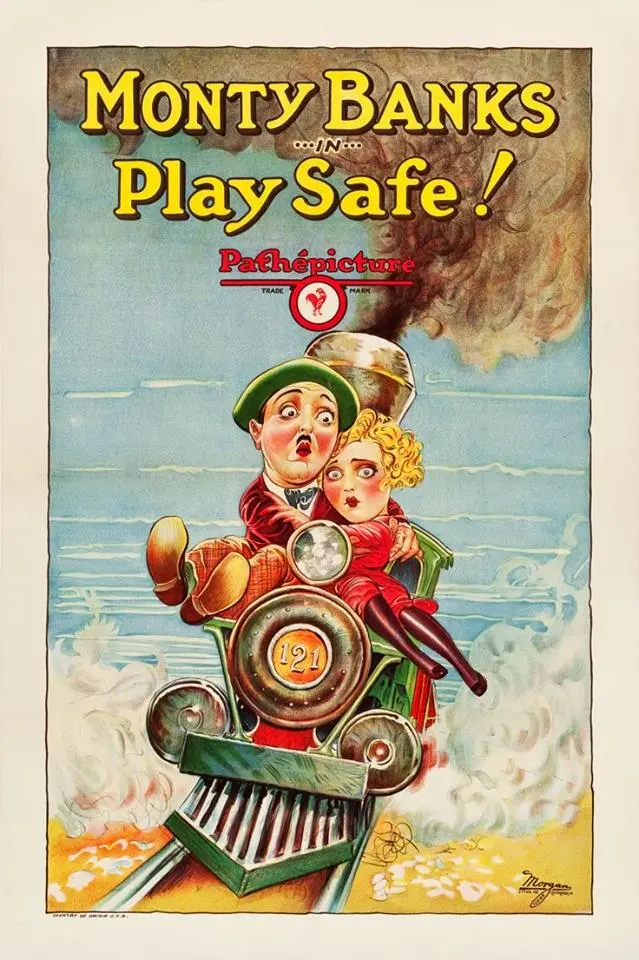
The premise of Play Safe is deceptively simple, yet it unfurls into a spectacle of relentless action. We are introduced to a scenario where a young woman, portrayed with convincing distress by Virginia Lee Corbin, finds herself cornered by a group of rather generic but effectively menacing bad guys. Her desperate attempt to evade capture leads her into a freight car, a seemingly innocuous hiding spot that quickly transforms into a death trap. Through a calamitous error, the train is set in motion, its throttle jammed at full speed, transforming a simple escape into a runaway nightmare. This initial misstep, a simple push of a lever, is the catalyst for nearly an hour of pure, unadulterated cinematic adrenaline, a testament to the power of a single, impactful plot point.
The film pivots on this central dilemma: a woman trapped, a train speeding out of control, and a hero, Monty Banks, who must somehow overcome impossible odds to save her. It’s a narrative engine that runs on pure momentum, much like the train itself. The stakes are clear, immediate, and constantly escalating. There’s no time for exposition or lengthy character arcs; the film thrusts you directly into the action and demands your unwavering attention. This directness, while perhaps lacking in thematic depth, is precisely its strength in delivering a visceral, thrilling experience.
This film works because of its relentless, innovative stunt work and Monty Banks’ captivating physical comedy, which never lets the high-stakes premise feel anything less than exhilarating. It's a pure shot of adrenaline.
This film fails because its narrative beyond the central chase is remarkably thin, offering little in the way of character development or thematic resonance, which can make its slower moments feel a touch padded. The villains, while functional, are utterly forgettable.
You should watch it if you are a devotee of silent-era action-comedies, appreciate groundbreaking practical stunts, or simply want to witness a film that prioritizes pure, unadulterated spectacle over intricate storytelling. It’s a historical artifact of incredible daring.
At the heart of Play Safe lies Monty Banks, a name that, while perhaps not as universally recognized as Keaton or Chaplin today, was synonymous with daring physical comedy and jaw-dropping stunts in the silent era. Banks is an absolute force of nature here. His performance isn't merely acting; it's a display of athletic prowess and comedic timing that feels genuinely dangerous. From the moment he realizes his beloved is in peril, his transformation into a determined, almost acrobatic hero is complete. He doesn't just chase the train; he becomes one with its movement, a human projectile launched into a ballet of peril.
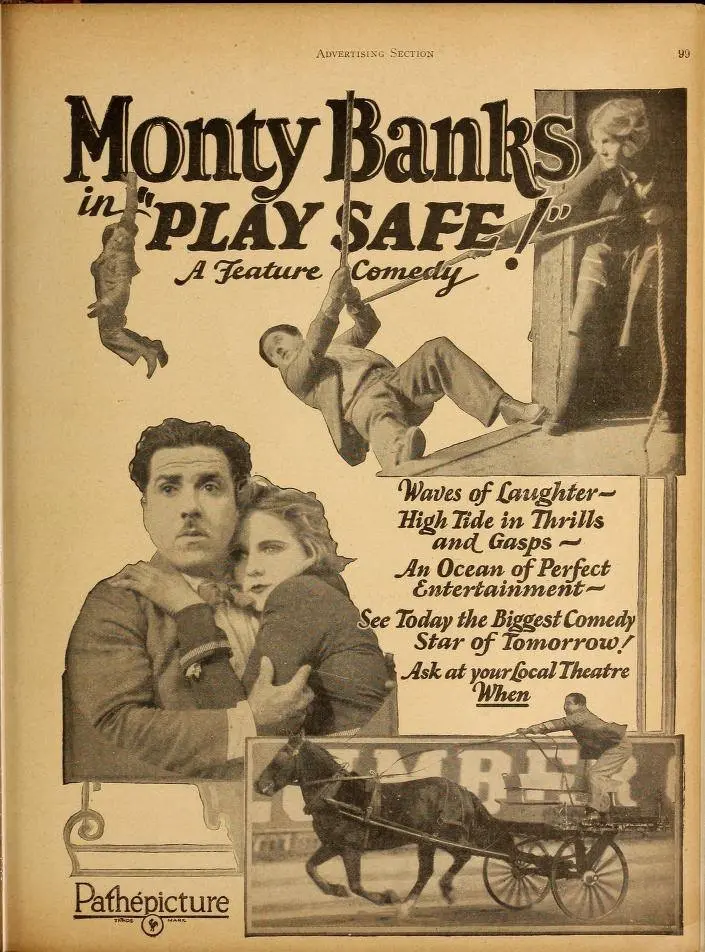
One of the film's undeniable highlights is watching Banks actually board the moving train. This isn't trick photography or a cleverly edited sequence; it's the real deal. He clambers, he leaps, he dangles, all with a surprising grace that belies the inherent danger. There’s a particular sequence where he navigates the exterior of the speeding train, clinging to its sides, scaling its various components, that is genuinely breathtaking. It’s the kind of practical stunt work that inspires awe and makes you question the sanity of the filmmakers and performers involved. Banks’ physical comedy isn’t always about broad gags; it’s often woven into the fabric of his perilous situation, a desperate chuckle in the face of certain doom. His expressive face, a vital tool in silent cinema, perfectly conveys his mounting frustration and determination, shifting from comedic bewilderment to steely resolve.
Banks, while a phenomenal physical comedian, sometimes lacks the melancholic everyman depth that made Keaton so enduring. Yet, what he brings is an almost manic energy, a relentless pursuit that feels less like a character arc and more like a force of nature. His commitment to the stunts is absolute, selling every precarious moment with a conviction that modern green-screen performances often struggle to replicate. It's an honest performance in the most brutal sense of the word, forged in sweat and genuine risk.
While Monty Banks is the undisputed star, the performances of the supporting cast, particularly Virginia Lee Corbin as the damsel in distress, are crucial to grounding the film’s escalating chaos. Corbin, though largely confined to the boxcar, effectively conveys terror and vulnerability. Her initial fear as the train lurches into motion, the dawning realization of her predicament, is palpable. She’s not just a prop; she’s the emotional anchor, the reason for Banks’ frantic heroism. Without her believable fear, the stakes would feel significantly diminished. Her wide-eyed expressions and frantic gestures in the confined space heighten the sense of claustrophobia and helplessness, making her eventual rescue all the more urgent.
The gang of villains, led by the likes of Frank Alexander and Bud Jamison, are archetypal silent-era heavies. They are not complex characters, nor do they need to be. Their function is purely antagonistic: to menace Corbin, to pursue Banks, and to add a layer of human malice to the already daunting mechanical threat of the runaway train. Their presence ensures that the hero isn't just fighting physics but also tangible, malevolent forces. The brief, brutal skirmishes between Banks and the gang members on the speeding train add another dimension of danger, transforming the chase from a mere race against time into a multi-faceted battle for survival.
Directors Harry Sweet and Charles Horan, along with Monty Banks himself who also contributed to the writing, understood the unique language of silent cinema. They crafted a film that speaks through movement, expression, and the sheer power of its visuals. The cinematography, while perhaps not groundbreaking in its artistic flourishes, is exceptionally effective in capturing the speed and scale of the unfolding disaster. The camera is often dynamic, tracking the train's relentless progress, emphasizing its velocity and the precariousness of Banks' position. There's a particular shot of the train hurtling through a tunnel, emerging into daylight, that perfectly encapsulates the journey's relentless, onward march.
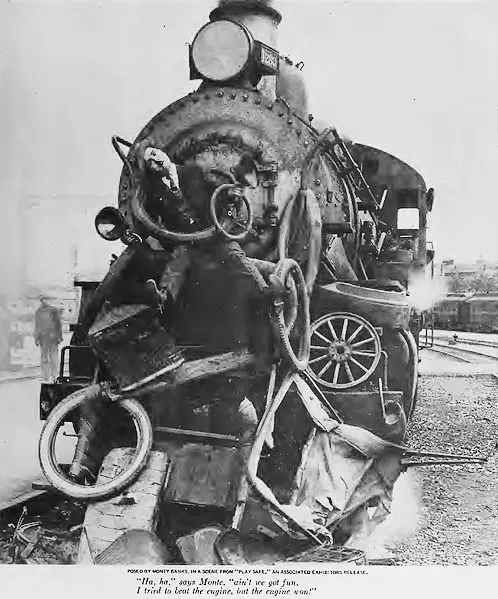
The use of the environment is particularly clever. Tunnels become moments of heightened tension, plunging the action into temporary darkness, only to reveal renewed peril on the other side. The looming presence of a water tower is not just a scenic element but a ticking clock, a potential obstacle that adds another layer of complexity to Banks' already impossible task. The film understands that a runaway train isn't just a vehicle; it's a character in itself, an antagonist of steel and steam, and the filmmakers exploit its every facet for dramatic effect. Every visual cue, from the smoke billowing from the engine to the blur of the passing landscape, contributes to the sense of accelerating doom. It’s a masterclass in visual communication, where every frame tells a part of the story without a single spoken word.
The pacing of Play Safe is, for the most part, a relentless sprint. Once the train starts, the film rarely lets up, maintaining a high level of tension through its continuous action sequences. There are moments where the plot momentarily slows down to allow for character reactions or brief comedic beats, but these are quickly subsumed by the next burst of kinetic energy. This constant forward momentum is key to the film's success as an action picture. It doesn't rely on jump scares or intricate plot twists; it relies on the sheer, visceral thrill of watching a man perform increasingly dangerous feats on a speeding train.
The practical effects here are truly astounding, especially when viewed through a modern lens. The sheer audacity of the stunts makes modern CGI spectacles feel almost sterile by comparison. When Banks hangs from the side of the train, you know it's him. When he dangles precariously over a chasm, the danger feels real because it probably was. The scene involving a frayed rope, which becomes a crucial element in one of Banks' most perilous maneuvers, is a prime example of how simple props, combined with incredible stunt work, can create nail-biting suspense. The steep grade, a natural feature of the landscape, is not just a backdrop but an active participant, adding visual dynamism and a sense of increasing difficulty to the hero's journey. It’s an ode to a bygone era of filmmaking where ingenuity and courage were the primary special effects.
One might argue that the film occasionally sacrifices narrative nuance for spectacle, but in the context of a silent comedy-thriller, this is hardly a flaw. It delivers precisely what it promises: a high-octane, laugh-out-loud, and genuinely thrilling experience. The tonal balance between the slapstick comedy and the very real danger is expertly managed, ensuring that the humor never undermines the stakes.
Yes, Play Safe is absolutely worth watching today. It offers a rare glimpse into the incredible practical stunt work of the silent era. The film is a pure, unadulterated dose of adrenaline and laughs. It showcases the immense talent and bravery of Monty Banks. Viewers interested in the history of action cinema will find it fascinating. It's a reminder of what could be achieved without digital effects. The film's energy is infectious, even a century later. It works.
Play Safe is more than just a relic; it's a vibrant, pulse-pounding experience that stands as a testament to the ingenuity and daring of silent-era filmmakers. While it may not possess the narrative sophistication of its more celebrated contemporaries, its sheer kinetic energy and the breathtaking practical stunts performed by Monty Banks make it an essential watch for anyone interested in the foundations of action cinema. It’s a film that demands to be seen not just for its historical value, but for the genuine thrill it still delivers. It reminds us that sometimes, the simplest premises, executed with incredible bravery and skill, can create the most enduring spectacles. It’s a wild ride, and nearly a century later, it still runs at full steam. Don't let its age fool you; this train is still very much on track for entertainment.
IMDb —
1918
Community
Log in to comment.