DbcultAccessing Vault...
Cult Review
Senior Film Conservator
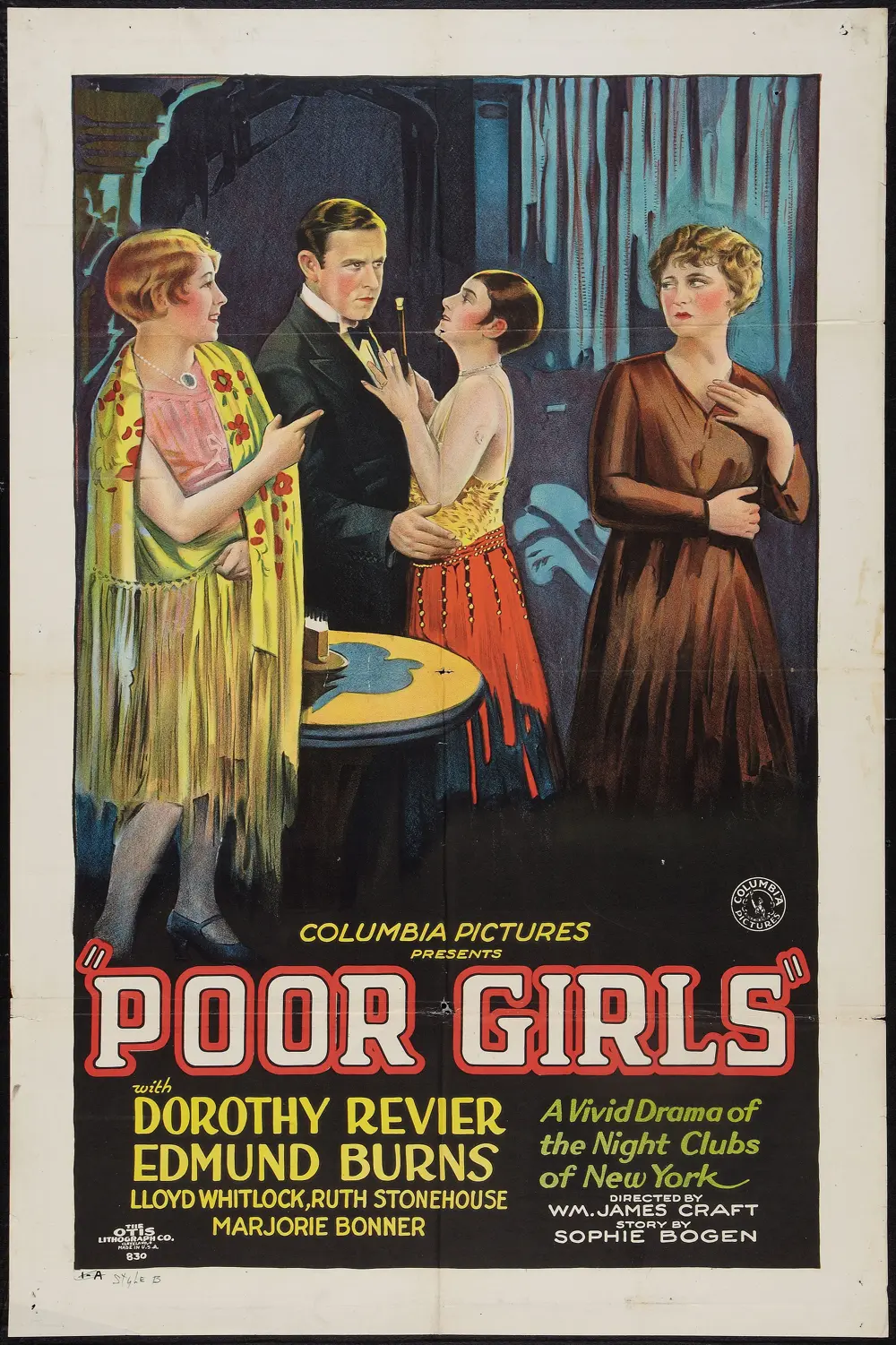
Is 'Poor Girls' worth watching today? Short answer: yes, but with significant caveats that demand a certain cinematic palate. This 1927 silent melodrama is a fascinating, if sometimes frustrating, window into early 20th-century morality plays, best suited for ardent silent film enthusiasts and scholars of social drama, but likely to test the patience of those accustomed to modern narrative pacing and straightforward character arcs.
This film works because of its surprisingly bold critique of societal double standards and Ruth Stonehouse's compelling, dual-faceted performance. It fails because its pacing can be uneven, and Dorothy Revier's central character, Peggy, often feels more like a plot device than a fully realized individual. You should watch it if you appreciate the raw, melodramatic power of the silent era and are interested in films that tackle complex themes of maternal sacrifice and social hypocrisy, even if imperfectly.
William Branch's 'Poor Girls' emerges from the silent era as more than just a forgotten relic; it’s a surprisingly potent, if somewhat unpolished, piece of social commentary wrapped in a thick layer of melodrama. At its core, the film grapples with the pervasive hypocrisy of a society that demands virtue while simultaneously creating the conditions for its transgression. It asks uncomfortable questions about the cost of respectability and the lengths to which a mother will go to shield her child from the very harshness that shaped her own life.
The narrative, penned by William Branch and Sophie Bogen, could easily have devolved into simplistic moralizing. Instead, it attempts, with varying degrees of success, to paint a picture of grey areas. Katherine Warren, played with an intriguing blend of grace and grit by Ruth Stonehouse, is not merely a 'fallen woman' but a strategic survivor. Her transformation into 'Texas Kate' isn't just an act of desperation; it's an assertion of power within a system designed to disempower women. This is where the film finds its most compelling, albeit sometimes unexplored, thematic depth.
The acting in 'Poor Girls' is, as expected for the era, broad yet often effective. Ruth Stonehouse, as the mother Katherine Warren, truly carries the emotional weight of the film. Her portrayal of the respectable society woman, burdened by a secret, is nuanced. We see the strain in her eyes, the subtle tension in her posture, even in moments of apparent calm. But it's her transformation into 'Texas Kate' that truly shines. Stonehouse imbues Kate with a captivating blend of confidence, weariness, and a pragmatic understanding of her world. In the lavish, smoky confines of the nightclub, Kate commands attention, her gestures becoming bolder, her gaze more direct. One particular moment, where she calmly dismisses a leering patron with a look that is both dismissive and subtly threatening, speaks volumes about the agency she has carved out for herself in this morally ambiguous domain.
Conversely, Dorothy Revier's performance as Peggy Warren, the daughter, is less impactful. While her initial shock and subsequent shame are conveyed adequately through the era's standard expressions of distress—wide eyes, trembling hands—her character often feels reactive rather than proactive. Peggy's journey from naive innocence to disillusioned independence, and then to a somewhat passive acceptance of her mother's actions, lacks the raw emotional conviction that Stonehouse brings. She is often more of a plot catalyst, a symbol of purity to be protected, rather than a fully fleshed-out individual making difficult choices. This disparity in performance, while understandable given the script's focus, occasionally leaves Peggy feeling underdeveloped, making it harder to fully invest in her emotional turmoil.
The supporting cast, including Edmund Burns, Marjorie Bonner, and Lloyd Whitlock, fulfill their roles adequately, providing the necessary foils and romantic interests without ever truly stealing the spotlight. Their performances are largely functional, serving to advance the plot points rather than adding significant psychological depth. Whitlock, as a potential suitor, embodies a certain smarmy entitlement common in such melodramas, making his eventual comeuppance feel earned, if a little predictable.
William Branch's direction is competent, adhering to many of the established conventions of silent film melodrama. He effectively uses close-ups to emphasize emotional moments, particularly during Katherine's internal struggles or Peggy's moments of despair. The visual contrast between the two worlds Katherine inhabits is well-executed: the respectable, almost sterile environments of Peggy's boarding school and the family home are juxtaposed with the opulent, yet often shadowy and morally ambiguous, sets of the New York nightclubs. The art direction for 'Texas Kate's' domain is particularly noteworthy, capturing an atmosphere of forbidden allure that feels genuinely enticing.
However, the film's pacing is undoubtedly its biggest hurdle for modern audiences. There are stretches, particularly in the exposition of Peggy's initial disillusionment and her subsequent attempts to forge an independent life, where the narrative meanders. Silent films often relied on title cards to convey crucial plot details and character thoughts, and 'Poor Girls' is no exception. While these are informative, they can slow the momentum, especially when the visual storytelling isn't constantly pushing the narrative forward. A scene depicting Peggy's struggles to find work and her subsequent vulnerability, for example, feels protracted, even if its purpose is clear.
The cinematography, while not groundbreaking, is effective. It captures the glamour of the nightclub scenes with a keen eye for detail, using lighting to create a sense of both excitement and danger. The more intimate scenes, particularly those between mother and daughter, are framed to emphasize their emotional connection and eventual separation. There isn't the experimental flair of some of the European silent masters, nor the grand scale of a Griffith epic, but it serves the story well. It works. But it’s flawed.
'Poor Girls' is a fascinating study of the 'fallen woman' trope, yet it subverts it in subtle ways. Katherine isn't merely a victim of circumstances; she makes a conscious, albeit agonizing, choice. Her 'immoral' life is presented not as a degradation, but as a means to an end—a powerful act of maternal sacrifice. This is a strong, debatable opinion: the film dares to suggest that the 'purity' Peggy enjoys is directly bought by her mother's 'impurity,' creating a moral paradox that society is unwilling to acknowledge.
The film critiques the superficiality of social standing, where outward appearances dictate worth, regardless of the underlying integrity or motivations. Peggy's initial shame isn't just about her mother's profession; it's about the perceived loss of her own social standing. It's a poignant commentary on how deeply ingrained class and reputation were in the social fabric of the 1920s. This societal pressure is also explored in films like The Price of Pleasure, which similarly dissects the hidden costs of maintaining a respectable facade.
The unconventional observation here is how the film, perhaps inadvertently, positions 'Texas Kate' as a figure of surprising strength and agency. In her world, she holds power, makes decisions, and can genuinely protect her daughter. This contrasts sharply with the more constrained lives of 'respectable' women of the era, suggesting that sometimes, stepping outside the lines offers a different, albeit dangerous, kind of freedom. This makes Katherine a more complex and compelling character than most heroines of the period.
Absolutely, for the right audience. 'Poor Girls' offers a unique lens into the socio-cultural anxieties of the late 1920s, particularly concerning women's roles, class, and morality. It's a valuable piece for understanding the evolution of melodrama and its capacity for social critique. The film's emotional core, centered on a mother's fierce love, remains resonant. However, its silent-era pacing and occasional narrative conveniences require patience and an appreciation for historical filmmaking techniques. It’s not for everyone, but for those who engage with it on its own terms, there are rich rewards.
'Poor Girls' is a film that demands a certain level of commitment, but rewards patient viewers with a surprisingly complex exploration of morality, sacrifice, and the enduring power of maternal love. While its silent-era trappings and some narrative shortcomings prevent it from being a universally acclaimed masterpiece, it stands as a valuable, thought-provoking piece of cinematic history. It's a melodrama, yes, but one with a surprisingly sharp critical edge that resonates even today. If you're willing to peel back the layers of time and convention, you'll find a story that's far richer than its simple title might suggest.

IMDb —
1918
Community
Log in to comment.