DbcultAccessing Vault...
Cult Review
Senior Film Conservator
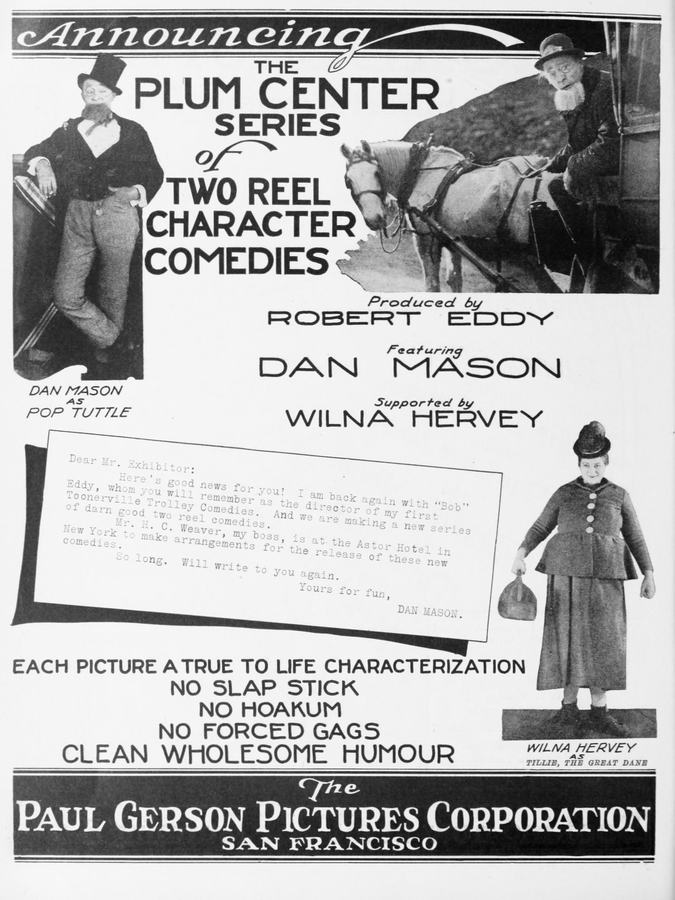
The year 1920 stood at a fascinating crossroads for the motion picture industry. While the grandiose dramas of Europe, such as the haunting Isterzannye dushi, were exploring the depths of the human psyche, the American short subject was perfecting the art of the 'everyman' hero. In Pop Tuttle's Clever Catch, we witness the crystallization of a character archetype that would influence decades of sitcom tropes: the seemingly bumbling elder whose sharp intellect far outpaces his physical vigor.
Dan Mason, a veteran of the stage, brings a lived-in authenticity to Pop Tuttle that transcends the silent medium's inherent limitations. Unlike the broad, often manic energy seen in King of the Circus, Mason’s performance is built on a foundation of subtle gestures and reactive timing. He doesn't just play for the camera; he inhabits the dusty boots of a man who has seen a thousand sunsets over the village stage lines. His interaction with Wilna Wilde provides a grounded emotional center, though the film's heart lies in the solitary battle of wits between the law-abiding citizen and the chaotic element of the frontier.
In contrast to the high-stakes melodrama of Love's Redemption, this short focuses on the minutiae of survival. The stagecoach itself becomes a character, a creaking vessel of local history that Pop Tuttle navigates with the precision of a sea captain. When the bandit appears, the shift in Mason’s posture—from relaxed driver to calculating strategist—is a marvel of silent acting. He avoids the melodramatic flourishes common in films like The Guilty Man, opting instead for a performance that feels surprisingly modern in its restraint.
The brilliance of Pop Tuttle's Clever Catch lies in its subversion of the 'holdup' trope. Most Westerns of the era, such as Days of Daring, relied on gunplay and equestrian stunts to resolve conflict. Writer Al Giebler, however, crafts a scenario that hinges entirely on psychological manipulation. The request for 'alibi holes' is a stroke of narrative genius. It weaponizes the bandit’s own vanity and overconfidence against him. By convincing the thug to empty his revolver into a hat and coat, Tuttle effectively disarms the threat without firing a single shot of his own—at least, not until the odds are entirely in his favor.
This cleverness reflects a broader trend in 1920s cinema where intelligence began to triumph over brute force. We see echoes of this in Home Talent, though Giebler’s work here is more tightly coiled. The pacing is relentless; every frame serves the eventual payoff. The dialogue, delivered through sparse but punchy intertitles, captures the vernacular of the rural working class without descending into caricature. It’s a script that understands the value of a 'con' within a 'con,' a theme that would later become a staple of the heist and caper genres.
One cannot discuss this film without mentioning Wildfire, the 'town truck horse.' In many ways, Wildfire serves as a mirror to Pop Tuttle himself. Both are perceived as relics of a slower age, perhaps slightly past their prime in a world rapidly moving toward the industrialization seen in What's His Name. Yet, when the moment of truth arrives, it is the reliability of the old guard that carries the day. The image of the bandit being forced to ride Wildfire into town—a slow, humiliating parade of defeat—is one of the most satisfying visual payoffs in early comedy.
This use of animals as narrative pivots was a common technique, yet here it feels less like a gimmick and more like an extension of the setting. Compare this to the more atmospheric use of locations in Tangled Fates. In Pop Tuttle's Clever Catch, the environment is a tool. The road, the stage, and the horse are all integrated into Tuttle’s grand design. The cinematography, while utilizing the standard static wide shots of the period, manages to capture the vastness of the trail, making the isolation of the holdup feel genuinely perilous before the comedy takes over.
To fully appreciate the impact of this film, one must look at the cinematic landscape of the early 1920s. While films like The Forbidden Thing dealt with heavy moral quandaries, and The Faith Healer explored spiritual ambiguity, the Pop Tuttle series provided a necessary catharsis for an audience navigating the post-war era. It celebrated the ingenuity of the common man. There is a certain kinship between Pop Tuttle and the protagonists of Passers-by, both navigating worlds that are changing faster than they are.
Furthermore, the film’s exploration of reputation—the 'alibi' that Tuttle seeks—speaks to a very human anxiety about how we are perceived by our community. Even in a comedic context, the fear of being seen as a coward is a powerful motivator. This same theme is explored with much darker undertones in the Hungarian production A tiszti kardbojt. By turning this anxiety into a trap for the villain, Giebler and Mason provide a triumphant resolution that is both hilarious and deeply resonant.
Technically, the film utilizes the natural light of its outdoor locations to great effect. The harsh shadows of the trail contrast with the softer, more inviting tones of the village scenes. This visual dichotomy reinforces the danger of the 'outside' world versus the safety of the 'inside' community. While it lacks the stylistic experimentation of The Ragged Princess, its simplicity is its strength. The editing is crisp, particularly during the sequence where the bandit is shooting holes in Pop’s clothing. The rhythm of the cuts builds a tension that is released only when the bandit hears the hollow 'click' of an empty chamber.
The film also benefits from a lack of the mawkish sentimentality that often plagued shorts like A Wee Bit o' Scotch. It is a lean, mean comedic machine. Every element, from Wilna Wilde’s brief but effective presence to the final triumphant trot into town, is calibrated for maximum impact. It is a testament to the efficiency of early studio filmmaking, where a clear vision and a charismatic lead could create something enduring out of a simple premise.
Ultimately, Pop Tuttle's Clever Catch stands as a vibrant reminder of the power of character-driven comedy. It doesn't need the sprawling cast of The Drifters to tell a compelling story. Instead, it relies on the universal appeal of the underdog outsmarting the bully. Dan Mason’s performance remains a highlight of the era, offering a masterclass in how to command the screen through wit and timing rather than spectacle. For those looking to understand the roots of the American comedic identity, this film is an essential piece of the puzzle—a clever, charming, and thoroughly entertaining slice of cinematic history.
IMDb —
1934
Community
Log in to comment.