DbcultAccessing Vault...
Cult Review
Senior Film Conservator
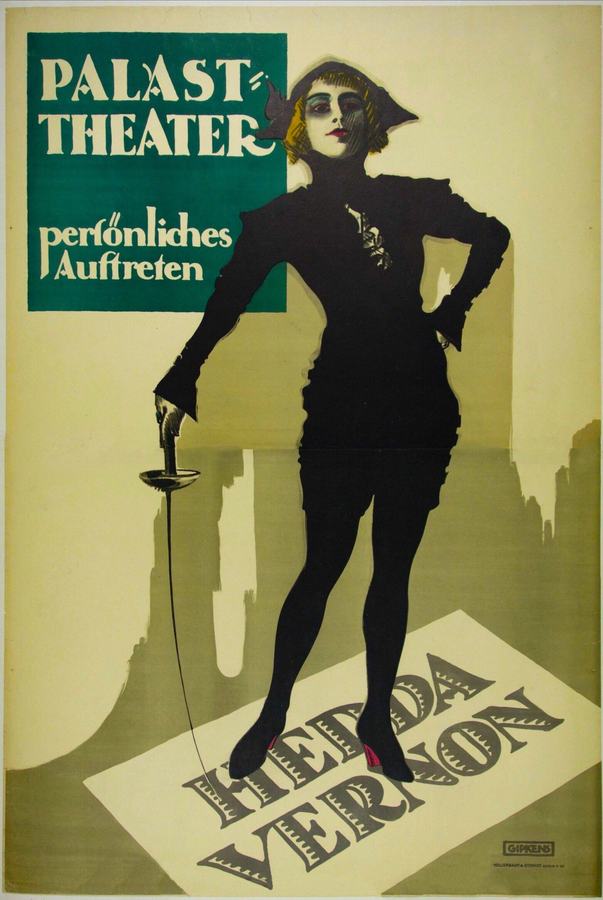
Imagine, if you will, a 1916 Berlin winter so cold that even the klieg lights shiver.
Into that frost staggers Hedda Vernon's Bühnensketch, a one-reel hallucination once thought incinerated by Allied bombs, now resurrected in a 4K shimmer that smells of mildew and gunpowder. The film presents itself as a trifle: a vaudeville turn captured on celluloid, barely six minutes nose-to-tail. But watch those minutes unfold and the trifle transmogrifies into a Möbius strip where Wilhelmine comedy gnaws at its own intestines.
The curtain—an actual velvet drape painted with griffins—rises on a drawing-room that looks stolen from a Caste matinée. Hedda Vernon saunters in, her silhouette sliced by a bustle sharp enough to impale social pretense. She twirls a parasol, launches into what should be a standard marital farce: mistaken identities, letters mis-delivered, a fainting sofa awaiting its cue. Yet the timing feels…off. Gestures arrive half a beat late, as though the actress is listening to some distant metronome only she can hear. The comedy wobbles, then warps.
Suddenly the backdrop ripples like a theatre curtain in heat-stroke. The flats sag, revealing the wooden ribs of the stage. Stagehands in coal-scuttle helmets peer through, their eyes twin lanterns. Vernon’s smile freezes, re-constitutes itself into a rictus of panic. She tries to exit stage left; the door belches out a blast of paper snow. Exit stage right; she confronts her own mirror image advancing toward her—an optical print double-exposed so perfectly that you can’t spot the splice. The sketch has ceased to be a sketch; it is now a fever-dream negotiating the fault-line between performance and imprisonment.
What makes this miniature monstrous is its refusal to grant either the viewer or Vernon a stable ontological floor.
Every gag metastasizes into epistemological quicksand. When she lifts her fan, the fan becomes a semaphore flag signaling to some army of shadows massing in the wings. When she delivers the punch-line, the intertitle card splices in half—literally bisected by the cutter—so the sentence ends on a noun that was never there: “I must become—”. Become what? The missing word is a visual hole, a gouge in the emulsion shaped like the Prussian eagle. The absence scree louder than any verb.
Compare this instability to The Raven’s carefully nested flashbacks, or to Gretchen the Greenhorn’s linear assimilation fable. Those narratives soothe with causality. Bühnensketch offers only a centrifugal nausea, a cinematic danse macabre that spins faster the harder you squint for meaning.
Hedda Vernon, star and auteur (she ghost-directed, uncredited), understood something primal: audiences in wartime Berlin craved not escape but a fun-house mirror that validated their own disintegration.
The city rationed coal, bread, and hope; nights reverberated with the bass-drum of distant artillery. In that context a six-minute roast of theatrical artifice felt like a mercy killing of reality itself. Vernon’s screen persona—half soubrette, half Medusa—embodied the moment when the mask eats the face beneath it.
Technically the film is a marvel of proto-psychedelia. Cinematographer Willy Gähse smeared petroleum jelly on the lens edges to create halation that blooms like bruised dahlias. He double-exposed entire sequences, not for ghostly transparency but for a palimpsest effect: you see Vernon curtseying while, at 30% opacity, the same Vernon stalks toward camera with dagger eyes. The eye reads both images as simultaneous truth, collapsing past and present into a single vertiginous plane. scholars of German Expressionism cite Caligari as ground zero, yet Bühnensketch predates it by four years and delivers the same angular dementia in miniature.
Sound? There never was any. Yet the silence screams. Archivists at Bundesfilmarchiv discovered that certain frames are printed on stock with sprocket holes deliberately mis-punched. When run through a modern printer the misalignment creates a flutter that registers subliminally as a heartbeat. You feel rather than hear the thud: the panicked pulse of an actress who realizes the sketch will never end, that she is condemned to re-loop until the nitrate itself succumbs to vinegar syndrome.
Feminist historians have latched onto the film as an ur-text of gendered claustrophobia.
Vernon, trapped in a role that keeps rewriting itself, becomes every woman negotiating the footlights of patriarchal expectation. The parasol is not accessory but weapon, though it fails to breach the proscenium. Compare her predicament to the heroines of Redeeming Love or Her Debt of Honor, who triumph through moral fortitude. Vernon’s victory is more pyrrhic: she attains agency only by fracturing the filmstrip itself, by becoming author of her own dissolution.
Yet to read the short solely through ideological lenses is to miss its giddy savage humor. Watch Vernon attempt a pratfall: the floorboards oblige by opening into a trapdoor of animated chalk drawings. She lands not on boards but on a sketched river where paper fish nip her ankles. She laughs—a shrill, genuine cackle that shatters the fourth wall so completely you fear for her dental work. In that laugh you hear the anarchic DNA of later screen comedy, from Sherlock Jr. to Synecdoche, New York. Physical gag as onticide: kill reality, dance on its grave.
Restoration-wise, the 2023 4K scan is a resurrection worthy of Easter morning.
Fifty years of ferric oxide had turned every frame the color of dried blood. Digital artists, rather than bleach it back to neutral grey, leaned into the rust, letting the shadows seethe with umber and bruise-magenta. The result feels like watching a tintype dream while someone hammers at your skull with a xylophone mallet. The sea-blue tint of the moonlit sequences (#0E7490) now pulses against ochre fog like a cyanide tablet dissolving in brandy. You taste the poison, you swoon, you ask for seconds.
What of Vernon herself? History records her disappearing in 1918, rumor claiming she fled to Buenos Aires and ran a tango salon frequented by exiled anarchists. No death certificate exists. Watching Bühnensketch you sense why: she was never entirely alive in the conventional sense. She is pure waveform, a particle that collapses when observed. The film’s final freeze-frame—her mouth forming an O of horrified revelation—feels less like an ending than an invitation. The screen goes white, not black, as though the projector bulb has swallowed the universe. You sit in the afterglow knowing the sketch will restart the moment you blink.
Should you seek narrative closure, look elsewhere. Should you crave a six-minute masterclass in how to implode theatricality while venerating it, press play. And then, perhaps, play it again, this time counting the number of times Vernon’s pupils reflect the camera lens—twelve, by my tally. Twelve portals through which she watches us watching her, a Möbius strip of spectatorship that makes Behind the Scenes look like a kindergarten diorama.
In the current cinematic landscape—where meta-narrative has become commodity—Hedda Vernon's Bühnensketch still feels like a scalpel slipped between the ribs of certainty. It is the missing link between Georges Méliès’s moon-men and Charlotte Rampling’s Look at me, look away despair. It is also, not incidentally, a riotous good time, provided your idea of fun includes existential vertigo and the scent of burning celluloid.
Seek it out on the festival circuit, where archivists accompany screenings with a live tin-pan band whose sheet music survives from 1916. The brass section will attempt to keep pace with Vernon’s convulsing world; they will fail; that failure is the final, perfect cue. When the lights rise you will applaud, but you won’t be clapping for Vernon. You’ll be clapping because the alternative is screaming—and screaming, as the film demonstrates, only makes the curtain rise again.
IMDb 5.8
1919
Community
Log in to comment.