DbcultAccessing Vault...
Cult Review
Senior Film Conservator
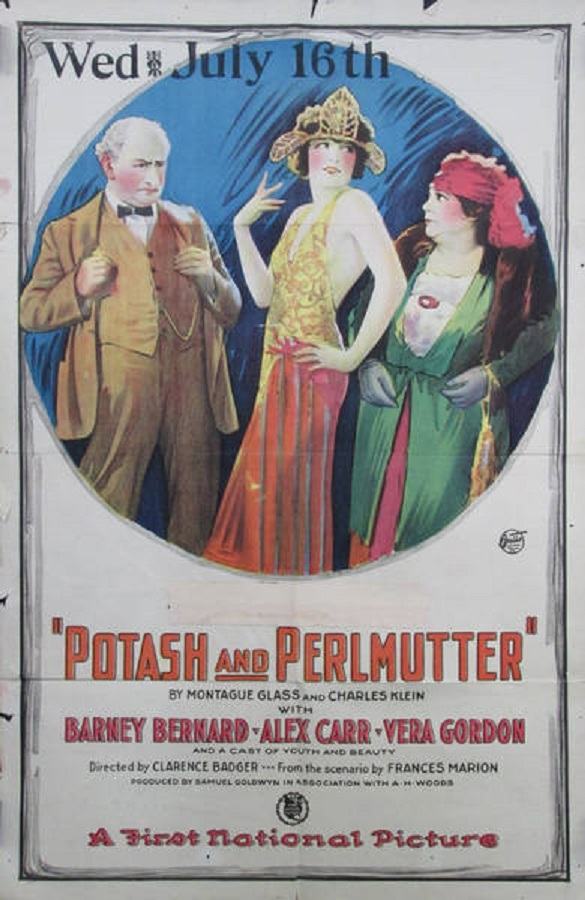
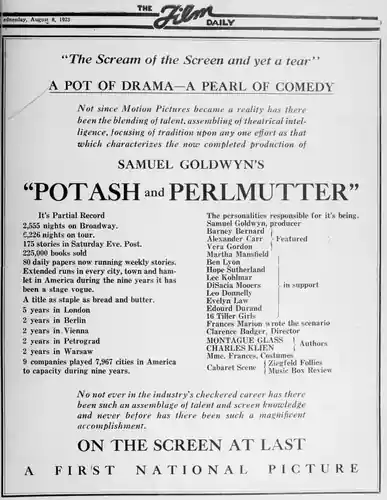
In the annals of early American cinema, few works capture the frantic pulse of the immigrant experience with as much verve and idiosyncratic charm as Potash and Perlmutter (1923). This celluloid adaptation of the celebrated stage play—itself an evolution of Montague Glass’s literary vignettes—serves as more than a mere comedy of errors; it is a sprawling, often poignant examination of the American Dream's industrial machinery. Directed with a keen eye for spatial dynamics and social hierarchy, the film invites us into the claustrophobic yet vibrant world of the New York garment trade, where every stitch is a gamble and every partnership a precarious dance between bankruptcy and bonanza.
The gravitational center of the film is undeniably the chemistry between Barney Bernard and Alexander Carr. Reprising their legendary stage roles, they imbue Abe Potash and Morris Perlmutter with a lived-in authenticity that transcends the caricatures often found in ethnic comedies of the era. Their dialogue, though rendered in silent intertitles, vibrates with the rhythmic cadence of Yiddish-inflected English, a linguistic feat that Frances Marion’s screenplay manages with surgical precision. Unlike the more somber domesticity found in A Doll's House (1922), where the domestic sphere is a cage of Victorian repression, the world of Potash and Perlmutter is one of constant, noisy negotiation.
Abe is the cautious, often stubborn traditionalist, while Morris represents a slightly more aspirational, if equally volatile, mercantile spirit. Their arguments are not merely plot devices; they are the rhythmic heartbeat of the film. When they hire Ben Lyon’s Boris Andrieff, the friction shifts from the internal to the external. Boris is the quintessential 'Other'—an artist trapped in a world of utility. His presence as a Russian violinist-turned-fitter introduces a lyrical counterpoint to the staccato bickering of the shop floor, much like the tonal shifts seen in The Book of Nature, though here the nature being explored is human and urban rather than pastoral.
Visually, the film is a masterclass in early 20th-century realism. The garment factory is depicted not as a sanitized stage set, but as a dense, tactile environment of fabric bolts, sewing machines, and swirling dust. The cinematography captures the frantic energy of the 'fitter'—a role Boris performs with a clumsy grace that signals his displacement. This realism serves to ground the more melodramatic elements of the plot. When the labor agitator is shot on the premises, the transition from light comedy to high-stakes drama is handled with a sophistication that rivals the atmospheric tension of Malombra.
The shooting serves as the narrative’s pivot point, dragging the characters out of their insular business world and into the harsh glare of the public eye. The scandal that ensues isn't just a threat to their reputations; it’s a threat to the very identity they’ve built in their adopted homeland. This thematic weight elevates the film above contemporary comedies like The Simp (1921), providing a social commentary on the precariousness of immigrant success. The shadow of the law looms large, reminding the audience that for men like Potash and Perlmutter, the margin for error is razor-thin.
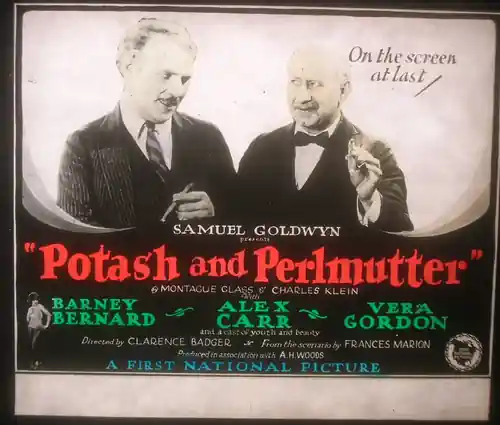
The inclusion of a 'labor agitator' as a primary catalyst for the third act is a fascinating choice for a 1923 production. It touches upon the genuine unrest of the era without descending into didacticism. While films like Fathers of Men explored paternal legacies, Potash and Perlmutter focuses on the legacy of the collective—the company as a surrogate family. The arrest of Boris and the subsequent legal turmoil highlight the systemic biases of the time. Boris, as a Russian immigrant with artistic leanings, is an easy scapegoat, a theme that resonates with the darker undertones of The Forbidden Path.
Yet, the film never loses its comedic soul. Even in the depths of the legal crisis, the banter between Abe and Morris provides a resilient scaffolding. Their loyalty to Boris, despite Abe’s initial desire for a 'better' match for Irma, showcases the evolution of their characters. They move from a narrow focus on capital to a broader understanding of human value. This moral ascent is portrayed with a subtlety that avoids the saccharine pitfalls of Eyes of the Soul.
Irma Potash, played with a delicate luminosity by Hope Sutherland, represents the bridge between the Old World values of her father and the New World possibilities of her heart. Her attraction to Boris is not merely a youthful rebellion but a recognition of a shared sensitivity. In a world defined by the price per yard of silk, their romance is a necessary, if dangerous, luxury. The disappointment Abe feels toward this match—his preference for the wealthy Feldman—is a classic trope, yet here it is imbued with the specific anxieties of the Jewish diaspora. Marriage isn't just about love; it's about security in an uncertain land.
This dynamic offers an interesting comparison to Over the Garden Wall, where romance is often a simpler, more pastoral affair. In the urban jungle of Potash and Perlmutter, love must survive the threat of imprisonment and the collapse of the family business. The resolution, where the victim recovers and Boris is exonerated, serves as a cathartic release, allowing the film to conclude on a note of triumph that feels earned rather than gifted.
The direction (credited to Clarence G. Badger, though often discussed in the context of its strong writing team) exhibits a rhythmic pacing that mirrors the clatter of the sewing rooms. The editing is particularly effective during the sequences involving the labor dispute, utilizing quick cuts to heighten the sense of mounting panic. This technical proficiency reminds one of the visceral intensity found in Blodets röst, though the subject matter is vastly different. The film also benefits from the contributions of Frances Marion, whose ability to weave complex emotional threads into a coherent narrative structure remains unparalleled in the silent era.
The set design deserves special mention. The juxtaposition of the cramped, utilitarian office where Abe and Morris hold court against the more expansive, opulent settings of the lawyer's world creates a visual shorthand for class aspiration. This use of space to tell a story of social mobility is as effective here as the grander architectural statements in La nave. Every frame feels intentional, contributing to a cohesive vision of 1920s New York.
When placed alongside other films of its year, Potash and Perlmutter stands out for its refusal to settle for easy slapstick. While The Quitter or Her Kingdom of Dreams might rely on more conventional narrative arcs, this film embraces the messy, contradictory nature of its protagonists. Abe and Morris are not always likable; they are greedy, loud, and frequently wrong. Yet, it is their very fallibility that makes them enduring. They represent a specific slice of the American pie that was rarely given such nuanced treatment in mainstream cinema.
The film’s legacy can be seen in the lineage of the 'buddy comedy,' but also in the more serious immigrant dramas that would follow in the sound era. It lacks the surrealist edge of Ein seltsames Gemälde or the sheer physical comedy of Peladilla cochero de punto, yet it possesses a grounded humanity that those films often eschew. It is a work of significant cultural weight, capturing a moment when the garment industry was the crucible in which the modern American identity was being forged.
To watch Potash and Perlmutter today is to witness a vital piece of social history. It is a film that understands the cost of success and the value of a loyal partner. The final scenes, with the union of Boris and Irma, are not just a happy ending for a romance; they are a symbolic merger of art and industry, tradition and progress. Like the intricate patterns of the garments they produce, the film weaves together disparate threads into a garment of lasting quality.
In the grand theater of silent cinema, where grand gestures and epic scales often dominated, this intimate, bickering, and ultimately profound story of two partners in the garment trade remains a singular achievement. It is as much a thriller as it is a comedy, as much a social drama as it is a romance. It is, quite simply, a masterpiece of the mundane made magnificent. For those seeking to understand the roots of the American character, look no further than the cluttered office of Potash and Perlmutter.
Related explorations in silent cinema history: Der Einbruch and the evolution of the crime-drama hybrid.
IMDb 5.1
1932
Community
Log in to comment.