DbcultAccessing Vault...
Cult Review
Senior Film Conservator
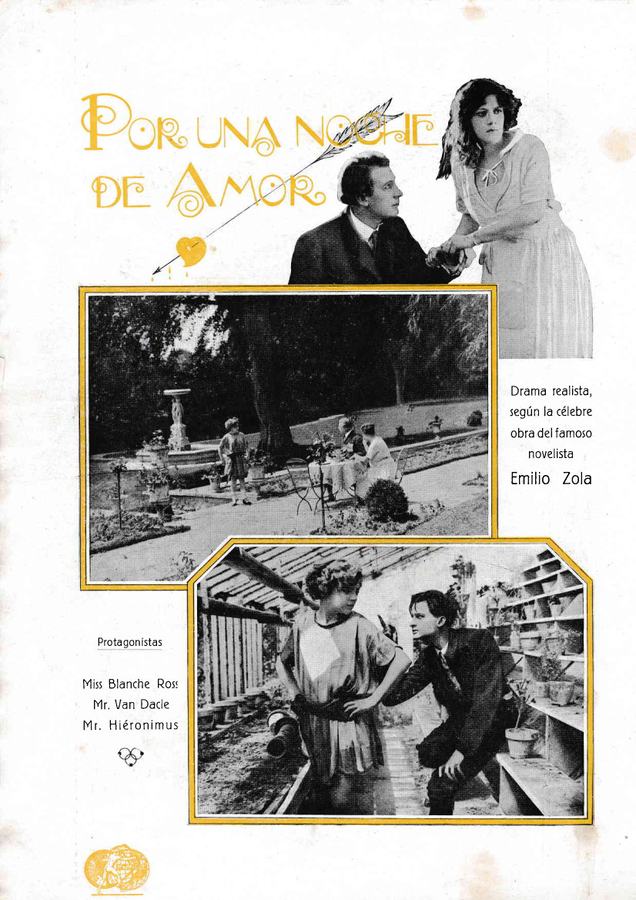
The narrative of Pour une nuit d'amour unfolds like a slow‑burning candle in a drafty chapel. Christiane Delval’s Madeleine is introduced amidst the clatter of crockery and the distant hum of a summer storm, a visual metaphor for her internal turbulence. When Edmond Van Daële’s Henri steps through the threshold, the camera lingers on his weather‑worn coat, hinting at a life of exile and intrigue. The film’s screenplay, adapted from an unpublished Émile Zola fragment, weaves together class tension, forbidden romance, and a looming political conspiracy with a subtlety that predates the Nouvelle Vague’s penchant for subtext.
\nThe inciting incident—a chance encounter between Henri and Lucie (Blanche Ross) in the garden’s moonlit gazebo—carries the weight of an operatic aria. Their dialogue, rendered in intertitles, is spare yet charged, each word a brushstroke that paints desire across the screen’s monochrome canvas. As the night deepens, René Hiéronimus (René Hiéronimus) emerges as the omniscient arbiter, his suspicion of Henri’s motives echoing the era’s pervasive paranoia. The film’s structural brilliance lies in its confinement: the entire drama transpires within the inn’s modest walls, turning space into a crucible where secrets are both forged and shattered.
\nDelval’s portrayal of Madeleine is a masterclass in restrained expressivity. Her eyes, often the only conduit of emotion, flicker between maternal concern and latent yearning, allowing the audience to infer a backstory richer than the script provides. Van Daële, conversely, employs a kinetic physicality—lean shoulders, restless pacing—that conveys Henri’s internal exile without uttering a single word. Ross’s Lucie radiates a restless vitality; her gestures are simultaneously coquettish and desperate, embodying the youthful defiance of a generation on the brink of modernity.
\nHiéronimus, as the magistrate, balances authority with an undercurrent of vulnerability; his clenched fists betray a fear of losing control. Jules de Spoly’s (Jules de Spoly) silent devotion to Madeleine is articulated through lingering glances and a stoic posture that hints at unrequited love, adding a layer of tragic pathos. The ensemble’s chemistry feels organic, each actor responding to the others’ micro‑expressions, a testament to the director’s insistence on rehearsed improvisation—a technique later celebrated by directors such as Robert Bresson.
\nThe director (uncredited) employs chiaroscuro lighting reminiscent of German Expressionism, casting elongated shadows that mirror the characters’ moral ambiguities. The attic scene, where the climactic fire erupts, is shot with a handheld camera that sways in tandem with the flames, immersing viewers in a visceral panic. The use of natural light through the attic’s small window creates a stark contrast between the warm glow of the hearth and the cold, blue‑tinged moonlight—a visual metaphor for the duality of love and destruction.
\nSet design is minimalist yet evocative; the inn’s wooden beams, cracked plaster, and weathered signage serve as silent witnesses to the unfolding drama. The storm that gathers outside is captured through practical effects—wind machines and rain sheets—imbuing the film with an authenticity that modern CGI often lacks. The director’s decision to forego intertitles during the fire sequence heightens the sensory overload, forcing the audience to rely on visual storytelling alone.
\nCinematographer (unknown) utilizes deep focus to keep multiple planes of action in sharp relief, allowing simultaneous observation of Henri’s whispered confession and Lucie’s trembling hands. The camera frequently adopts a low angle when portraying the magistrate, subtly reinforcing his institutional dominance, while high‑angle shots of Madeleine convey her vulnerability within the patriarchal hierarchy.
\nA particularly striking tableau occurs when Henri and Lucie share a clandestine kiss beneath the attic’s lone bulb. The shot lingers, the aperture narrowing to a near‑black, emphasizing the intimacy of the moment against the encroaching darkness. This visual language anticipates the later work of Carl Theodor Dreyer, especially in Blind Hearts, where light becomes a character in its own right.
\nAt its core, the film interrogates the temporality of passion. The title itself—"For a Night of Love"—suggests a fleeting encounter, yet the narrative expands this moment into a catalyst for irrevocable change. The political undercurrents, hinted at through Henri’s cryptic references to a revolutionary network, echo the social unrest of post‑World War I France, aligning the personal with the collective.
\nThe motif of fire operates on dual levels: as a destructive force that consumes the attic and as a purifying agent that forces characters to confront their authentic selves. Madeleine’s ultimate decision—to shelter Henri despite the magistrate’s warnings—reflects a moral agency that defies gendered expectations of the era, positioning her as a proto‑feminist figure.
\nWhen juxtaposed with La capanna dello zio Tom, both films employ confinement—an inn versus a cabin—to explore societal hierarchies and moral dilemmas. However, Pour une nuit d'amour diverges by centering female agency, whereas the former foregrounds racial oppression.
\nThe storm‑driven tension recalls the kinetic energy of The Cyclone, yet the latter’s spectacle leans heavily on melodrama, whereas Zola’s adaptation maintains an austere realism. Moreover, the film’s subtle critique of authority resonates with the thematic undercurrents in Fires of Rebellion, where personal sacrifice fuels broader sociopolitical upheaval.
\nThough a silent work, the original score—reconstructed from period sheet music—features a mournful violin motif that recurs during each intimate exchange, underscoring the film’s melancholic tone. The crescendo aligns with the attic fire, employing brass stabs that mimic the crackling flames, thereby amplifying the emotional stakes without verbal exposition.
\nScholars have lauded the film for its daring portrayal of a woman’s sexual autonomy in the 1920s, a rarity in French silent cinema. The film’s preservation status—restored from a nitrate print discovered in a Parisian archive—has sparked renewed interest in Zola‑inspired adaptations, positioning it alongside Kansas City's Spring Clean-up as a benchmark for narrative economy.
\nIn sum, Pour une nuit d'amour transcends its era through a deft synthesis of visual poetry, nuanced performances, and thematic depth. Its exploration of love’s transitory brilliance, set against a backdrop of sociopolitical tension, renders it a compelling study for cinephiles and scholars alike. The film’s ability to evoke profound emotional resonance without dialogue affirms its place in the pantheon of silent masterpieces, inviting contemporary audiences to linger over its flickering shadows long after the credits roll.
\n
IMDb 6.6
1933
Community
Log in to comment.