DbcultAccessing Vault...
Cult Review
Senior Film Conservator
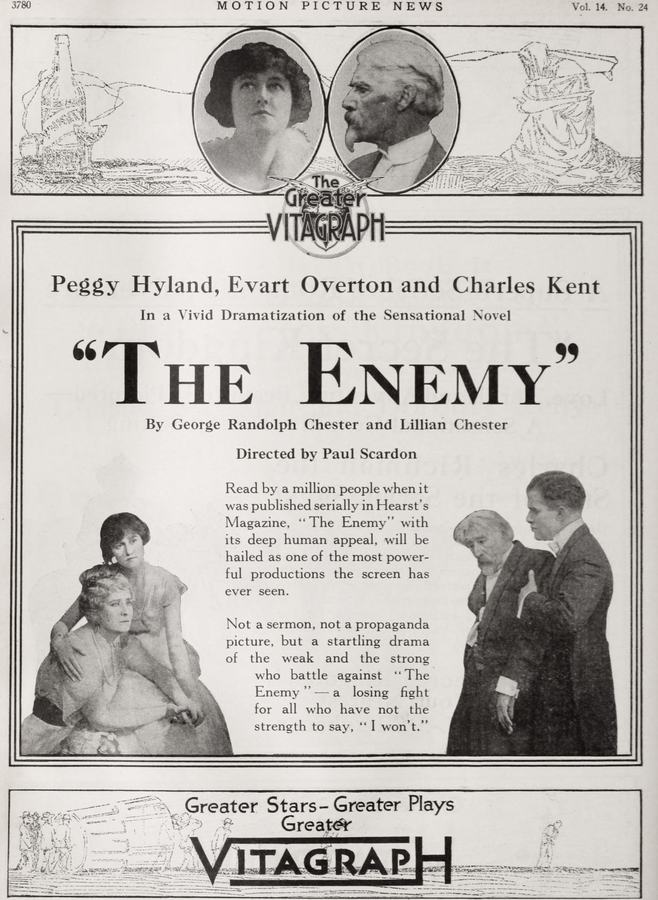
The cinematic landscape of the early 20th century was often a canvas for exploring the dramatic extremes of human experience, yet few films from that nascent era confront the insidious grip of addiction and the arduous path to redemption with the raw, uncompromising intensity of 1916's The Enemy. This isn't merely a tale; it's a stark, moralistic odyssey, charting the cyclical nature of human frailty and the profound sacrifices sometimes demanded for salvation. It peels back the veneer of societal respectability to reveal the devastating consequences of personal demons, a narrative that, despite its silent origins, resonates with a startling contemporary relevance.
At its core, The Enemy presents us with Harrison Stuart, portrayed with a compelling gravitas by Evart Overton, an architect of prodigious talent whose genius is tragically eclipsed by the encroaching shadow of alcoholism. His fall from grace is depicted not as a sudden plunge but a gradual erosion, transforming a pillar of society into a derelict haunting the city's forgotten corners. This descent into the ignominious existence of flop houses is a visceral representation of how addiction can strip away not just wealth or status, but identity itself. The film masterfully conveys this loss through visual storytelling, painting a bleak picture of a man adrift, a ghost of his former self. It evokes a similar sense of tragic decline seen in other moralistic dramas of the period, perhaps even more starkly than the moral compromises explored in As Ye Sow, where societal pressures often catalyze individual downfall.
Enter Billy Lane, a young, aspiring architect, brought to life by Billie Billings, whose admiration for Stuart's past work transcends the older man's current squalor. Lane embodies the nascent hope, the pure, uncorrupted idealist who sees beyond the present wreckage to the potential for restoration. His intervention is not merely an act of charity but one born of profound respect, a desire to salvage a legacy. This dynamic, of the younger generation reaching out to uplift the fallen elder, forms the initial bedrock of the narrative's redemptive arc. Lane's efforts culminate in a poignant reunion between Stuart and his estranged family, a delicate rekindling of bonds frayed by years of neglect and despair. The emotional weight of these scenes, conveyed through subtle gestures and expressions characteristic of the silent era's finest performances, is palpable, suggesting that even the most shattered relationships can find a path to mending.
The narrative then pivots, introducing a romantic entanglement that promises further solace and stability. Lane falls deeply in love with Stuart's daughter, Peggy Hyland, whose presence symbolizes the possibility of a future untainted by the past's bitter legacy. Their engagement is meant to be a celebration, a declaration of new beginnings, yet it becomes the unwitting catalyst for a fresh wave of tragedy. This is where The Enemy introduces its most cynical and devastating twist: the external force of malice. Another woman, consumed by a venomous jealousy towards Lane's fiancée, orchestrates a cruel deception. By spiking his punch and artfully manipulating him into heavy drinking, she initiates Lane's own descent into alcoholism. This act of deliberate sabotage is a chilling reminder of how human malevolence can exploit vulnerabilities, turning moments of joy into harbingers of destruction. The film doesn't shy away from depicting the insidious nature of such betrayal, perhaps even more acutely than the broken trust portrayed in The Broken Promise, where the damage is often self-inflicted or circumstantial rather than purely malicious.
The irony is heartbreaking: the man who pulled Harrison Stuart from the brink now finds himself mirroring Stuart's own tragic trajectory. Lane's addiction is not a slow burn but a swift, devastating plunge, fueled by a single, wicked act. This parallel descent is one of the film's most potent narrative devices, highlighting the cyclical nature of addiction and the fragility of recovery. As Lane succumbs, the narrative delivers its most gut-wrenching blow: Harrison Stuart, witnessing the replication of his own nightmare in his protégé, teeters on the edge of a full relapse. The specter of his past returns with a vengeance, threatening to drag him back into the abyss he had so recently escaped. Yet, in a moment of profound clarity, or perhaps, ultimate despair, Stuart makes a choice that transcends mere personal struggle. Before fully submitting to the insidious pull of his old habit, he commits suicide.
This act is not depicted as a surrender but as a desperate, final act of agency, a tragic sacrifice intended to shock Lane back to sobriety. It is a powerful, almost biblical, moment of self-immolation for the sake of another's redemption. The suicide functions as a stark, unavoidable mirror, forcing Lane to confront the ultimate consequences of his path. This dramatic climax is handled with an unflinching directness, a testament to the film's willingness to explore the darkest corners of the human psyche. The sheer weight of this event, the crushing realization of what Stuart sacrificed, jolts Lane to his senses. He swears off drinking, his resolve forged in the crucible of Stuart's tragic end. His return to Harrison's daughter is not merely a romantic reunion but a symbolic embrace of a future earned through suffering and sacrifice, a future where the enemy within has, for now, been vanquished.
The performances, even through the lens of a century, are noteworthy. Evart Overton as Harrison Stuart delivers a portrayal of nuanced despair and fleeting hope, making his eventual sacrifice all the more impactful. Billie Billings, as Billy Lane, transitions convincingly from earnest admirer to desperate addict and finally, to sober survivor, charting a complex emotional journey. Peggy Hyland, as Stuart's daughter, embodies the steadfast love and quiet suffering that anchor the male characters' tumultuous arcs. Charles Kent and Julia Swayne Gordon, portraying the family, lend authenticity to the domestic scenes, emphasizing the collateral damage and ultimate healing that addiction can bring to a household. The directorial choices, guided by the script from Lillian Christy Chester, Garfield Thompson, and George Randolph Chester, demonstrate a keen understanding of visual storytelling, using close-ups and dramatic staging to convey emotion in an era devoid of spoken dialogue.
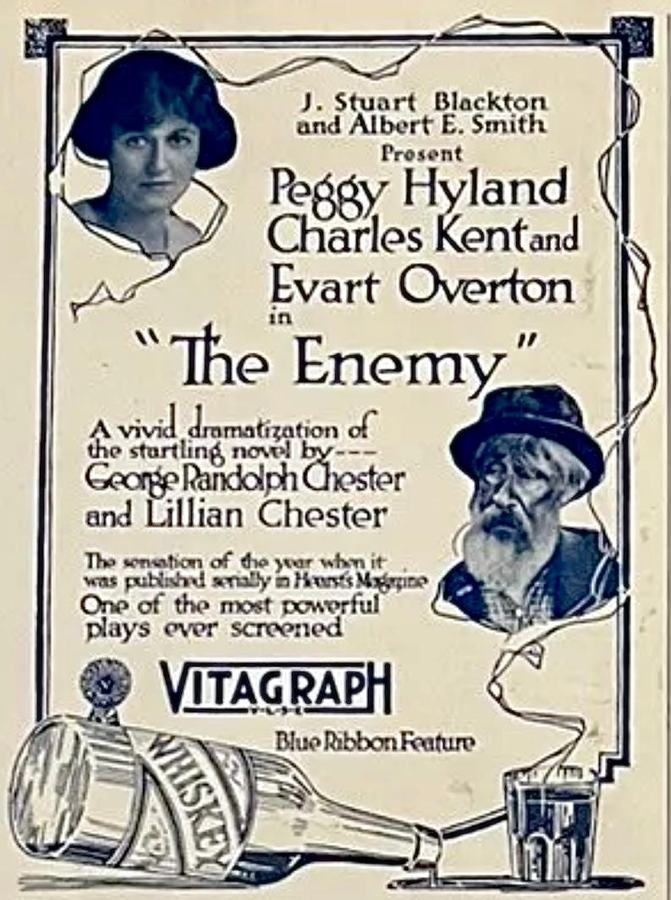
The thematic richness of The Enemy extends beyond the immediate narrative of addiction. It delves into the nature of mentorship, the corruption of innocence, and the redemptive power of self-sacrifice. The film asks profound questions about responsibility – both personal and communal – and the limits of human endurance. It suggests that sometimes, the gravest tragedies can serve as the most potent catalysts for change, echoing the profound moral lessons found in films like The Broken Law, which also explored the high cost of moral transgression. The concept of 'the enemy' itself is multifaceted; it's the liquor, yes, but also the jealousy that fuels betrayal, the despair that leads to relapse, and perhaps, most fundamentally, the flaws within oneself that make one vulnerable to these external and internal forces.
One could argue that the film, while powerful, occasionally leans into melodramatic conventions common to its era. The jealous rival's machinations, for instance, serve as a clear plot device to propel Lane's downfall, perhaps simplifying the complex origins of addiction. However, this directness also contributes to the film's stark impact, ensuring its moral message is delivered with undeniable force. Unlike the more observational or documentary-style films of the time, such as The Capture of a Sea Elephant and Hunting Wild Game in the South Pacific Islands, The Enemy is firmly entrenched in the dramatic tradition, aiming to evoke strong emotional responses and impart a clear moral lesson.
The silent film era, often dismissed by modern audiences, was a period of immense innovation in visual storytelling. The Enemy stands as a compelling example of how complex psychological states and intricate moral dilemmas could be conveyed without a single spoken word. The use of intertitles, while sometimes verbose, effectively bridges the gaps in narrative, ensuring clarity while allowing the actors' expressions and body language to carry the emotional weight. The film's pacing, building from the slow burn of Stuart's initial decline to the rapid, shocking climax of his suicide, demonstrates a sophisticated understanding of dramatic tension. It's a testament to the capabilities of early filmmakers to craft narratives that were both entertaining and profoundly thought-provoking, a craft that can still be appreciated alongside more lighthearted fare like Hoodoo Ann or even the more adventurous Ultus, the Man from the Dead, which focused on escapist thrills.
Ultimately, The Enemy is a powerful, if somber, reminder of the destructive power of addiction and the often-unforeseen paths to redemption. It's a narrative that underscores the fragility of human resolve when confronted with temptation and malice, but also the enduring strength of love and the profound impact one life can have on another, even in death. The film's conclusion, with Lane's newfound sobriety and reconciliation, offers a sliver of hope, hard-won through immense suffering. It doesn't sugarcoat the pain but suggests that even from the ashes of despair, a renewed sense of purpose can emerge. For those interested in the social dramas of early cinema and the timeless struggle against personal demons, The Enemy remains a compelling and deeply affecting watch, a forgotten gem that speaks volumes about the human condition, echoing the profound introspections of other character-driven dramas like Dorian's Divorce, where personal choices lead to irreversible consequences. Its stark portrayal of a universal struggle ensures its place as a significant, if often overlooked, piece of cinematic history.
The film’s exploration of societal attitudes toward alcoholism in the early 20th century is also subtly revealing. While not overtly preachy, the narrative implicitly critiques the devastating impact of the substance, portraying it as a force capable of dismantling not just individual lives but also family units and professional legacies. Harrison Stuart’s initial ostracization and subsequent attempts at reintegration reflect a period where alcoholism was increasingly viewed as a moral failing, yet also one that could potentially be overcome, albeit with immense effort and support. The community's role, or lack thereof, in Stuart’s initial decline is contrasted with Lane’s individual initiative, suggesting that personal intervention can be a more potent force for change than societal judgment alone. This nuanced perspective adds another layer to the film's enduring appeal, setting it apart from simpler cautionary tales. The narrative doesn't just condemn; it seeks to understand the mechanisms of fall and rise, making it a more complex character study than many of its contemporaries. It delves into the internal battles that define a person's trajectory, much like the internal strife depicted in Ben Blair, where a character's journey is deeply personal and transformative.
The intricate web of relationships – mentor-mentee, father-daughter, romantic partners, and jealous rivals – forms the emotional backbone of The Enemy. Each character serves a vital function in illustrating the various facets of human connection and conflict. The initial admiration of Lane for Stuart transforms into a desperate desire to save him, which then morphs into a shared vulnerability. Stuart’s daughter, initially a symbol of his lost family and potential for reconciliation, becomes the emotional anchor for both men, representing hope and stability. The antagonist, though perhaps less developed than the main protagonists, functions as a crucial plot device, demonstrating how external malice can profoundly disrupt even the most promising trajectories. Her actions are a stark reminder that the 'enemy' is not always an internal struggle, but can manifest as a deliberate, destructive force from the outside world. This complex interplay of characters and motivations elevates The Enemy beyond a simple melodrama, imbuing it with the depth of a true human drama.
The enduring power of The Enemy lies in its ability to transcend its silent film origins and speak to universal themes. The struggle against addiction, the quest for redemption, the pain of betrayal, and the capacity for self-sacrifice are all timeless elements of the human experience. While the aesthetic might be that of an older era, the emotional truth remains strikingly vivid. It is a film that challenges its audience to reflect on the choices we make, the consequences we face, and the profound impact we have on one another’s lives. In an age of increasingly complex narratives and advanced cinematic techniques, the raw, unadorned power of The Enemy serves as a poignant reminder of the fundamental elements that make storytelling resonate across generations. It’s a compelling piece of film history that deserves to be rediscovered and appreciated for its timeless message and courageous narrative. Its impact is a testament to the enduring human spirit, a narrative that, in its quiet intensity, shouts volumes about the struggles and triumphs that define our existence, much like the quiet dignity found in the characters of Gretna Green, whose personal journeys are equally compelling.
The film’s ultimate message, that true redemption often comes at a profound cost, is delivered with an unflinching honesty that avoids easy platitudes. Harrison Stuart’s suicide is not a resolution in itself, but a desperate, final act of love and a catalyst for change. It highlights the idea that sometimes, the greatest acts of giving are those that demand everything. This challenging perspective sets The Enemy apart from many films that prefer a more straightforward, less tragic path to resolution. It forces the audience to grapple with the moral complexities of self-sacrifice and the ripple effects of individual choices on an entire community. The cyclical nature of addiction, where one man's fall mirrors another's, further emphasizes the pervasive nature of this 'enemy' and the constant vigilance required to combat it. This depth of thematic exploration, conveyed through compelling performances and a tightly constructed plot, solidifies The Enemy as a significant contribution to early dramatic cinema, a work that asks its audience to consider the profound weight of human actions and the enduring hope for a better tomorrow, even after the darkest night. It’s a powerful testament to the storytelling capabilities of an era often underestimated, delivering a narrative as potent and relevant today as it was over a century ago.
IMDb —
1926
Community
Log in to comment.