DbcultAccessing Vault...
7.1/10
Senior Film Conservator
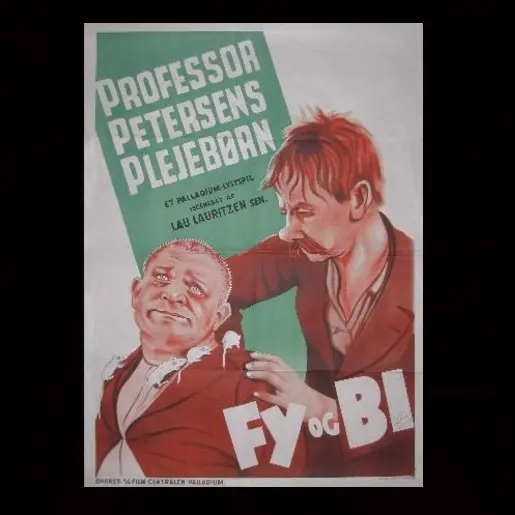
A definitive 7.1/10 rating for a film that redefined the boundaries of cult cinema. Professor Petersens Plejebørn remains a cornerstone of transgressive art.
To witness Professor Petersens Plejebørn is to step into a time capsule where the grammar of cinema was still being written with ink made of pure imagination. Directed by the visionary Lau Lauritzen, this 1924 gem stands as a testament to the golden age of Danish silent film—a period when the Nordisk Film and Palladium studios were the envy of the cinematic world. The film is not merely a sequence of jokes; it is a rhythmic exploration of the human condition, viewed through the distorting yet clarifying lens of slapstick. Unlike the more somber, earth-bound narratives found in Sons of the Soil, Lauritzen opts for an effervescent levity that defies gravity and logic alike.
The screenplay, co-authored by A.V. Olsen, functions as a playground for the legendary duo of Carl Schenstrøm and Harald Madsen. Known internationally as 'Pat and Patachon,' their presence here is nothing short of magnetic. In an era where physical performance was the primary currency of storytelling, their chemistry achieved a level of transcendence that few have matched since. While The Happy Warrior relied on a more traditional heroic arc, Professor Petersens Plejebørn thrives on the subversion of heroism, replacing it with a bumbling, endearing vulnerability that resonates across a century.
The narrative scaffolding of the film—the Professor’s misguided attempt to foster a group of adults—is a stroke of comedic genius that allows for a vertical exploration of social strata. Oscar Stribolt, as the Professor, provides the necessary 'straight man' anchor, his academic pomposity serving as the perfect foil for the mercurial antics of his charges. The film’s pacing is a marvel of editorial precision. Each gag is allowed to breathe, to build from a mere flicker of a misunderstanding into a roaring conflagration of absurdity. It lacks the frantic, sometimes exhausting speed of American contemporaries like Sure-Fire Flint, preferring instead a more European, observational cadence.
Consider the sequence in the dining hall, where the simple act of sharing a meal becomes a battlefield of etiquette. The contrast between the Professor’s refined expectations and the foster children’s primal impulses is played for maximum comedic effect. Here, Maria Garland and Lili Lani shine, providing a nuanced counterpoint to the central duo’s broader strokes. Their performances remind us that silent film was never truly 'silent'; it was a symphony of gesture, a ballet of the eyebrows, and a profound exercise in facial semiotics. This nuance is often lost in more plot-heavy works like A Corner in Cotton, where the thematic weight sometimes stifles the performative joy.
When placing Professor Petersens Plejebørn alongside other monoliths of the era, such as the epic Peer Gynt, one begins to appreciate the sheer versatility of the 1920s film industry. While Peer Gynt sought to capture the vastness of the human soul and the ruggedness of the landscape, Lauritzen’s work finds the infinite within the confines of a bourgeois household. There is a domestic intimacy here that mirrors the claustrophobic tensions found in Bachelor Apartments, yet it is infused with a warmth and a sense of communal belonging that is uniquely Danish.
The film also offers an interesting juxtaposition to the period’s fascination with historical grandeur, as seen in Richard the Lion-Hearted. While the latter utilizes scale to evoke awe, Professor Petersens Plejebørn utilizes the minute to evoke empathy. The plight of the foster children, though framed in comedy, touches upon the universal desire for acceptance and the fear of being cast out. It is this emotional core that prevents the film from becoming a mere relic of vaudevillian tropes. Even the more supernatural or psychological explorations of the time, like Baffled or A Naked Soul, lack the grounded, earthy humor that makes Lauritzen’s work so enduringly watchable.
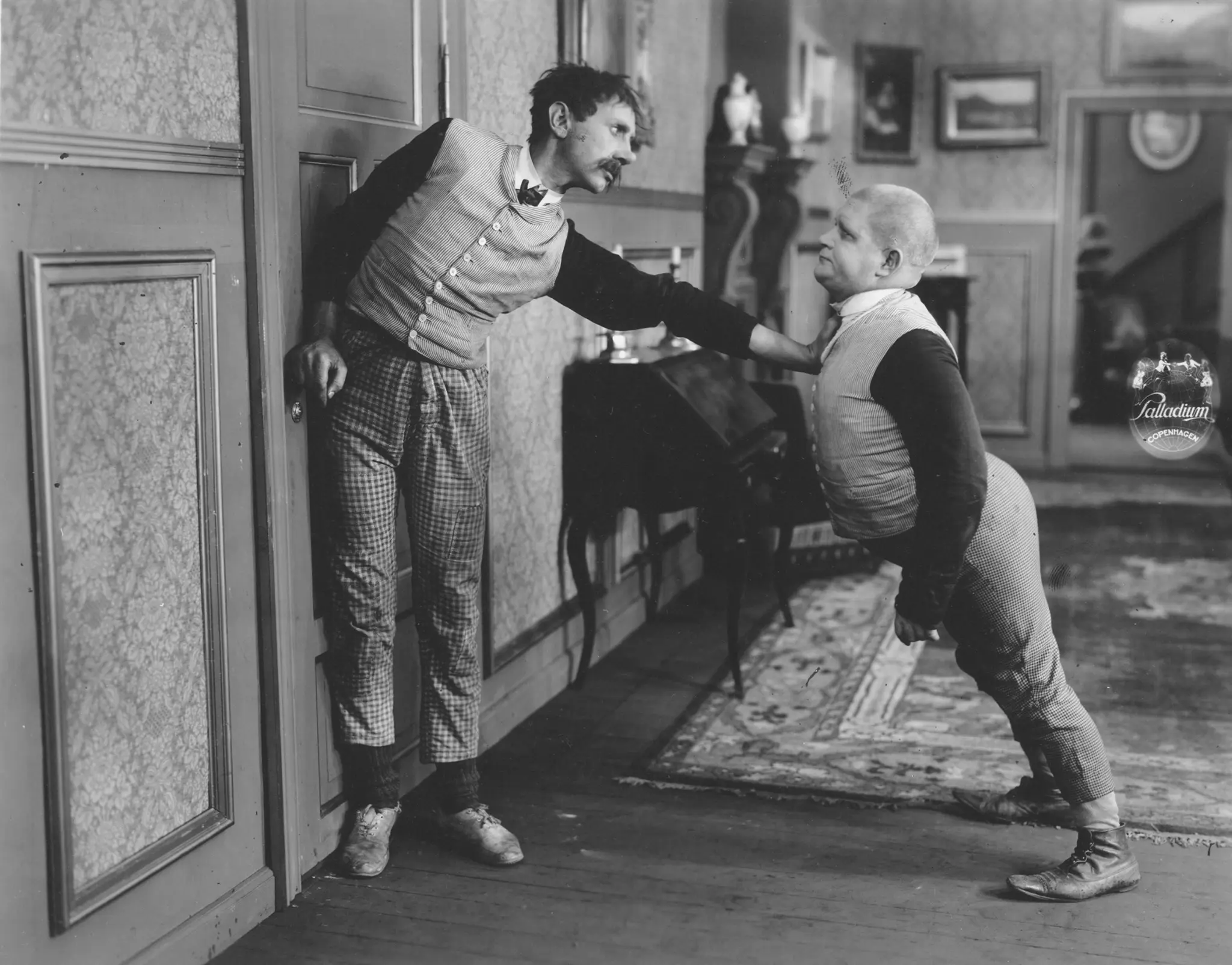
The cinematography by A.V. Olsen is a masterclass in the use of natural light and depth of field. In an age before sophisticated optical effects, the camera had to be a silent witness to the truth of the performance. The framing of Madsen and Schenstrøm—one tall and gaunt, the other short and rotund—is handled with an eye for geometric comedy. Every frame is composed to highlight this physical disparity, turning their very silhouettes into a punchline. This visual branding was so successful that it influenced comedic pairings for decades to come, far outlasting the more transient popularity of films like The Caprices of Kitty.
Furthermore, the set design reflects a meticulous attention to detail. The Professor's study is a labyrinth of books and artifacts, a visual representation of a mind cluttered with theory and divorced from the messy reality of life. When the foster children enter this space, they don't just occupy it; they dismantle it. This destruction of the 'sacred' academic space is a recurring theme in Lauritzen’s oeuvre, also glimpsed in Munkens fristelser, where religious and social institutions are subjected to the same irreverent scrutiny.
It is impossible to discuss this film without acknowledging the presence of a young Poul Bundgaard. Though his role here is a mere footnote in a career that would later define Danish cinema in the 'Olsen Gang' series, his inclusion bridges the gap between the silent pioneers and the modern era. The film serves as a foundational text for Danish national identity, celebrating a specific brand of 'hygge' mixed with a healthy skepticism of authority. It avoids the melodramatic excesses of international productions like Die Prinzessin Suwarin, opting instead for a charm that is both parochial and universal.
In the broader context of 1920s cinema, where films like Famous Women in World's Work were highlighting social progress, Professor Petersens Plejebørn offers a different kind of progress: the democratization of laughter. It suggests that despite our titles, our education, or our social standing, we are all ultimately bumbling 'children' in the eyes of fate. This philosophical undercurrent is what elevates the film from a simple farce to a work of art. It shares a certain thematic kinship with Between Men, exploring the bonds that form in the most unlikely circumstances, though it swaps the rugged grit of the West for the polished floors of a Danish manor.
To watch a restored print of Professor Petersens Plejebørn today is to be struck by the clarity of its vision. The slapstick remains as sharp as a razor, the pathos as poignant as a cello solo. It reminds us that comedy is perhaps the most difficult genre to master, requiring a precision that drama can often bypass. While a film like My Dog, Pal might tug at the heartstrings with direct sentimentality, Lauritzen earns his emotional beats through the sheer exhaustion of laughter.
The enduring appeal of Fyrtårnet and Bivognen lies in their refusal to conform. In the Professor's house, they are the agents of entropy, the chaotic neutral forces that remind us why we need art in the first place: to break the monotony of the 'proper' world. As the film reaches its crescendo, the line between the foster children and the Professor blurs, suggesting that perhaps we all need a bit of Petersen’s benevolent madness in our lives. This is not just a movie; it is a celebration of the human spirit’s inability to be tamed by textbooks or social codes.
In the pantheon of silent cinema, Professor Petersens Plejebørn remains a luminous example of what can be achieved when technical mastery meets an unbridled sense of play. It is a cornerstone of European film history and a mandatory watch for anyone who wishes to understand the roots of modern comedy. Lau Lauritzen didn't just make a film; he captured the lightning of human folly and bottled it for eternity.
IMDb —
1922
Community
Log in to comment.