DbcultAccessing Vault...
Cult Review
Senior Film Conservator
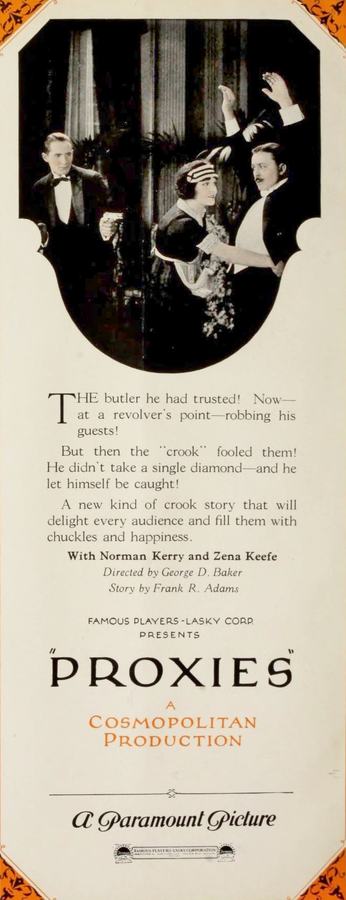
To view George D. Baker’s 1921 cinematic offering, Proxies, is to engage with a sophisticated exploration of social fluidity and the haunting persistence of one’s history. In an era where the silent screen often relied on binary moralities, this film introduces a refreshing degree of ambiguity through its protagonists, Mendoza and Clare Conway. Portrayed with a nuanced restraint by Norman Kerry and Zena Keefe, these characters are not merely ex-convicts seeking a quiet life; they are performers within a performance, navigating the rigid hierarchies of the Darley household with the precision of seasoned actors. The film’s title itself serves as a multi-layered metaphor, referring not only to the legal document that drives the plot but to the characters themselves—proxies for a class of people striving to transcend the labels imposed upon them by a judgmental society.
The narrative velocity increases significantly with the introduction of John Stover, played with a chilling, bureaucratic malice by Paul Everton. Stover represents the predatory nature of unbridled capitalism, a theme that resonates as strongly today as it did a century ago. His attempt to embroil Christopher Darley (William H. Tooker) in a fraudulent stock scheme provides the moral fulcrum of the film. Unlike the overt villainy found in The Shielding Shadow, Stover’s threat is one of signatures, boardrooms, and legal technicalities. He is the modern wolf in a bespoke suit, and his recognition of Mendoza’s past serves as the catalyst for a collision between the underworld and the upper crust.
The centerpiece of Proxies is undoubtedly the staged holdup during the Darley party. Baker’s direction here is masterful, utilizing the spatial dynamics of the manor to create a sense of claustrophobic tension. Mendoza’s decision to revert to his criminal skillset—not for personal gain, but for the preservation of his benefactor’s integrity—is a profound subversion of the 'heist' trope. It is an act of self-sacrifice that mirrors the thematic weight found in The Red Lane, where the boundary between legality and justice becomes blurred by the necessity of the moment. The visual of the proxy document being reduced to ash is one of the most potent images in early 20th-century cinema, symbolizing the destruction of the leverage that the past holds over the present.
The chemistry between Kerry and Keefe provides the film's emotional heartbeat. Their relationship is depicted with a quiet dignity that eschews the histrionics common in many contemporary melodramas like Little Miss Nobody. Instead, we see a partnership forged in the fires of mutual struggle. Their domestic roles as butler and maid are played with such convincing verisimilitude that the audience almost forgets their illicit origins, making the eventual reveal to Darley all the more impactful. The screenplay by Frank R. Adams and George D. Baker avoids the pitfalls of easy sentimentality, opting instead for a denouement that feels earned through sweat and psychological turmoil.
Visually, Proxies benefits from an exquisite attention to detail in its set design. The Darley estate is not merely a backdrop; it is a character in its own right, representing the stability and wealth that Mendoza and Clare are desperately trying to protect. The lighting, though limited by the technology of 1921, manages to capture the stark contrast between the bright, public spaces of the party and the shadowed, private corners where the real drama unfolds. This interplay of light and dark serves as a visual shorthand for the dual lives of our protagonists. While it may lack the frantic energy of Love in a Hurry, it compensates with a deliberate, atmospheric pacing that allows the gravity of the situation to settle upon the viewer.
The supporting cast, including Raye Dean and Robert Broderick, provide a solid foundation for the central trio. Each character, no matter how minor, contributes to the sense of a lived-in world. The social dynamics are portrayed with a keen eye for the subtle snobberies and expectations of the post-war American elite. In comparing this work to With Hoops of Steel, one can see a similar preoccupation with loyalty, yet Proxies manages to transpose these themes into a more complex, urban setting where the stakes are not merely survival, but the very definition of one’s identity.
What truly elevates Proxies above the standard fare of its time is its implicit critique of the legal and financial systems. The 'proxy' is a piece of paper that carries more weight than a man’s character or a lifetime of honest service. Stover’s ability to manipulate the law to facilitate theft is a stinging indictment of a system that favors the cunning over the virtuous. Mendoza’s decision to break the law to save the man who represents the law is a delicious irony that Baker leans into with sophisticated glee. This thematic depth is reminiscent of the moral quandaries found in The Seventh Noon, though handled here with a more grounded, realistic touch.
The conclusion of the film, featuring the gift of a country house, might seem like a fairytale ending to a modern audience, but in the context of 1921, it represents the ultimate validation. The agrarian ideal—the 'little house in the country'—was the quintessential American dream of the era, a place where one could literally and figuratively cultivate a new existence. It is a reward not just for Mendoza's bravery, but for his willingness to risk his freedom once again for a cause greater than himself. Unlike the tragic undertones of The Blow That Killed Father, Proxies offers a vision of hope that is tempered by the reality of the characters' pasts.
In the wider pantheon of George D. Baker’s filmography, which includes diverse works like Oh! Louise! and A Moonshine Feud, Proxies stands out as a particularly mature work. It demonstrates a director in full command of his craft, capable of weaving together disparate threads of suspense, romance, and social commentary into a cohesive and compelling whole. The film’s exploration of the 'proxy'—the idea that our actions can stand in for our true selves, or that one person can act as the moral agent for another—is a sophisticated philosophical inquiry disguised as a high-society thriller.
Reflecting on Proxies today, one is struck by its modernity. The dialogue (conveyed through intertitles) is sharp and devoid of the flowery excess that plagued many silents of the period. The performances are naturalistic, particularly Norman Kerry’s Mendoza, who conveys a world of weariness and hidden strength through a single glance. While it may not have the rugged outdoor scale of The Girl Alaska or the investigative intrigue of The Mystic Hour, it possesses an internal, psychological scale that is far more resonant. It is a film about the masks we wear and the courage it takes to eventually take them off.
For the contemporary cinephile, Proxies is more than a historical curiosity; it is a testament to the enduring power of narrative economy and character-driven drama. It challenges the viewer to consider the nature of redemption: can a single act of virtue truly outweigh a history of vice? Baker’s answer is a resounding, albeit complex, yes. The film suggests that while we may be haunted by our pasts, we are not defined by them, provided we are willing to fight for the future we desire. This message, delivered with the stylish flair of the Jazz Age, ensures that Proxies remains a vital and engaging piece of cinema a century after its premiere.
In summary, Proxies is a quintessential example of the sophisticated storytelling that was possible in the silent era. It combines the tension of a crime thriller with the emotional depth of a character study, all while navigating the treacherous waters of class and morality. Whether compared to the high-stakes drama of Escaped from Siberia or the whimsical energy of Leap Year Leaps, Proxies holds its own as a work of significant artistic merit. It is a film that demands to be seen, analyzed, and appreciated for its bold vision and its unwavering belief in the possibility of transformation.
Rating: 8.5/10 - A Silent Masterwork of Identity and Integrity
IMDb —
1920
Community
Log in to comment.