DbcultAccessing Vault...
6.3/10
Senior Film Conservator
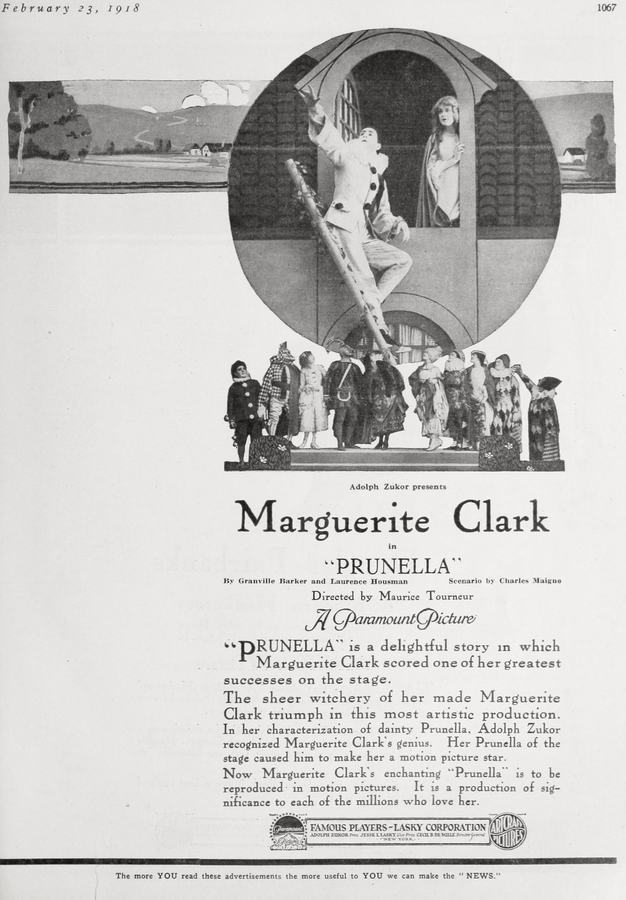
A definitive 6.3/10 rating for a film that redefined the boundaries of cult cinema. Prunella remains a cornerstone of transgressive art.
I. The Garden as Panopticon
Imagine a terrarium blown from blown glass: light enters, but sound is swallowed. That is the universe Housman and Granville-Barker conjure for Prunella’s first act. Cinematographer William J. Gross bathes each frond in mercury-light so that chlorophyll appears metallic, almost venomous. The aunts glide through this Eden like black-veiled Fates, snipping roses with the same dispassion one might sever a jugular. Their dialogue cards—white letters on charcoal stock—read as edicts: „The world is a fever; the garden, the cure.“ Already the film announces its central tension: interiority versus intrusion, the hothouse bloom versus the vagabond wind.
II. Pierrot’s Trespass: Eros in Whiteface
When the commedia troupe materializes, the camera performs a miniature act of revolution: it tilts up, breaching the vertical axis that has, till now, flattened the virginal estate into a board-game. We glimpse caravan roofs, then a calf-leather boot, then the grin of a zanni who knows every back-gate in Europe. Pierrot—Henry Leone, all razor-sharp clavicles and soot-ringed eyes—vaults the hedge in a single, under-cranked bound. The cut is invisible; the trespass feels like a splice in the soul. In close-up, his powdered face cracks like old porcelain, revealing a seam of living flesh beneath. The eroticism is not in the kiss itself but in the anticipatory silence: Marguerite Clark’s pupils dilate until the iris becomes a penumbra of doubt. At that instant the garden ceases to be a refuge; it becomes a stage, the first of many.
III. Parisian Vertigo: From Eden to Arc-Light
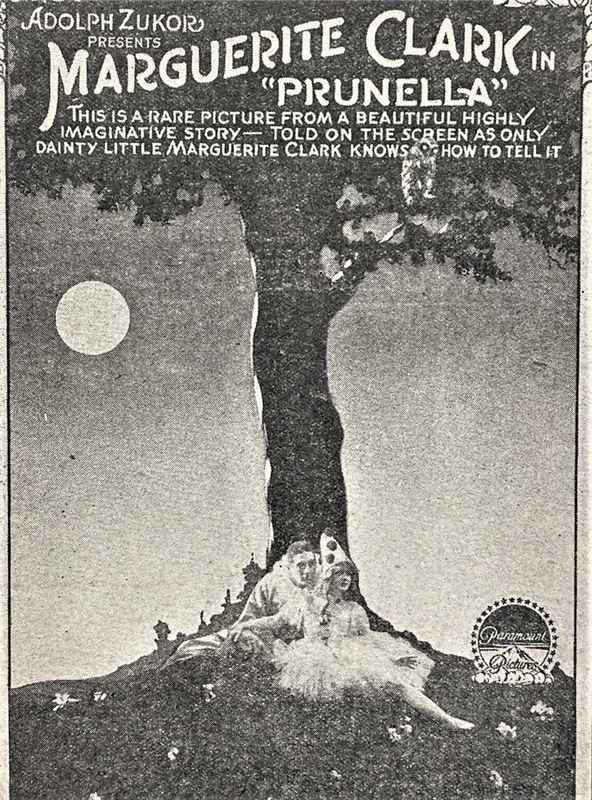
Cut to Montmartre at dusk, gas-jets igniting like a string of jealous suns. The film’s palette warms from chlorophyll green to absinthe amber; intertitles now arrive in canary-yellow, their serif fonts drunkenly slanted. Directors Barker and Maigne splice stock footage of the Folies Bergère crowd with medium shots of Clark onstage, veiled in tulle that catches the carbon-arc glare until she resembles a comet with a human face. The edit is so fluid that documentary and dream intermingle, predicting the city-symphonies of the twenties. Watch how Isabel Berwin, as Pierrot’s new paramour, enters the narrative: a foot sliding into frame, ankle first, like a letter slipped under a lover’s door. Female rivalry is staged not through slaps but through competing luminosities—Clark’s cool lunar glow versus Berwin’s solar flare.
IV. The Collapse of Pantomime
Mid-film, Pierrot abandons Prunella for a dancer whose laugh is all canines. The breakup is shot in an unbroken take: a single corridor, two torches sputtering, characters receding until their silhouettes are the size of marionette shadows. No dialogue cards interrupt; only the whir of the camera mechanism is heard on the silent optical track—a ghost-frequency that makes the viewer hyper-aware of absence. This is where Happiness (1917) and Prunella converse: both films understand that happiness is a negative space, definable only once vacated. The deserters leave behind not wrath but vacancy—a hole shaped exactly like oneself.
V. The Return: Cottage as Cradle-Tomb
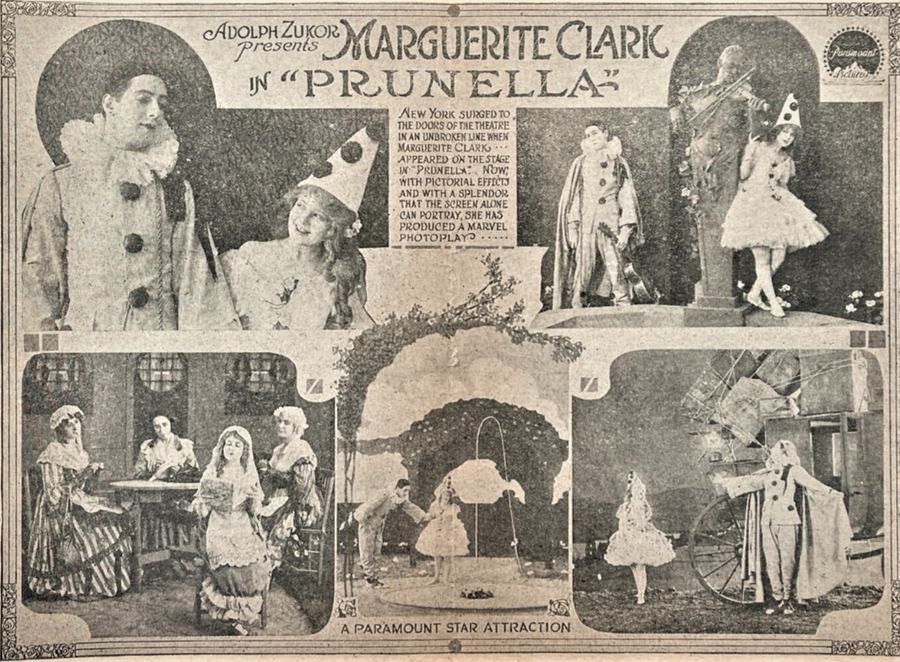
Years compress into a single fade. Pierrot, now solvent but hollow, repurchases the cottage from the last surviving aunt, a woman whose face has ossified into a map of arterial roads. The dwelling is shot at Dutch angles, its walls sagging like wet cardboard, ivy threading the mortar like sutures. Hosting a bacchanal for his old troupe, Pierrot stages a commedia revue inside the very rooms where propriety once reigned—an inversion akin to holding an orgy in a chapel. Yet the revelers are middle-aged, their whiteface flaking, their laughter ricocheting off rafters that remember whispers of shame. Note the kicker: Charles Maigne’s script refuses catharsis. Pierrot’s quest is not redemption but retrieval of an image, a pigment of memory he can no longer differentiate from the living woman.
VI. The Final Embrace: Specter, Flesh, or Both?
In the garden, night-blooming nicotiana exhales a narcotic scent. Pierrot sees a figure in white—Prunella’s erstwhile costume—and approaches as though walking through water. The camera racks focus: background dissolves into bokeh that resembles spilled champagne. When he embraces her, the footage momentarily over-exposes, blooming into a solarized halo. Is she ghost, hallucination, or the stubborn persistence of desire? The film withholds verdict. Clark’s eyes—those same moonlit saucers—blink twice, a gesture too mammalian for a spirit. Yet the over-exposure lingers, suggesting that every reunion contains a grain of its own haunting. Love returns not as fact but as exposure—an image burned onto the retina long after the plate has been shelved.
VII. Performances: Porcelain and Powder
Marguerite Clark, barely five feet tall, carries the picture on the blade of her clavicle. She mutes the theatricality of her Broadway training, opting for micro-gestures: the way her thumb rubs the inside of her forearm when Pierrot lies, as though erasing a stain only she can see. Henry Leone, by contrast, amplifies the commedia tradition—every shrug a semaphore, every grimace a hieroglyph of self-loathing. Their chemistry is asynchronous: she recedes as he advances, creating a negative space where the viewer’s longing pools. Supporting players orbit like moons: Nora Cecil’s Aunt Privacy, whose single tear is filmed in insert so extreme it resembles a liquid planet; Marcia Harris’s landlady, delivering exposition while gutting a fish, its silver scales mirroring the celluloid itself.
VIII. Design & Texture: From Gingham to Gauze
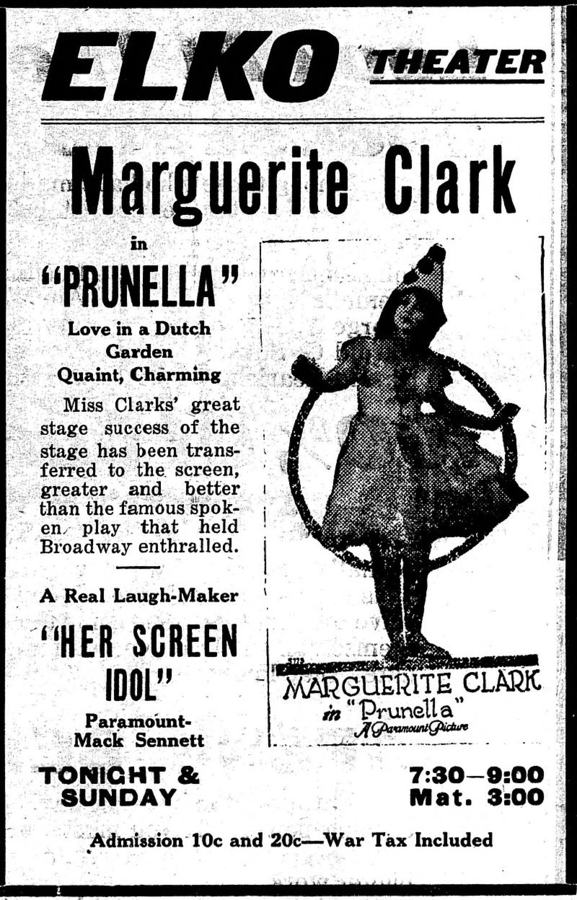
Art director A. Voorhees Wood contrasts two visual lexicons. The garden scenes favor axial symmetry, topiary spheres echoing the aunts’ balloon-sleeved gowns. Paris sequences detonate into chaos: gilded prosceniums, papier-mâché moonscapes, a staircase that spirals like a snail shell—an homage to Monsieur Lecoq’s vertiginous sets. Most ravishing is Prunella’s dressing room, wallpapered with discarded fan portraits that turn her into a palimpsest of public desire. When Pierrot rips one photo, the tear reveals another face beneath—suggesting that celebrity is merely layered anonymity.
IX. Tempo & Rhythm: The Metronome of Memory
Editor John De Lacey alternates between tableau duration—actors holding poses as if for a magic-lantern slide—and staccato cuts that prefigure Soviet montage. The elopement sequence cross-spools three temporalities: the cart wheels turning (shot at 8 fps), Prunella’s heartbeat rendered via intercut iris shots, and the static grin of the moon. The result is a temporal vertigo that mimics adolescent fugue. Compare this to Anna Held’s more linear biopic structure; Prunella opts for cubist fragmentation, insisting memory is never chronological but gravitational—events orbit a core wound.
X. Intertextual Echoes: From Commedia to Canterbury
Housman’s script teems with literary phantoms. Pierrot’s powdery mask invokes both the commedia archetype and the „pale Galilean“ of Swinburne, while Prunella’s name puns on prune—dried fruit, wrinkled virgin, but also the horticultural promise of regeneration. One intertitle lifts wholesale from A Midsummer Night’s Dream: „Ill-met by moonlight, proud Pierrot.“ The theft is brazen, yet justified: Shakespeare’s Athenian woods and Prunella’s walled garden both stage the same ritual—carnivalesque inversion followed by weary reintegration. Even the final image, a long shot of intertwined lovers silhouetted against dawn, rhymes with the closing The Christian tableau, though here the rising sun feels less like benediction than exposure.
XI. Gender & Agency: The Exit from the Dollhouse
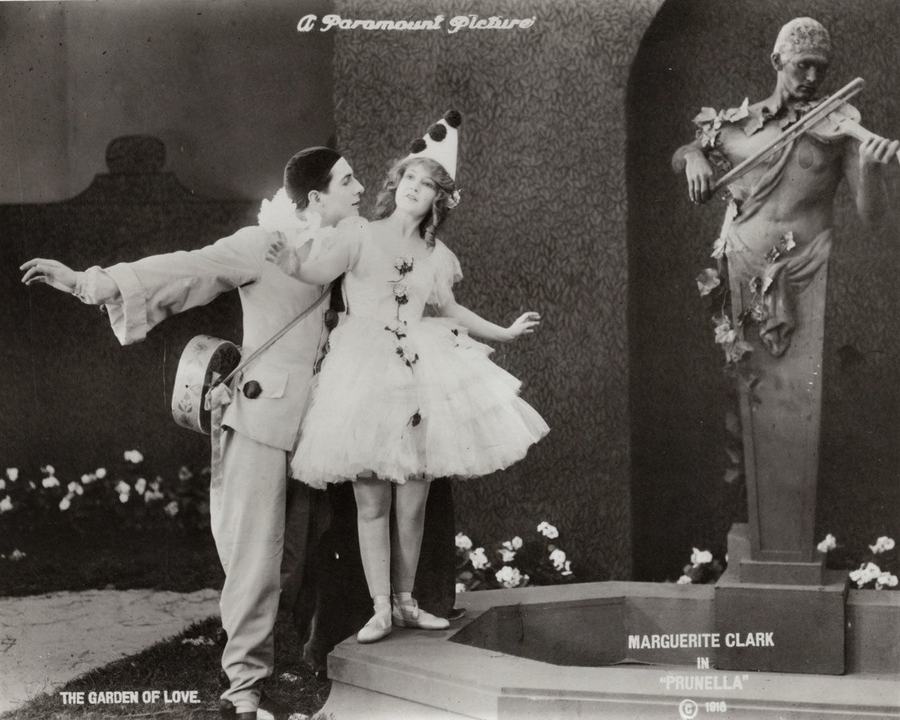
Modern viewers might bristle at Prunella’s return to the garden, interpreting it as a capitulation to patriarchal hearth. Yet the film complicates that read. She departs the stage on her own terms, leaving Pierrot to chase a memory rather than a wife. When he buys the cottage, he enters her mythos, not vice versa. The final embrace occurs under a pear tree she planted as a child; its roots fracture the foundation, splitting the house along its Victorian seams. If this is surrender, it is a surrender that lets the wild back in. Compare American Maid, where the heroine’s return domesticates her; Prunella’s return colonizes the domestic, turning it feral.
XII. Preservation & Presentness: A Print in the Archive
Only two 35 mm prints survive: one at MoMA, tinted amber and cyan, the other at Cinémathèque Française, nearly monochrome. Neither is complete; both lack the rumored dream sequence where Pierrot confronts his older self. Yet scarcity amplifies aura. Watching Prunella today is like viewing a daguerreotype through a kaleidoscope: edges fray, colors migrate, but the emotional acuity remains shockingly intact. The film demands projection at 18 fps—any faster and the performances slide into slapstick; slower, and they petrify into waxwork. When screened correctly, the audience forgets the ticking of the modern world, surrendering instead to the hush of aperture blades and the faint smell of nitrate whispering its own floral decay.
XIII. Why It Matters: The Loop of Leaving & Returning
In an era of algorithmic matchmaking and disposable intimacy, Prunella posits love as a walled garden you must flee to appreciate—and then spend your life trying to re-enter, knowing the gate will never admit you the same way twice. The film’s radicalism lies not in plot but in structure: it refuses the three-act arc, opting instead for a Möbius strip where departure and return are the same side of the tape. Viewers raised on The Measure of a Man may find the morality slippery, yet that slipperiness is the point. Desire is not linear; it loops, knots, frays, and—if you are lucky—rethreads through the eye of the needle you dropped in the grass long ago.
Verdict: A chamber-piece masquerading as a pantomime, Prunella is the silent era’s most piercing meditation on the archaeology of affection—excavating layers of paint, powder, and regret to reveal the raw, embarrassingly alive pulse beneath.
IMDb 5.5
1926
Community
Log in to comment.