DbcultAccessing Vault...
Cult Review
Senior Film Conservator
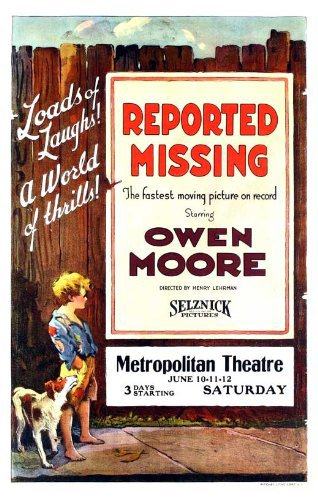
To witness Reported Missing is to observe a pivotal moment in the evolution of the American action-adventure genre. Released in 1922, a year when the cinematic language was rapidly shedding its stage-bound origins, this Henry Lehrman-directed vehicle for Owen Moore functions as both a social critique of the idle rich and a masterclass in early 20th-century spectacle. Unlike the more somber explorations of social mobility found in His Divorced Wife, Lehrman’s work here is unashamedly kinetic, trading psychological interiority for the raw thrill of the chase and the visceral impact of the elements.
Owen Moore portrays Richard Boyd with a specific brand of charming lethargy that was a hallmark of the era’s leading men. Boyd is a man of inherited wealth, a character archetype that often served as a surrogate for the audience’s own anxieties regarding the American work ethic. His transformation is not merely a plot point; it is the film's moral spine. When J. Young (played with a chilling, albeit period-typical, 'Orientalist' menace by Tôgô Yamamoto) enters the fray, the film shifts from a drawing-room comedy into a high-stakes corporate thriller. The machinations of Young and the turncoat Andrew Dunn represent the dark underbelly of the shipping industry—a theme that echoes the maritime tensions explored in Out of the Fog.
The technical prowess of Reported Missing cannot be overstated. The shipwreck sequence, which occurs mid-narrative, serves as the film’s atmospheric pivot. The cinematography captures the chaotic intersection of wood, water, and human desperation with a clarity that rivals the grand scale of Mathias Sandorf. Lehrman, known for his background in slapstick, brings a frantic energy to these scenes, ensuring that the stakes feel immediate and lethal. The transition from the shipwreck to the hydroplane chase is a stroke of editorial genius, showcasing a modern obsession with speed that was beginning to define the 1920s.
Nita Naldi, though perhaps underutilized, brings an electric presence to the screen. Her role as the 'other woman' or the agent of temptation provides a sharp contrast to Pauline Garon’s more traditional portrayal of the fiancée. While The Awakening of Ruth offers a more nuanced look at female agency during this period, Garon’s Pauline is more than a mere trophy; she is the catalyst for Boyd’s redemption, even if the era’s tropes often relegate her to the role of the rescued.
One must address the presence of Tom Wilson as Sam, the valet. Sam is a character of immense loyalty and bravery, yet he is framed within the restrictive and often offensive comedic tropes of the 1920s. However, in the context of the film’s action, Sam is Boyd’s most capable ally. His role is reminiscent of the complex racial depictions found in Body and Soul (1920), though far less subversive. Sam’s participation in the final assault on Young’s stronghold is a testament to the film’s reliance on his physical prowess, even as the script denies him the full dignity of his contributions. It is a fascinating, if uncomfortable, study in the contradictions of early Hollywood.
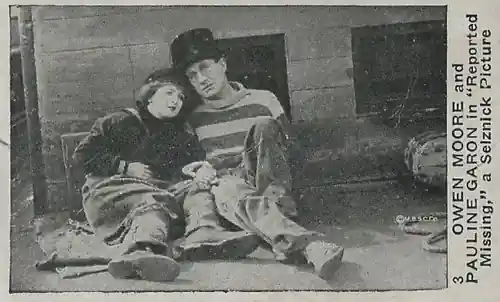
Henry Lehrman’s direction is characterized by a refusal to let the audience breathe. The narrative moves with the velocity of the hydroplanes it depicts. This relentless pacing distinguishes it from the more deliberate, atmospheric tension of Midnight Madness. Lehrman understands that in a story of corporate theft and maritime survival, the environment itself must be a character. The 'stronghold' of J. Young is rendered with a shadowy, almost expressionistic dread that heightens the stakes of the final confrontation. It is in these moments that the film transcends its pulpy origins and becomes a work of genuine cinematic art.
Owen Moore’s Boyd is a precursor to the modern action hero—the man who must lose everything to find his true self. This theme is a perennial favorite in cinema, seen in various forms from The Birth of a Man to the swashbuckling adventures of Cameo Kirby. What sets Reported Missing apart is its integration of contemporary technology into the hero’s journey. The hydroplane isn't just a gimmick; it is a symbol of Boyd’s mastery over the modern world he once merely inhabited as a ghost. The final race is not just for the ships or the girl; it is a race against his own former obsolescence.
In the wider landscape of 1920s cinema, often dominated by the grit of Westerns like The Return of Draw Egan, this film offers a refreshing, albeit chaotic, maritime alternative. It captures the zeitgeist of an era caught between the Victorian past and a motorized, high-speed future. The ensemble cast, including the under-appreciated Frank Wunderlee and Robert Cain, provides a solid foundation for the central trio to shine. While the writing credits are shared among a small army of contributors—including Lewis Allen Browne and Henry Lehrman himself—the film maintains a surprisingly cohesive vision.
The visual texture of the film, even in surviving prints, suggests a sophisticated use of lighting to differentiate between the 'civilized' world of the Boyd Shipping Company and the 'primitive' world of the shanghaied. The use of shadows in Young’s lair creates a sense of claustrophobia that contrasts sharply with the expansive, sun-drenched horizons of the sea. This visual storytelling is what allows the film to remain engaging even when the intertitles are sparse. It is a testament to the power of the image over the word, a principle that many modern blockbusters would do well to remember.
Ultimately, 'Reported Missing' is more than a relic of the silent era; it is a vibrant, albeit flawed, exploration of masculinity, industry, and the sheer thrill of the chase. It demands to be viewed not just as a historical curiosity, but as a foundational text in the grammar of action cinema. For those willing to look past the dated social conventions, there is a pulse here that still beats with a surprising, hydro-powered intensity.
IMDb —
1920
Community
Log in to comment.