DbcultAccessing Vault...
5.6/10
Senior Film Conservator
A definitive 5.6/10 rating for a film that redefined the boundaries of cult cinema. Return to Zion remains a cornerstone of transgressive art.
A reel that smells of orange blossoms and cordite
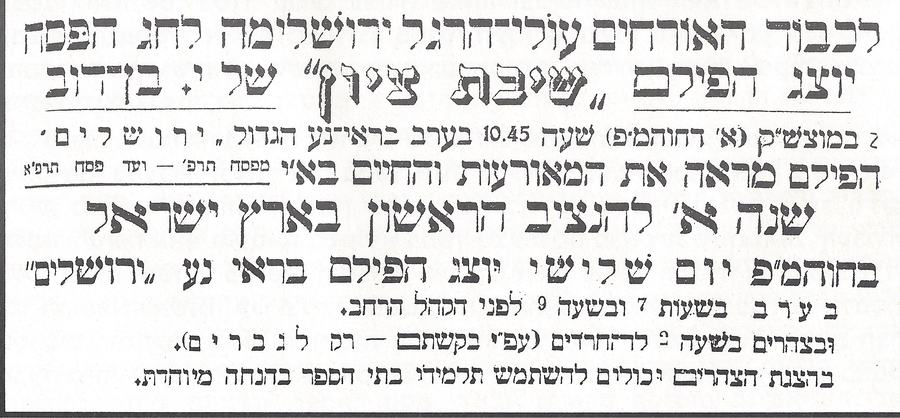
In the flicker of nitrate, Return to Zion feels less like a narrative than a séance conducted on sprocket holes. Shot in Ottoman Palestine before borders had hardened into barbed myths, Ya’ackov Ben-Dov’s 1913 fragment—barely 42 surviving minutes—oozes the tactile fever of a region arguing with its own future. You taste salt on the wind, you hear the chalky scrape of chisels rebuilding a Hebrew signage above Arab stonemasons who hum ya lahwi between cigarettes. The camera does not observe; it inhales.
Imagine Méliès moonlighting as a Zionist cartographer: every pan across Jerusalem’s skyline is a celestial map stitched with celluloid comets. Yet unlike the orientalist postcard vistas of From the Manger to the Cross, Ben-Dov’s frames refuse to fetishize the “timeless.” A tractor belches smoke beside a Crusader arch; a woman in a Second Aliyah frock hitches her skirt to sprint for a tram ticket—modernity barges in like a rude cousin.
Scholars still feud over whether the production was bankrolled by Lovers of Zion societies or by an eccentric Odessa flax merchant who wanted proof that the desert could bloom. Either way, the budget shows: tripods sink into dunes, lenses flare like solar flares, and every grain of sand seems invoiced. Compare this tactile largesse to the claustrophobic marital farce of His Matrimonial Moans, where walls press inward; here space billows outward until geography becomes theology.
Cinematographer Ben-Dov, doubling as protagonist, never lets you forget the apparatus. Tripod legs invade the mise-en-scène; shadows of the crew ripple across white linen drying on rooftop lines. Such self-reflexivity predates the Soviet montage boys by a decade, flaunting cinema as colonizer of reality. When the widow kisses the scroll, her eyes flick not heavenward but straight into the lens—an erotic pact with posterity.
Close-ups linger until pores resemble lunar craters. A Yemenite boy, drafted as an extra, stares so long his pupils seem to leak tar. The effect disturbs precisely because it withholds sentimental empathy; you study him like an anthropologist who suspects the camera might steal his soul. Compare that to the masked titillation of The Wax Model, where faces are decorative masks; here they are contested terrains.
Sound, though absent, haunts aurally. Intertitles—handwritten on repurposed synagogue receipts—appear irregularly, sometimes mid-action, like a stutter. One card reads: "The land was without form, and void; and silence was upon the face of the settlers." The biblical cadence weds exile to creation, implying that nation-building begins not with words but with an ache too deep for speech.
British officers stride through scenes like unwanted extras, their pith helmets bobbing among prayer-shawl fringes. One sergeant, caught unawares, flips the bird at the camera—an anachronistic middle finger that somehow survived the censor’s scissors. The moment crystallizes the film’s uneasy triangulation: indigenous Arabs, diaspora Jews, and imperial bureaucrats all jostling for the same square mile of sunlight. Watch it alongside The Devil’s Passkey and you’ll notice a shared obsession: borders that shift faster than identities.
Yet Ben-Dov refuses victimhood porn. When the pioneers irrigate a patch of sand, the irrigation ditch becomes a mise-en-abyme: water reflects sky, sky reflects hope, hope reflects nothing—just the circular labor of desire. The sequence lasts ninety seconds but feels like a lifetime of Friday afternoons waiting for rain.
Archivists at Jerusalem’s Cinematheque discovered the nitrate in a rusted tea tin labeled "Seder 1932," fused together like a fossilized snake. Restoration meant bathing the stock in citrus oil—an irony not lost on historians who note that orange exports financed much of pre-state cinema. Four reels remain lost, including the rumored footage of Tel Aviv’s first electrical grid. Their absence amplifies the myth: we project onto the lacunae our own ideological fever charts.
Compare that elusiveness to the tidy closure of The Cup Winner, where the final goal redeems every narrative thread. Return to Zion offers no such catharsis; it ends mid-song, the horizon sliced off like a severed artery, leaving viewers suspended between diaspora and sovereignty.
Female bodies map the contested land. The widow’s hips sway through market stalls, her black dress a mobile void amid blaze-white robes. A pioneering girl in shorts—scandalous for 1913—drives a tractor, her thighs smudged with engine grease that looks, in monochrome, like menstrual blood. The camera fetishizes yet empowers, complicating any feminist read. Unlike the femme fatale circuitry of The Huntress of Men, here women’s labor is literal soil-turning, not metaphoric man-trap.
One unforgettable shot frames a pregnant woman against a half-erected silo; her belly and the concrete cylinder rhyme in silhouette, as if the national womb and the storehouse of grain shared the same blueprint. The image is both utopian and eugenic, forecasting later obsessions with demographic arithmetic.
Ben-Dov, a defector from yeshiva life, secularizes scripture by reversing the exodus: instead of desert wandering, we witness urban grafting. The parting of the Red Sea becomes the drilling of a well; manna falls as imported wheat; the golden calf morphs into a cash register in a Jerusalem souk. Sacred geography thus gets re-coded as labor vouchers and land deeds, yet the camera’s reverent tilt—upward, always upward—retains a devotional shimmer.
Cue the Sabbath sequence: candlelight flares so brightly the frame blooms into solarization, turning bodies into X-ray skeletons. For eight seconds we watch the secular sabbat: workers lighting candles not for God but for Kodak. The transcendence is chemical, not liturgical.
Editing violates classical continuity. Jumps in daylight direction, mismatched eyelines, and flash frames of Arabic signage rupture any orientalist fantasy of coherence. The strategy anticipates 1920s Soviet agit-prop, yet lacks didactic slogans; instead, the ruptures mimic the polyglot chaos of Ottoman Palestine itself. You half-expect a splice of Punin i Baburin’s gentry ennui to wander in, so porous is the film’s sense of boundary.
Tempo alternates between languid horizon scans and staccato inserts: a donkey’s hoof, a telegraph key, a child’s eyelash. The contrapuntal rhythm infects the viewer’s pulse; you exit the screening room blinking in Morse code.
Modern screenings employ a live oud-qanun duo whose microtonal laments undercut the Zionist optimism, reminding us that every major chord carries a suppressed minor. When the musicians slide into a maqam bayati during the tree-planting scene, the saplings suddenly look like grave markers. Silence, strategically inserted, lands like a guillotine.
Avoid the DVD release that slaps on a syrupy orchestral score; it flattens the dialectic into kitsch. Seek the version with the Jerusalem-based ensemble Qudud, whose improvisations honor the film’s unresolved tensions.
Directors as disparate as Amos Gitai and Nadav Lapid have cited the film’s DNA in their own long-take obsessions. Gitai’s House trilogy lifts the pregnant-woman/silo silhouette verbatim, swapping concrete for glass. Lapid’s Synonyms borrows the ruptured montage to depict identity whiplash. Even the popcorn pulp of New Folks in Town owes its handheld restlessness to Ben-Dov’s precedent that geography should never sit still.
Streaming platforms now algorithmically suggest Return to Zion beside nature documentaries, proof that its imagery has metastasized into meme-level shorthand for “biblical landscape.” Context collapses, yet the footage retains its uncanny shimmer—like a prayer uttered by someone who no longer believes in God but still savors the cadence.
Masterpiece is too small a word for a film that refuses to fit inside its own runtime. Return to Zion is a palimpsest where every viewer scribbles their own longing. I have seen it six times—once on a rooftop in Jaffa with fighter jets rehearsing overhead—and each screening births a different country. Take the dusty print to a desert, project it on a bed sheet billowing like a ship’s sail, and you’ll understand: nations are edited, not born. Five shattered reels out of five.
Pro-tip: If Jerusalem’s Cinematheque schedules a midnight screening with live qanun, book the hard-seat row; the discomfort keeps you from romanticizing exile.
IMDb —
1936
Community
Log in to comment.