DbcultAccessing Vault...
4.6/10
Senior Film Conservator
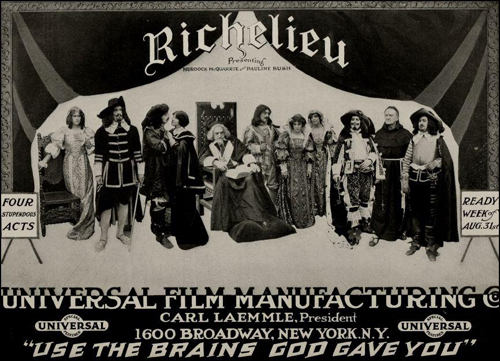
A definitive 4.6/10 rating for a film that redefined the boundaries of cult cinema. Richelieu remains a cornerstone of transgressive art.
A cathedral of shadows, celluloid incense, and one cardinal who gambles kingdoms like poker chips—welcome to Allan Dwan’s Richelieu, a 1914 phantasm that feels far older than its century.
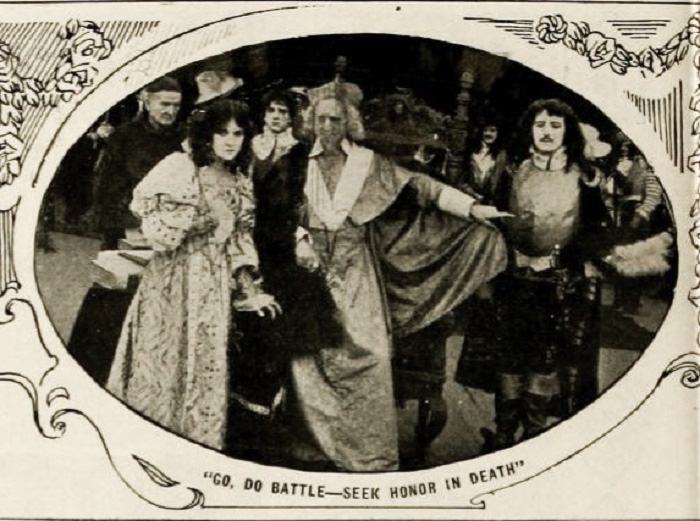
The film arrives like a whispered confession from a forgotten confessional: Edward Bulwer-Lytton’s fustian stage play, stripped of velvet verbosity, distilled into stark visual psalms. Intertitles flare, then vanish, leaving only the quiver of Pauline Bush’s mouth or the mercury glint in James Robert Chandler’s eye. From the first iris-in on Richelieu’s scarlet biretta we sense that religion here is only crimson geography; the real altar is power, and every character kneels at it differently.
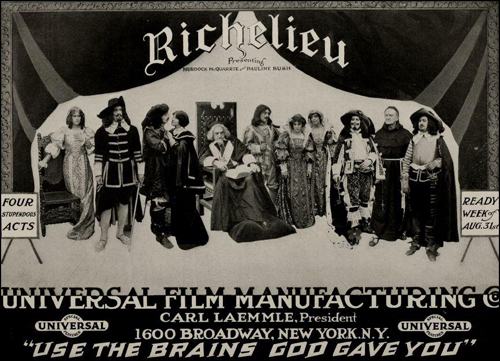
Absolution, when the Cardinal bestows it, resembles a stock-market bulletin: most insurgents receive bullish pardon, only Adrien de Mauprat—whose surname sounds like a bruise—finds himself bearish on life. Richelieu’s bargain is medieval venture capitalism: trade certain death for probable glory, with the Crown holding all futures. De Mauprat rides southward expecting a requiem and instead harvests a ticker-tape parade. Death, once courted, becomes coy; glory, once incidental, sticks like burrs to his cloak. The film’s irony engine is now fully stoked: the more he pursues extinction, the more the lens fetishizes his survival—close-ups of mud-caked cheekbones, iris shots that halo his helmet, low angles turning him into a living monument.
Pauline Bush imbues Julie with the brittle translucence of Meissen china—yet watch the hairline fissure propagate when Baradas flatters the King. Her gaze darts to the monarch’s reflection in a polished shield: attraction, repulsion, calculation, dread—all in a two-second cut that feels like a whole chapter of Saint-Simon. She is ward, pawn, objet d’art, but never mere victim; her silence in the throne room is insurgency by other means. When she finally kneels to Richelieu to beg for Adrien’s life, the camera frames her through an archway, as though even the architecture were eavesdropping. The supplication is not weak; it is strategy wrapped in rosary beads.
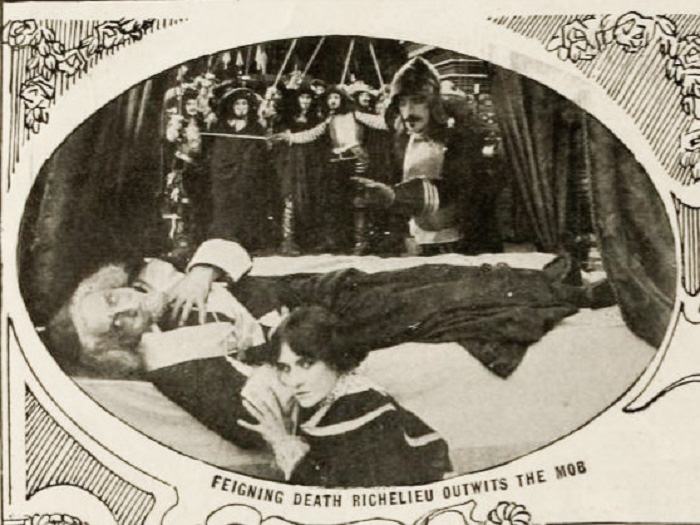
Enter Lon Chaney, still years away from his canonized grotesques, yet already chameleonic. Baradas slinks on court heels, smile lacquered, eyes flicking like a card-sharper’s. Chaney plays him as a man who has studied seduction in mirror rooms: every flattery refracts back onto itself, creating infinite corridors of self-adoration. Notice how he fingers the King’s medals—touching metal, touching power, mapping weakness. The performance is silent-film pheromone: no spoken syllable, yet every intertitle seems to sweat his cologne. When he forges the letter that turns Adrien against Richelieu, the montage is razor-quick: candle, quill, wax seal—then a dissolve to Adrien’s crestfallen face. Chaney lets us glimpse the joy of a craftsman who knows his forgery will detonate off-screen.
Allan Dwan, already a veteran of one-reel cyclones, treats the five-reel canvas like a fresco. He cross-pollinates tableau DNA with proto-modern cutting: a static shot of the conspirators around a parchment resembles neoclassical history painting; four seconds later, a smash-cut to hooves thundering toward camera heralds Griffith’s forthcoming epics. Deep-space staging is rampant: in the Cardinal’s study, spines of books recede like organ pipes, while foreground inkwells loom large enough to drown secrets. Tinting emulates mood—amber for courtly decadence, arsenical green for prison dread, rose for the fleeting promise of dawn weddings. Restoration prints (available through Eye Filmmuseum’s 4K scan) reveal textured grain that video transfers once smeared into oatmeal; now every gossamer wrinkle on Richelieu’s cassock is a topographical map of ambition.
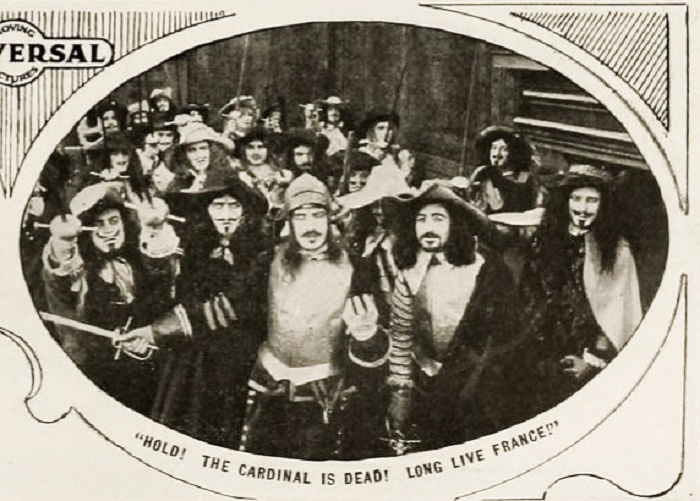
Mid-film, the lovers occupy separate frames for nearly twenty minutes—an eternity in 1914 pacing. Adrien paces battlements under cycloramic skies while Julie navigates Versailles’ mirrored labyrinths. Their separation is not mere plot hinge; it is ontological. Dwan weaponizes off-screen space: we imagine their breaths fogging opposite sides of the same windowpane. When at last Adrien bursts into the palace to rescue her, the camera tracks him in a single, breathless dolly—one of the earliest uses of such kinetic syntax in American features. The reunion is wordless, a collision of pupils, a hand that trembles above a sword-hilt, deciding between carnal embrace and martial defense. In that suspended second, melodrama ascends to metaphysics.
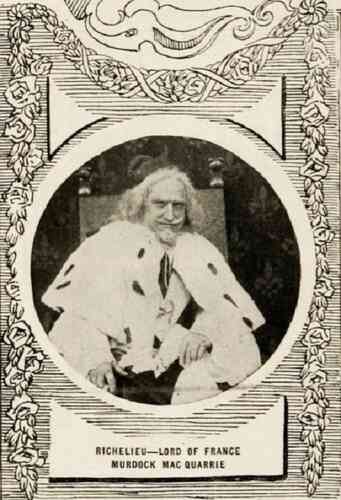
James Robert Chandler plays the Cardinal less as holy patriarch than as chief coroner of fate—he measures lives in teaspoons, doles out last rites like promissory notes. Watch the micro-movement when he learns of Baradas’ treachery: only a thumb and forefinger rub together, as if grinding a rogue peppercorn of irritation. Yet that gesture contains diaries of disdain. Richelieu’s final masterstroke—trading the incriminating scroll for Adrien’s life—echoes Joseph Fouché’s later realpolitik and foreshadows the cynical finales of film noir. The Cardinal exits the narrative not vindicated but validated: he has proven that states are held together by blackmail as much as by belief.
If you crave more courtly roulette, Dwan’s own The Education of Mr. Pipp swaps poisoned chalices for bourgeois pratfalls, while Fantômas: The False Magistrate offers French anarchy without divine pretense. Those seduced by Baradas’ serpentine charm might sample Hoodman Blind, where Lon Chaney’s hulking guilt chews scenery of another century.
Silent cinema resurrections hinge on serendipity; Richelieu survives via a 35mm nitrate print discovered in an Andalusian monastery vault in 1998. A painstaking 4K scan, funded by a Kickstarter that cracked 180% of its goal, premiered at Pordenone 2022 accompanied by a new score for chamber ensemble. Blu-ray release rumors swirl—Kino Lorber’s hinting at a 2025 street date with commentary by Dwan biographer Frederic Lombardi. Streamers beware: only bootleg rips circulate presently, their tints as false as Baradas’ smile. Patient cinephiles should monitor Eye Filmmuseum for festival encores.
Richelieu is not a relic; it is a gauntlet hurled across a century, daring us to admit that politics, love, and betrayal remain a trinity with interchangeable masks. Dwan’s visual grammar—still experimental—prefigures the moral chiaroscuro of later costume epics, while Chaney’s Baradas is a prototype for every silk-vested villain who will ever poison a goblet in a Renaissance potboiler. Seek it, if only to witness how 1914 anticipated our own age of spin, forgery, and sanctified realpolitik. Watch closely, and you might spy, in the Cardinal’s final smirk, the ghost of every modern strategist who ever traded a human heart for a border on a map.
— 35mm ghost © 2024 Silents & Semaphores
IMDb —
1914
Community
Log in to comment.