DbcultAccessing Vault...
Cult Review
Senior Film Conservator
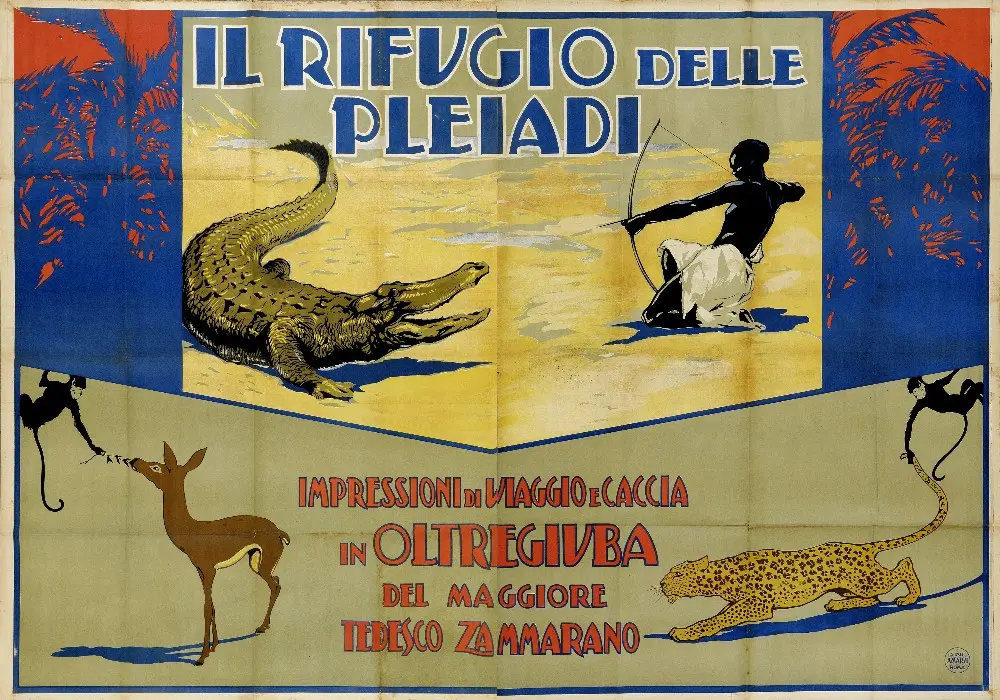
Is 'Rifugio delle Pleiadi: impressioni di viaggio e di caccia in Oltregiuba' worth watching today? Short answer: yes, but with significant caveats and a specific, critical lens required. This isn't a film for those seeking narrative escapism or conventional cinematic thrills, but rather an invaluable, albeit ethically complex, historical document for archivists, historians, and students of colonial studies.
It exists. And that is its power. This obscure 1922 travelogue, a relic from an era of European expansion and ethnographic curiosity, offers a stark, unfiltered window into a bygone world. It is a challenging watch, not for its technical prowess or dramatic tension, but for the profound questions it raises about perception, documentation, and the indelible stain of history.
This film works because of its unparalleled archival value, offering a raw, unfiltered visual record of Italian colonial activities and the natural environment of early 20th-century Oltregiuba (modern-day Somalia/Kenya borderlands). Its very existence as a moving image document from this period is a rare gift to historical research.
This film fails because it lacks any semblance of narrative structure, character development, or critical self-reflection, presenting a purely observational, often problematic, perspective that feels profoundly dated and ethically challenged by modern standards. It makes no attempt to engage the viewer beyond showing, which can be alienating for contemporary audiences.
You should watch it if you are a historian, an anthropologist, or deeply interested in the visual documentation of colonial expeditions, early cinematic techniques, or the environmental history of East Africa, understanding that you are engaging with a product of its time that requires a critical eye. Conversely, if you expect a compelling story, nuanced characters, or a politically correct portrayal of indigenous cultures, this film is decidedly not for you.
To approach 'Rifugio delle Pleiadi' as one would a modern film is to fundamentally misunderstand its purpose and context. This isn't a narrative feature like The Oath of Stephan Huller or even a lighthearted comedy like Behind the Front, both contemporaries in the silent era. Instead, it belongs to a category of early cinema that blurred the lines between documentary, travelogue, and ethnographic record. It is, as its title suggests, a collection of 'impressions of travel and hunting'—a visual diary compiled by Vittorio Tedesco Zammarano, who is credited both as a cast member and, by implication, the primary figure documenting this expedition.
The film offers a fascinating, if often uncomfortable, window into a specific slice of Italian colonial history. Oltregiuba, a territory administered by Italy at the time, becomes the backdrop for a journey that feels both grand in its scope and intimate in its observational style. There are no grand pronouncements, no dramatic arcs, just the steady, unblinking eye of the camera capturing what it encounters.
The cinematography, rudimentary by today's standards, is precisely what gives 'Rifugio delle Pleiadi' its raw power. Shot on what was likely relatively primitive equipment, the footage possesses an almost accidental artistry. The frames are often static, observing rather than directing, yet they capture the vastness of the East African landscape with a stark beauty that belies the technical limitations. We see wide-angle shots of arid plains stretching to the horizon, punctuated by acacia trees and distant mountains, conveying a sense of untamed wilderness that is both alluring and formidable.
Specific moments stand out, not for their dramatic content, but for their documentary value. The sequences depicting local wildlife, from herds of gazelle to the pursuit of larger game, are particularly striking. These aren't polished nature documentary shots; they are candid, sometimes shaky, glimpses of animals in their natural habitat, often followed by scenes of the hunt itself. This directness, while potentially jarring for modern sensibilities accustomed to conservation ethics, provides an authentic record of early 20th-century hunting practices and the prevalent attitudes towards wildlife.
"It's less a film and more a moving photograph album, a raw, unedited glimpse through a colonial lens that refuses to pretend otherwise."
The film's visual language is that of an explorer's log. We witness the logistics of the expedition: the porters carrying supplies, the encampments, the daily routines under the African sun. These scenes, while seemingly mundane, are historically invaluable. They illustrate the practicalities of long-distance travel in an era before modern infrastructure, offering a tangible sense of the effort and organization required for such an undertaking. The lack of sophisticated editing or narrative voice-over (common in later documentaries) means the images speak for themselves, forcing the viewer to interpret rather than simply consume.
Perhaps the most challenging aspect of 'Rifugio delle Pleiadi' is its unapologetically colonial gaze. The film, created by European explorers, inherently positions the local African populations as 'the other.' While direct exploitation or overt cruelty may not be explicitly depicted, the power dynamics are palpable. Indigenous people are often shown in a transactional context, as guides or laborers, or observed with a detached, almost anthropological curiosity, rather than as individuals with agency or complex societies.
This is not a film that seeks to understand or empathize; it seeks to document and, implicitly, to assert dominance. The scenes involving interactions with local communities are particularly telling. There's a clear observational distance, a sense of subjects being viewed rather than collaborators being engaged. This perspective, while historically accurate for its time, demands a critical viewing today. It serves as a stark reminder of the biases embedded in early ethnographic filmmaking and the broader colonial project.
One could argue that to fault the film for its colonial viewpoint is anachronistic, judging a historical document by modern ethical standards. However, as a critic, it is imperative to acknowledge and highlight these inherent biases. Ignoring them would be to ignore a significant part of what the film communicates, however unintentionally. It becomes a document not just of a journey, but of an ideology.
The pacing of 'Rifugio delle Pleiadi' is deliberate, almost meditative. Without a traditional plot to drive it forward, the film moves at the rhythm of the expedition itself—long stretches of travel, moments of observation, interspersed with the more intense, albeit brief, sequences of hunting. There is no rising action, no climax, no resolution. This can be jarring for viewers accustomed to conventional storytelling. It’s a film that demands patience and a willingness to simply *observe*.
The tone is largely neutral, detached. There's an absence of overt emotional manipulation or dramatic scoring (which would have been live or absent in 1922). This objectivity, however, is deceptive. The very act of choosing what to film, how to frame it, and what to include imbues the film with an inherent, if subtle, bias. It’s a quiet film, but its implications echo loudly.
Compared to other silent-era films like Il castello del diavolo, which aimed for theatrical spectacle, 'Rifugio delle Pleiadi' operates on an entirely different wavelength. Its power lies not in its ability to entertain in a conventional sense, but in its capacity to transport the viewer to a specific time and place, to witness history as it unfolded, even if through a limited lens.
Community
Log in to comment.