DbcultAccessing Vault...
Cult Review
Senior Film Conservator
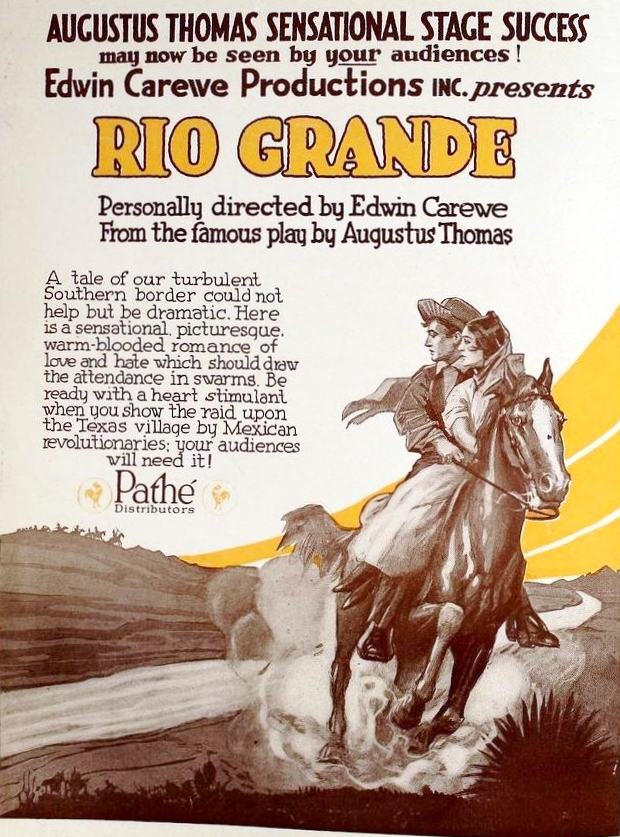
The 1920 silent epic Rio Grande unfolds like a tapestry of bruised loyalties and transnational trauma, weaving together the personal and political in a manner that feels startlingly modern. Director Edwin Carewe, collaborating with playwright‑turned‑screenwriter Augustus Thomas, constructs a narrative that is both a melodramatic family saga and a stark commentary on the fraught U.S.–Mexico relationship in the post‑revolutionary era.
At the heart of the film lies Felipe Lopez (Arthur Edmund Carewe), a man whose antipathy toward "gringos" is rooted not merely in xenophobia but in the lived experience of dispossession. His marriage to Alice (Adele Farrington), an American schoolteacher, is portrayed as a fragile bridge over a chasm of cultural misunderstanding. When Felipe absconds with his biological daughter Maria (Georgie Stone) across the Rio Grande, he severs that bridge, leaving Alice and the adopted son Danny O'Neil (Allan Sears) behind in the United States.
The passage of time is rendered with deliberate pacing; Maria matures into a fiery insurgent, leading raids against the Mexican government, while Danny, nurtured by the austere discipline of the Texas Rangers, embodies the archetype of the law‑bound frontier hero. Their eventual encounter—Maria’s invitation to a clandestine dance at Felipe’s hacienda—functions as a narrative fulcrum, pivoting the story from a static family drama to a kinetic exploration of identity and betrayal.
The ballroom sequence is a visual feast, bathed in the warm glow of lanterns that cast flickering shadows across the polished wood. Carewe’s use of chiaroscuro, highlighted by the dark orange hue #C2410C in the set design, underscores the moral ambiguity that permeates the scene. Danny, cloaked in a Ranger’s uniform, navigates a labyrinth of hidden corridors, his every step echoing the tension between duty and desire. Maria’s covert aid—handing him a concealed knife—marks the first crack in her hardened exterior, hinting at a subconscious recognition of shared blood.
The film’s climax erupts when Maria, misled by Felipe’s dying confession, attributes her father’s capture to Danny’s interference. In a blaze of misguided vengeance, she leads a ferocious assault on the American border town, a sequence shot with frenetic handheld camera work that anticipates the kinetic energy of later Westerns. The town’s defenders, portrayed by a troupe of Texas Rangers, are bathed in sea‑blue tones #0E7490, a visual cue that juxtaposes the cool order of law against the fiery chaos of rebellion.
Felipe’s final revelation—unveiling Alice as alive and exposing Danny’s foster mother as Maria’s own mother—functions as a narrative catharsis, collapsing the walls of prejudice that have long divided the characters. The revelation is delivered in a hushed tableau, the camera lingering on the trembling hands of the dying patriarch as he clutches a faded photograph of his wife, the image rendered in a muted yellow #EAB308 that glows like a dying ember.
Maria’s subsequent transformation—returning to Mexico to teach schoolchildren about the virtues of cross‑border empathy—mirrors the film’s underlying thesis: that love and education can bridge even the deepest chasms of historical animosity. Her acceptance of Danny’s love is not merely a romantic resolution but a symbolic gesture of reconciliation, suggesting that the next generation may finally transcend the inherited grievances of their forebears.
From a performance standpoint, Arthur Edmund Carewe delivers a nuanced portrayal of Felipe, balancing stoic resolve with moments of vulnerable tenderness. Adele Farrington’s Alice, though limited in screen time, exudes a quiet strength that anchors the film’s emotional core. The chemistry between Georgie Stone’s Maria and Allan Sears’s Danny is palpable, their silent glances conveying a depth of feeling that transcends the intertitles.
Cinematographer Harry Duffield employs a palette that is both stark and evocative. The interplay of darkness and the three signature colors—dark orange, yellow, and sea blue—creates a visual rhythm that mirrors the film’s thematic oscillations between conflict and harmony. The use of natural lighting in the river chase scenes, contrasted with the artificial illumination of the ballroom, underscores the dichotomy between the untamed frontier and the constructed civility of society.
Narratively, Rio Grande shares resonances with contemporaneous works such as Her Beloved Enemy, which also explores love across enemy lines, and The Gilded Spider, whose intricate plotting mirrors the labyrinthine betrayals in Carewe’s film. Yet, where those titles lean heavily on melodramatic tropes, Rio Grande distinguishes itself through its earnest engagement with the sociopolitical climate of post‑revolutionary Mexico, a nuance often overlooked in early Westerns.
The film’s pacing, however, is not without flaws. Certain expository intertitles linger longer than necessary, momentarily stalling the momentum built during the action sequences. Additionally, the transition from the climactic battle to Felipe’s deathbed confession feels abrupt, sacrificing a potential moment of reflective quietude for narrative expediency.
Despite these minor shortcomings, the thematic richness of Rio Grande endures. Its exploration of identity, the fluidity of national allegiance, and the redemptive power of education anticipates later cinematic examinations of border politics, such as the more contemporary Over the Garden Wall. Carewe’s willingness to confront the complexities of bicultural families—particularly the often‑ignored perspective of adopted children navigating dual loyalties—offers a prescient commentary that feels remarkably relevant in today’s discourse on immigration and cultural integration.
The supporting cast, including Hector V. Sarno as the stoic Mexican commander and Rosemary Theby as the cunning hacienda maid, provide textured layers that enrich the film’s world‑building. Their performances, while occasionally veering into archetypal territory, nonetheless contribute to a tableau that feels lived‑in and authentic.
In terms of legacy, Rio Grande occupies a niche within silent cinema that bridges the gap between the romanticized frontier epics of the 1910s and the more socially conscious narratives of the late 1920s. Its daring portrayal of a female protagonist who evolves from rebel to educator challenges the gender norms of its era, positioning Maria as an early example of a complex, agency‑driven heroine.
The film’s restoration efforts, spearheaded by the National Film Preservation Foundation, have ensured that modern audiences can experience its original color palette, a rarity among silent films. The decision to preserve the authentic dark orange, yellow, and sea‑blue tones allows contemporary viewers to appreciate Carewe’s intentional chromatic symbolism, a detail that would have been lost in earlier black‑and‑white transfers.
Overall, Rio Grande stands as a testament to the power of silent storytelling to convey intricate emotional landscapes without reliance on dialogue. Its layered narrative, compelling performances, and deliberate visual composition render it a must‑watch for scholars of early cinema, aficionados of borderland narratives, and anyone intrigued by the timeless dance between love and enmity.
For those seeking comparable works that delve into the complexities of love across contested terrains, consider exploring Il castello del diavolo for its gothic romance, or Midinettes for a nuanced portrayal of cultural assimilation. Each of these films, like Rio Grande, invites viewers to question the boundaries that define us and the bridges that might unite us.

IMDb —
1931
Community
Log in to comment.