DbcultAccessing Vault...
Cult Review
Senior Film Conservator
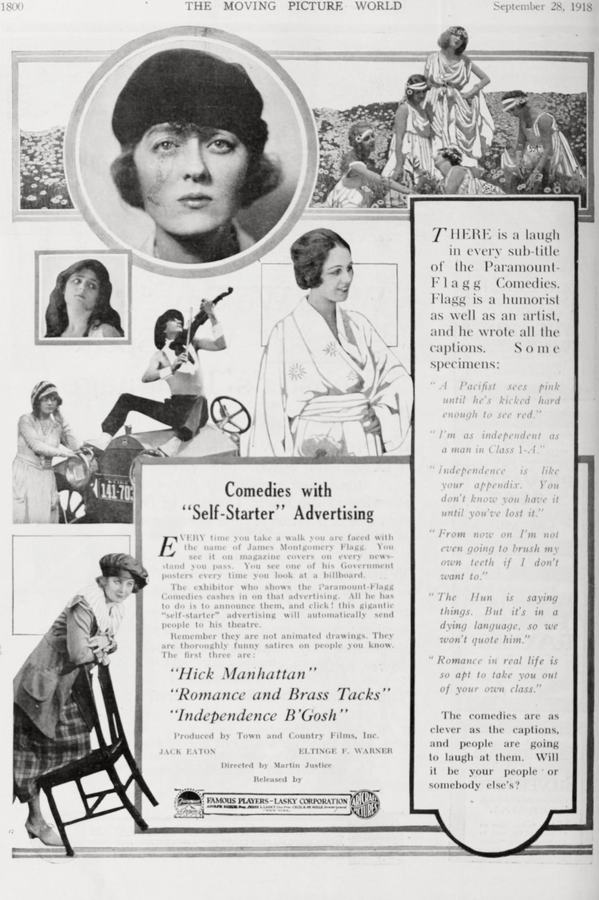
The year 1918 stood as a precipice in the American cultural consciousness, a moment where the world was shedding the heavy, brocaded skins of the 19th century and stepping, blinking, into the neon glare of modernity. It is within this seismic shift that Romance and Brass Tacks emerges not merely as a motion picture, but as a sociological artifact. Penned by the legendary James Montgomery Flagg—a man whose inkwell seemed to contain the very essence of American identity—this film functions as a droll subversion of the romantic tropes that had, until then, dominated the flickering screens of nickelodeons and grand cinema palaces alike.
James Montgomery Flagg was already a titan of the printed page, his illustrations defining the 'ideal' American face. When he turned his caustic wit toward the cinema, he brought a draftsmanship of character that few professional screenwriters could emulate. In Romance and Brass Tacks, we see the 'Girls You Know' series translated into a kinetic medium. Unlike the sprawling, quasi-religious epics like Civilization, Flagg’s work is surgically precise, focusing on the domestic interior rather than the global battlefield. He is interested in the skirmishes of the parlor, the trench warfare of the dinner table, and the diplomatic failures of the moonlit stroll.
The film’s aesthetic mirrors Flagg’s illustrative style: high contrast, sharp lines, and an almost obsessive attention to the physical tics of his subjects. The 'brass tacks' of the title are the cold, hard realities that Flagg loved to throw into the gears of sentimental machinery. While other films of the era, such as The Testing of Mildred Vane, relied on heavy-handed moralizing to reach their conclusions, Flagg utilizes a sophisticated cynicism that feels startlingly contemporary. He isn't interested in testing his characters' souls; he is interested in testing their patience and their pocketbooks.
At the center of this whirlwind of pragmatism is Olin Howland. To modern audiences, Howland might be a recognizable face from his later character work, but here, in his relative youth, he is a revelation of physical comedy. His lanky frame and expressive features allow him to convey a specific brand of American neurosis—the man who wants to be a hero but is constantly tripped up by his own shoelaces or the rising cost of rent. His performance is a stark departure from the stilted, declamatory style found in earlier works like Sapho. Howland moves with a fluidity that suggests a man constantly trying to adjust his dignity to fit an increasingly undignified world.
Howland’s chemistry with Claire Adams is the engine that drives the film. Adams, who would later find fame in more rugged fare like The Man from Montana, here displays a deftness for social satire. She represents the 'New Woman'—not yet the flapper of the 1920s, but a precursor who is far more interested in the 'brass tacks' than the 'romance.' Her performance is characterized by a series of knowing glances and subtle deflations of her male counterpart’s ego. When compared to the more traditional heroine roles in The Pearl of the Antilles, Adams feels like a gust of fresh, albeit slightly chilly, air.
"The brilliance of Flagg’s script lies in its refusal to offer a soft landing. It suggests that love is not a soaring eagle, but a domestic pet that requires constant feeding and produces a fair amount of mess. It is the antithesis of the cinematic escapism that would soon define the Hollywood Golden Age."
The narrative structure of Romance and Brass Tacks is episodic, almost like a series of Sunday comic strips brought to life. This format allows Flagg to explore various facets of social hypocrisy without the need for a convoluted, melodramatic plot. We see the protagonists navigate the perils of the formal dinner, the awkwardness of the chaperoned date, and the ultimate realization that the 'brass tacks' of life—money, logistics, and personality flaws—are far more enduring than the fleeting 'romance' of poetry and flowers. This cynical worldview was a hallmark of the 'Girls You Know' series, which often poked fun at the archetypes of the era, much like the satirical bite of Bulling the Bolshevik.
Technically, the film is a marvel of its time. The lighting, while primitive by today’s standards, is used effectively to highlight the contrast between the soft-focus 'romantic' sequences and the harsh, brightly lit 'brass tacks' moments. The cinematography doesn't strive for the epic scale of Neal of the Navy, but its intimacy is its strength. By keeping the camera close to the actors, the director (likely working under Flagg’s heavy influence) captures the subtle eye-rolls and lip-curls that constitute the film’s real dialogue.
To truly appreciate the iconoclasm of Romance and Brass Tacks, one must view it alongside its contemporaries. While Exile or The Isle of Life were wallowing in the shadows of European-style tragedy and existential longing, Flagg’s film was firmly planted in the American soil of pragmatism. It shares more DNA with Douglas Fairbanks’ light-hearted romps like Down to Earth, yet it possesses a sharper, more intellectual edge. Where Fairbanks used athleticism to overcome obstacles, Howland uses a sort of weary, intellectual resignation.
Furthermore, the film’s treatment of marriage and domesticity is light years ahead of the moral panic seen in Idle Wives. Flagg doesn't see domestic boredom as a tragedy to be cured by a return to traditional values; he sees it as a comedy to be endured with a stiff drink and a sarcastic remark. This thematic maturity is also evident when contrasted with the melodramatic suffering of The Shadow of Her Past. In Flagg’s world, the past doesn't cast a shadow; it just sends a bill for unpaid services.
Harold Foshay’s presence in the film adds a layer of solid, dependable supporting work that anchors the more flighty comedic moments. His performance provides a necessary counterweight to Howland’s kinetic energy, representing the established social order that the younger characters are simultaneously trying to emulate and escape. This dynamic is reminiscent of the character interplay in Tempered Steel, though played for laughs rather than high-stakes drama. The film also benefits from the cultural shorthand of its time—references to wartime austerity and the changing roles of women are woven into the fabric of the script without being didactic.
The film’s pacing is another of its virtues. Silent comedies often suffered from 'gag-lag,' where a bit would be dragged out long after the audience had grasped the punchline. Romance and Brass Tacks, however, moves with the speed of a well-edited magazine. Each scene is a punchy editorial comment on the state of modern love. It has the breezy confidence of Bab's Burglar but trades that film’s youthful innocence for a more seasoned, worldly perspective. It is, in many ways, the sophisticated older sibling to films like Pretty Mrs. Smith.
As we look back at Romance and Brass Tacks through the lens of over a century, its relevance is startling. The conflict between the curated 'romance' of our public personas and the 'brass tacks' of our private realities has only intensified in the age of social media. Flagg was deconstructing the 'Instagram aesthetic' of 1918 before the technology even existed. He understood that humans have a perennial desire to dress up their lives in the finery of sentiment, only to be constantly reminded that life is made of coarser materials.
The film’s refusal to provide a saccharine ending is perhaps its most 'modern' attribute. It leaves the characters—and the audience—in a state of enlightened pragmatism. We are not promised that love conquers all; we are promised that if we keep our wits about us and our eyes on the 'brass tacks,' we might just survive the experience of romance. This intellectual honesty makes the film a vital watch for anyone interested in the evolution of the American comedy. It is a bridge between the slapstick of the early silents and the sophisticated screwball comedies of the 1930s.
In the final analysis, Romance and Brass Tacks is a triumph of wit over sentiment. It is a testament to James Montgomery Flagg’s ability to see through the nonsense of his era and capture the enduring absurdities of the human condition. With stellar performances from Olin Howland and Claire Adams, and a script that remains as sharp as a freshly sharpened pencil, it is a silent gem that deserves to be polished and presented to a new generation of cinemaphiles who appreciate a little bit of salt with their cinematic sugar.
***
IMDb 3.9
1926
Community
Log in to comment.