DbcultAccessing Vault...
6.5/10
Senior Film Conservator
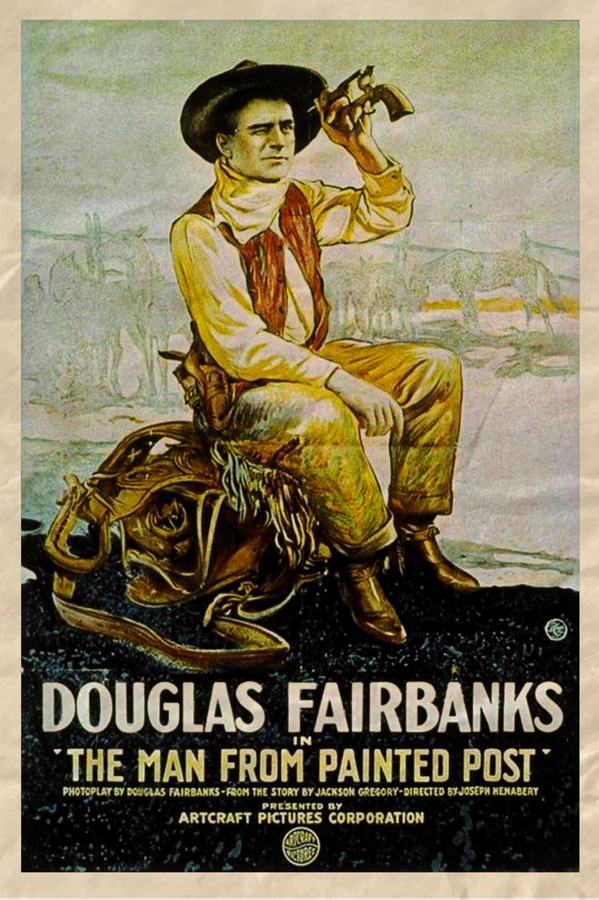
A definitive 6.5/10 rating for a film that redefined the boundaries of cult cinema. The Man from Painted Post remains a cornerstone of transgressive art.
Painted Post—no dot on most maps—becomes, in Joseph Henabery’s sinewy 1917 oater, an existential bullring where identity is less birthright than costume change. The film, brisk at 56 minutes yet as dense as mesquite smoke, positions Douglas Fairbanks at the apex of his pre-swashbuckling incarnation: the athletic ironist who can parody effete ineptitude without ever surrendering his core of tensile steel. The plot—cattle rustlers gouging homesteaders—sounds rudimentary, but beneath its weather-beaten hide pulses a meditation on performance itself, on America’s habit of wearing frontier naïveté like calfskin gloves.
The conceit—veteran stock detective adopts the guise of a dandyish tenderfoot—predates the “city slicker” trope later flogged to death by mid-century sitcoms. Fairbanks, however, weaponizes it. His dandy is all flapping coat-tails and hand-tooled Oxford boots, but the eyes—those coiled-spring irises—never blink. Watch him in the mercantile: he fingers gingham as if decoding cuneiform, while actually memorizing the ledger of bartered steers. The performance-within-performance recalls the layered masks of Fantômas, yet Painted Post swaps urban gaslight for alkali glare, substituting subterranean sewers with canyon mazes that swallow thundering herds.
Film scholars often overlook how this Western anticipates film-noir’s obsession with aliases. The detective’s alias is not a mere plot hinge; it is the film’s epistemological fulcrum. Knowledge—who owns which beeves, who burns brands, who inks the tally—circulates like contraband, and only the man who refuses a single fixed self can surf those rip currents. Fairbanks’s body, famously catlike, literalizes this fluidity: he vaults from balcony to saddle in one seamless arc, revealing prowess precisely when the ruse should collapse. The stunt is not spectacle; it is ontology.
The screenplay—credited to Jackson Gregory, polished by Fairbanks and Henabery—sketches rustling less as opportunistic larceny than as vertically integrated plunder. Cattle barons bankroll the operation; cowboys on the skids supply muscle; Eastern syndicates launder beef through abattoirs that sprout along freshly laid rail. In 1917, when labor unrest convulses copper mines and wheat belts, Painted Post smuggles that ferment into its narrative marrow. One thinks of The Cinderella Man or Tangled Fates, where economics tug heartstrings; here, however, the critique rides shotgun with six-gun verve.
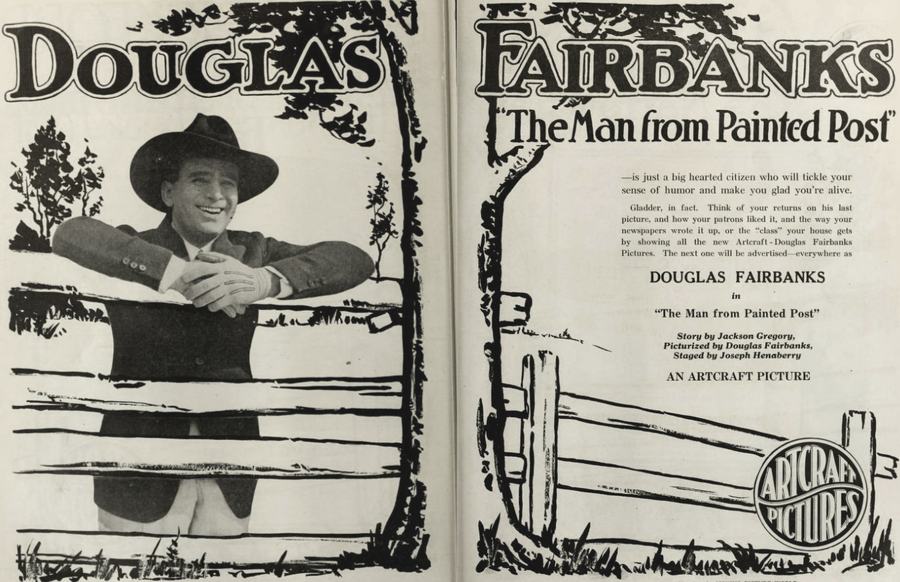
A pivotal scene unfolds in the half-light of a branding pen: crimson firelight licks the flanks of terrified steers while a violin screeches a reel off-screen. The detective, still feigning clumsiness, ‘accidentally’ overturns a pot of branding acid, forcing the rustlers to reveal a running iron hidden beneath straw. The moment crackles with proletarian fury: the very tools used to forge ownership become weapons of usurpation. Fairbanks’s smile—half apology, half dagger—encapsulates the film’s politics: revolt disguised as blunder.
Cinematographer Hugh C. McClung, weaned on newsreels, opts for high-contrast orthochromatic stock that renders the prairie a tessellation of bone-white highlights and inkwell shadows. Faces burn like magnesium flares against dusk; gunmetal clouds smother horizons with operatic gloom. The palette—limited yet forceful—anticipates the sea-blue nocturnes of The Mystery of the Rocks of Kador and the sulphur-yellow dread of The Light That Failed.
Henabery’s blocking is equally kinetic. In an early saloon set-piece, the camera pirouettes from card table to balcony rail, mimicking the detective’s roving gaze. Fairbanks, center-frame, performs a vaudeville of pratfalls—yet each tumble re-maps the room’s geometry. By the time he crawls beneath a swinging bat-wing door, we have catalogued every exit, every face, every latent threat. The sequence lasts 90 seconds, but its spatial cartography rivals the labyrinthine montage of Body and Soul.
Eileen Percy’s character—nameless beyond “Ranch Heiress” in intertitles—initially appears ornamental. Yet her arc traces a stealthy parabola from ornamental witness to epistemic engine. She alone deciphers the tremor in Fairbanks’s masquerade, spotting calluses that contradict his dandy aura. Their courtship transpires through exchanged artifacts: she lends him a tooled-leather glove; he returns it branded with the rustlers’ clandestine mark. The glove, freighted with both intimacy and evidence, becomes a laconic love letter, a harbinger of union forged in duplicity.
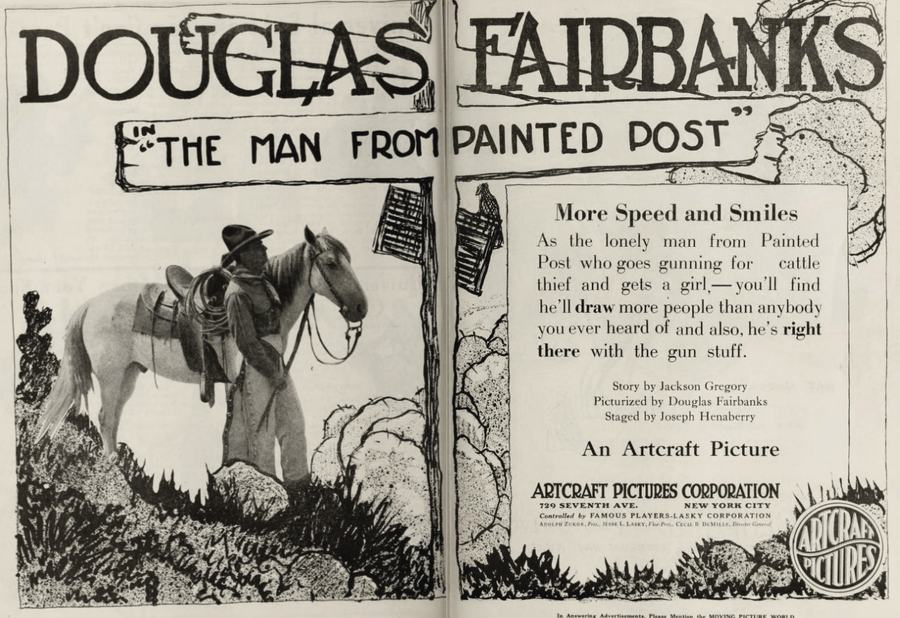
Compare this to the mute yet eloquent protagonist of The Dumb Girl of Portici; both women weaponize objects to destabilize patriarchal crime. Percy’s final gesture—torching the ledger that would condemn her cattle-baron uncle—erupts as an act of both mercy and annihilation, love and revolt, sealing the film’s conviction that justice, like oxygen, feeds on combustion.
One cannot overstate Fairbanks’s self-reflexivity. He was, by 1917, already a brand: the ebullient hero who leapt from stage to celluloid like a pogo-stick demigod. Painted Post toys with that persona, letting him play against type for a full reel before unleashing the familiar acrobatic id. The delay is delicious. When he finally scrambles up a hayloft beam, dives through a skylight, and lands saddle-ready on a horse’s bare back, the audience’s catharsis mirrors the detective’s liberation from artifice. The body—lithe, spring-heeled—becomes truth’s instrument, as if to say: no mask can muzzle kinetic authenticity.
Scholarship sometimes splits Fairbanks’s career into pre-Zorro “comedian” and post-Zorro “athletic swashbuckler.” Painted Post explodes that binary. His humor here is tactical, a feint within a feint; his athleticism philosophical, a manifesto that the self is not fixed but forged in motion. One thinks of Let Katie Do It, where role-play also interrogates gender roles; Fairbanks extends that interrogation to the very marrow of American masculinity.
Intertitles, often maligned as narrative scaffolding, here function as drumbeats. Phrases like “A fool—but watch his eyes!” or “Brands heal; stolen honor does not” crack like whips, syncing with montage rhythms. The font—slab-serif, resembling burnt fence posts—roots the dialogue in the soil it defends. Compare the ornate curlicues of La leggenda di Pierrette; Painted Post opts for typographic austerity, as if words themselves must earn their keep under frontier bookkeeping.
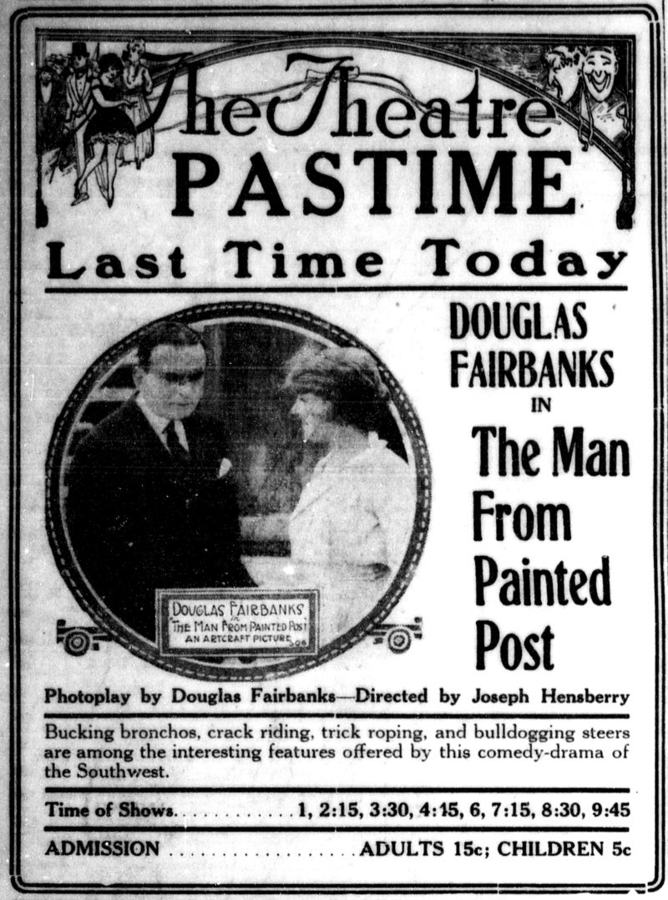
Mid-film, a thundering herd—spooked by strategically placed firecrackers—careens through main street. Shot day-for-night via coal-black filters, the scene anticipates Eisensteinian montage: hooves, faces, shutters, church bell, repeat. The sequence lasts 78 seconds yet encapsulates the film’s ontological wager: order masquerading as chaos, chaos revealing order. Fairbanks, astride a pinto, surfs the torrent, lasso flicking like a metronome. Historians cite it as proto-action cinema; I argue it is also a thesis on modernity itself—technology (the camera) taming primordial panic through rhythmic editing.
Released the same year as revolutionary upheavals from Petrograd to the Wobblies’ picket lines, Painted Post smuggles insurrection into a populist genre. Its DNA reverberates across continents: the spectral masks of Mohini Bhasmasur, the matriarchal guilt of A Mother’s Confession, the class treachery of Bristede Strenge. Yet Painted Post’s genius lies in embedding critique within kinetic joy, proving that agitprop need not taste like medicine.
For decades, only a frayed 9.5 mm Pathé condensation circulated among collectors. Then, in 2018, a nearly-complete 35 mm nitrate negative surfaced in a Nebraska hayloft, wedged between threshing invoices. The Library of Congress’s 4K restoration reveals granular detail—every tumbleweed spine, every pore on Fairbanks’s sun-dappled neck. Contemporary festival crowds, weaned on CGI superheroes, still gasp when Fairbanks vaults onto that horse. The stunt, performed without trickery, feels alchemical precisely because it is human.
Some silents feel embalmed in amber; Painted Post bristles like barbed wire. Its themes—corporate graft, performative identity, ecological precarity—have aged into prophecy. Yet ideology alone cannot explain its pulse. The film endures because Fairbanks, that mercurial maestro, fuses athletic grace with intellectual mischief, because Henabery’s camera refuses to sit still, because the West, as Painted Post imagines it, is not a destination but a question: who are you when no one knows your name, when the land itself can be rebranded by flame and ink?
So, reader, if you crave a Western that gallops beyond black-hat-white-hat pantomime, stream this sun-scorched jewel. Let its alkali winds abrade your assumptions; let Fairbanks’s wink remind you that identity is a rodeo—no grip too tight, no flip too high, and every landing a chance to reinvent the dust you kick up.
IMDb —
1921
Community
Log in to comment.