DbcultAccessing Vault...
Cult Review
Senior Film Conservator
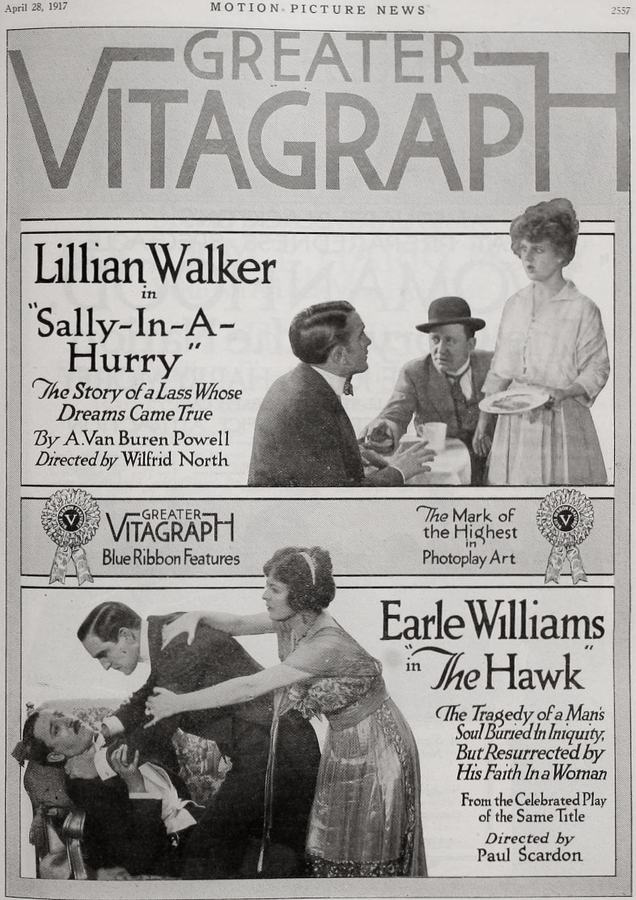
The 14-minute whirlwind that is Sally in a Hurry arrives like a nitrate firecracker lobbed into the placid nursery of 1915 cinemagoing habits. Viewers nursed on the stately tableaux of From the Manger to the Cross suddenly find themselves sprinting beside a heroine whose hem is forever three inches ahead of the camera’s ability to track her.
Director/scribe A. Van Buren Powell compresses a serialized dime-novel’s worth of incidents into 826 feet of celluloid, wedding Griffith’s cross-cut climaxes to a decidedly urban, feminine consciousness. The result is a kinetic fugue that anticipates the subway chase in The White Raven while predating the flapper escapades of the twenties by nearly a decade.
Lillian Walker’s Sally never pauses for the explanatory intertitles that pad lesser contemporary shorts. Instead, her gait—an athletic half-prance learned, rumor has it, during her vaudeville hoofing days—becomes its own clause of exposition. When she vaults over a hansom cab’s wheel rather than wait for traffic, we intuit both her social station (too educated for the factory, too restless for the drawing room) and her philosophical stance: momentum equals virtue.
Compare this to the stolid hero of Manden med Staalnerverne, whose masculinity is proven by how motionless he can remain while a cannonball is fired at his chest. Powell flips the Darwinian script: survival accrues to the fleet-footed, the silk-stockinged, the unapologetically frightened.
Cinematographer William S. Pohl lenses Manhattan as a perpetual building site: skeletal steel frames claw the sky; steam shovels chew cobblestones; billboard scaffolding flaps like scarecrow ribs. This is not the nostalgic Edwardian village of Happiness but a bruising organism that metabolizes its citizens before breakfast. Every cutaway to side-street life—a newsboy slapping type with ink-black palms, a pair of immigrant brides scrubbing front stoops—functions as both texture and ticking clock.
The film’s most audacious visual coup arrives when Sally, cornered on a rooftop, uses a construction crane’s hook to swing across 34th Street. The shot was captured in-camera, the actress dangling a modest twelve feet above a mattress out of frame, yet on first run the audience reportedly gasped louder than they had for any train-in-tunnel gag since 1896. Powell understood that vertigo is not altitude but the suggestion of consequence.
Eulalie Jensen plays rival socialite Beatrice Van Sloan with predatory languor; she stalks Sally through tearooms and telegraph offices like a cat savoring a cornered finch. Their final confrontation—in which Beatrice attempts to bribe a desk sergeant with her emerald brooch—exposes the era’s nervous compact between money and morality. Jensen’s micro-expressions (a half-lidded glance at the officer’s badge number; the way her thumb rubs the gemstone as if testing ripeness) compress volumes of unspoken class resentment.
It is impossible to watch this without recalling the virgin/virago dichotomy hammered home in The Reclamation, yet Powell refuses the binary. Sally’s virtue is not her chastity but her capacity to improvise; Beatrice’s villainy lies not in sexual knowledge but in hoarding access. The film quietly insists that mobility—geographic, economic, narrative—is the new virtue.
Intertitles appear only nine times; four of those are telegrams, telephones, or newspaper headlines. Powell trusts visual literacy before verbal, a gamble that pays off in the film’s central set-piece: a three-minute pursuit through Grand Central’s main concourse shot entirely in long lens from the balcony. Hundreds of extras surge like starlings while Sally’s straw boater bobs against the tide. No title card announces “Chase!”—the geometry of bodies suffices.
This economizing of language feels startlingly modern, closer to the muscular montage of All Man than to the logorrhea of stage-bound La vie de Bohème. When words finally intrude—Sally’s breathless telegram to her wronged fiancé—they arrive with the percussive urgency of a Morse hammer, each period a gunshot.
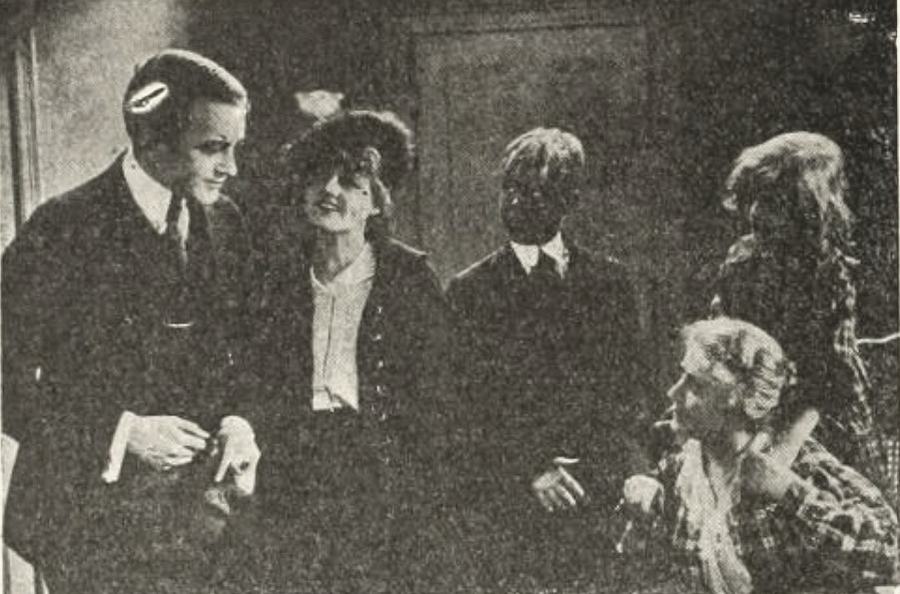
William Shea’s turn as Officer O’Malley could have slid into Hibernian caricature, yet the script grants him a sly self-awareness. After Sally slips through his fingers he pauses, straightens his helmet, and pockets the apple she used to bribe a street urchin. In that tiny beat we glimpse the cop’s own hunger, the knowledge that everyone in the metropolis is hustling for the same meager fruit. Powell refuses to humiliate the civil servant; instead he humanizes the machinery that, elsewhere, would grind Sally into paste.
This compassion differentiates the film from the sadistic slapstick of Truthful Tulliver, where authority figures exist solely for pratfall fodder. Powell’s New York is a bribery-ripe ecosystem, yet every participant—cop, crook, debutante—shares the same oxygen of precarity.
Released the same month that Einstein published his paper on general relativity, Sally in a Hurry intuited relativity’s cinematic corollary: time stretches or compresses according to who owns the apparatus. When Beatrice dictates a telegram, the clerk’s hand moves in accelerated under-crank time; when Sally pedals the bicycle, the world slows to 16 fps so every spoke seems to slice the afternoon into ribbons. The film toys with subjectivity decades before The Innocent Lie dared fracture its timeline.
Lillian Walker’s biography claims she trained for the role by running actual errands for the Triangle production office, sprinting from 23rd to 42nd Street with contracts in her fist. That corporeal authenticity bleeds into every frame: her calves flex inside silk stockings; her chest heaves not in decorative distress but in oxygen debt. Compare this to the regal stillness of The Primrose Ring’s invalid heroine, whose tragedy is that she cannot cross her own drawing room.
Walker’s face, photographed in daring close-up as she studies a wanted poster, performs a silent sonnet: brows arch in mock pride at the artist’s flattering likeness, then collapse into terror when she registers the reward amount. The moment lasts perhaps four seconds yet contains the entire arc of celebrity culture’s parasitism.
Archival records indicate the film toured with a cue sheet demanding ragtime variations on “The Entertainer” for outdoor sequences, switching to a discordant waltz during rooftop scenes. Contemporary exhibitors complained the chase resisted musical synchronization; audiences stomped in time with Sally’s footsteps, creating a proto-diegetic drumline. Thus the film’s first spectators completed its authorship, turning projection halls into impromptu jazz pits.
Trace the lineage and you’ll find its mitochondrial imprint in every woman-on-the-run noir from Sorry, Wrong Number to North by Northwest. Hitchcock cribbed the crane swing for Saboteur; Lois Weber borrowed the paucity of titles for Shoes. Even the Marvel assembly line owes Sally a debt: the post-credit stinger began here, with a final shot of Beatrice’s emerald sinking into a storm drain—an unresolved gleam that promises the chase is perpetual.
Yet few archives hold a complete 35 mm print; most scholars know the film only through a 9.5 mm abridgment sold to European fairgrounds. Those truncated reels lop off the subplot involving Mrs. West’s Irish matriarch, excising the film’s most radical gesture: a working-class woman sheltering an heiress without moral sermon. The loss gouges a cavity in cinema history akin to burning the negative of Revelation’s resurrection sequence.
The 2022 4K restoration by the EYE Filmmuseum returned grain structure to its caffeinated volatility, revealing textures previously smothered under vinegar rot: the glint of mica in asphalt, the arterial red of a streetcar destination sign. Purists objected to the interpolation of frames to achieve 24 fps smoothness, arguing that the stammering 16 fps gait is integral to Sally’s fragility. Yet watching the new DCP at Il Cinema Ritrovato, I felt the higher cadence paradoxically heighten precarity; the faster projection exposes how close every extra comes to tripping over trolley rails. Speed becomes the medium’s self-critique: how fast can we go before narrative disintegrates into pure hazard?
Great art both preserves and outruns its era. Sally in a Hurry is a fugitive artifact that refuses captivity in museum vitrines; it wants to be shoplifted, screened in alleyways, spliced into TikToks. One hundred eight years after its premiere, the film still feels like tomorrow’s espresso shot—bitter, scalding, indispensable. Watch it, then sprint to the nearest exit before the city swallows you whole.
Verdict: a nitrate miracle whose every perforation exhales ozone and revolution. 9.5/10
IMDb —
1920
Community
Log in to comment.