DbcultAccessing Vault...
Cult Review
Senior Film Conservator
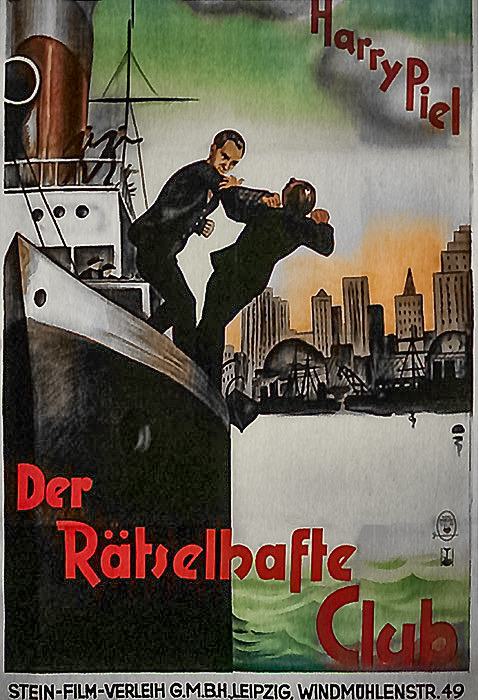
The first glimpse of the Sphinx-Club is a vertiginous iris-shot that sucks you through a keyhole into a universe where gilded griffins leer at chorus girls kicking in perfect synchrony. Cinematographer Carl Hoffmann—moonlighting from his Expressionist chores—bathes the proscenium in a sulphuric glow that feels equal parts cathedral and abattoir. The camera then pirouettes above the audience, revealing monocled silhouettes whose faces are never quite in focus, as though the film itself refuses to grant the bourgeoisie the dignity of recognition. From this lofty vantage, Der rätselhafte Klub announces its thesis: spectatorship is conspiracy, and conspiracy is the only national sport left to a republic on respirator.
Harry Piel, that indefatigable showman, understood that post-war German viewers craved not only adrenaline but also a hall of mirrors in which to interrogate their complicity. He therefore grafts a routine whodunit onto a kaleidoscope of set-pieces: biplane dogfights that metamorphose into Keystone-style chases through laundry lines; expressionist dream sequences where Lyuba’s ballad reverberates in reverse, the phonograph spinning like a dying planet; underwater card games inside the club’s flooded cellar, where air-bubble kisses stand in for pillow talk. Each detour feels gratuitous until one realises that the excess is the message—Weimar Berlin itself was a non sequitur sustained by cocaine and contracts written in vanishing ink.
Esther Hagan delivers the film’s wounded heart. When she croons "Mein blauer Mond", her vibrato quavers on the brink of detonation; the lyric’s blue moon becomes a metaphor for a republic that can never quite complete its orbit. Close-ups of her pupils—dilated, ink-dark—mirror the Spirograph designs that the villainous Countess sketches while plotting coups. The film’s boldest editorial choice is to deny Lyuba a conventional arc; instead of metamorphosis, she gets mise-en-abyme, reappearing in ever-shifting disguises—scullery maid, newsboy, cadaver—until identity itself liquefies. Hagan’s performance anticipates the modern trope of the unreliable protagonist, yet her exhaustion is palpably historic: one senses the entire actress trembling under the weight of a nation trying to pawn its future for one more night of forgetting.
Piel the auteur is less interested in solving the theft of the blueprints than in exposing the architecture of deceit that undergirds any urban nightlife. Consider the extended sequence inside the cabaret’s backstage: seamstresses stitch sequins onto body-stockings while, behind a false wall, policemen forge autopsy reports; meanwhile, a child errand-boy trades morphine for theater tickets, his eyes already older than the Kaiser’s bust being melted down for soap in the courtyard. Crosscutting these tableaux with the onstage revue, Piel orchestrates a contrapuntal montage worthy of Eisenstein, yet flecked with the sardonic shrug of Lubitsch. The result is a tonal vertigo that leaves the viewer morally seasick—exactly the psychic hangover that 1923 required.
Visually, the palette is a fever dream of sea-blue shadows and arterial oranges. A petrol fire in an airfield hangar is rendered in such saturated ochre that the flames seem to drip molten citrine onto the celluloid. Conversely, the nocturnal alleyways are daubed with cyan gel, turning brickwork into aquarium walls behind which the city’s predatory fish glide. Hoffmann’s camera filters—often improvised from coloured cigarette papers—lend the smoke itself a carnivorous agency, curling around waists like boa-constrictors. Critics who reductively slot the film into German Expressionism miss its proto-noir cosmopolitanism; here, chiaroscuro serves not metaphysical dread but the more quotidian dread of unpaid tabs and political turncoats.
Compared to the frontier nihilism of Hell’s Hinges, Der rätselhafte Klub is urban cynicism incarnate. Both films hinge on a building that embodies moral rot—the saloon versus the cabaret—yet Piel’s characters lack even the consolatory horizon of open desert. Where William S. Hart’s preacher found redemption in ashes, Piel’s protagonists exit through a trapdoor that deposits them back onto Berlin’s paving stones, still slick with yesterday’s blood. Likewise, the documentary starkness of De røvede Kanontegninger shares the theme of state secrets, yet the Danish film’s linear sobriety feels almost naïve beside the German picture’s baroque self-reflexivity.
Sound, or rather its absence, becomes a character. Released at the tipping point toward talkies, the film flaunts intertitles that behave like percussion instruments: "KLANG!" accompanies a cymbal crash; "…und Stille" lingers over a tableau of hanged marionettes. These typographic stabs anticipate the jump-cut dissonances later perfected by the French New Wave. Contemporary reports describe orchestra pits improvisating jazz riffs that syncopate with the editing, turning each screening into a unique Happening. One imagines Kurt Weill humming along, taking notes for Threepenny Opera.
Gender politics simmer beneath the sequins. The Countess’s pansexual machinations treat human hearts as tradable futures; her final comeuppance—a forced striptease before the male parliament—reads as a cynical concession to censorship boards, yet the camera lingers on her unbroken gaze, implying that曝光(nudity) is just another costume. Conversely, Lyuba’s refusal to be saved destabilises the damsel trope; when Jens offers her an aviator’s escape, she retorts via intertitle, "Your wings are only big enough for your ego.” That riposte, delivered with Hagan’s coal-fire eyes, detonates the patriarchal scaffolding of the adventure genre more cleanly than any bomb.
The screenplay, attributed to Piel and Max Bauer, betrays a fascination with synecdoche: a missing cufflink unlocks ministerial resignations; a dog’s severed tail reveals a forger’s signature. Such narrative minimalism—where the part stands for the decadent whole—mirrors the macroeconomics of hyperinflation, where a single banknote might purchase either a townhouse or a pretzel depending on the hour. Dialogue favors the epigrammatic. My favorite exchange: "You smell like yesterday’s truth.” – ”Truth, like milk, sours overnight.” That brittle wit could sit comfortably in a Chandler novel, yet it is spoken in a Berlin accent thick enough to butter bread.
From a craft perspective, the stunt work astounds. Piel, an athlete in the Douglas Fairbanks mold, insisted on practical leaps between Zeppelins, achieved by anchoring a trapeze to a barnstormer’s wing while ground cameras cranked at 12fps to elongate the jump. The resultant footage—grainy, wind-whipped—feels documentary, prefiguring the daredevil authenticity Jackie Chan would mint decades later. Yet the spectacle never eclipses the emotional stakes; each physical peril externalises the ethical free-fall of a republic whose constitution is written on water.
Critical reception at the time was bifurcated. Lichtbild-Bühne praised its ”cinematic roller-coaster that leaves one’s moral stomach behind,” while the more conservative Kinematograph decried its ”decadent crossword puzzle lacking edifying answers.” Audiences, however, queued around the block, desperate for any illusion of coherence amid street battles between Spartacists and Freikorps. Box-office tallies placed it third behind Der letzte Mann, a feat akin to an indie thriller outgrossing today’s Marvel behemoth.
Modern restorations reveal subtleties invisible in duped 16mm prints: the glint of a spy’s monocle reflecting the film’s own title card, a meta-wink worthy of Nothing But the Truth. Yet scars remain—a missing reel, presumably lost in the 1945 flak-storm, creates a narrative lacuna that scholars still patch with speculative synopses. Rather than debilitate the experience, this void intensifies the mystique, turning the film into a living artefact that mutates with each archival discovery.
Comparative analysis with Woman (also 1923) illuminates divergent strategies for gendered suffering. While the Swedish film sanctifies its protagonist’s martyrdom, Der rätselhafte Klub refuses redemption outright; survival is merely the privilege to be re-commodified. In that regard, it shares DNA with Little Speck in Garnered Fruit, though Piel’s cynicism lacks the latter’s metaphysical whimsy. Thematically, the closest cousin might be As Ye Repent, yet where that morality play kneels before divine retribution, Piel’s finale issues a secular shrug: the roulette wheel spins, the envelope changes hands, and the city’s neon sighs flicker on.
Is the film flawless? Hardly. The comic relief—an inebriated nobleman chasing a runaway automaton—derails momentum, and the film’s orientalising depiction of a Chinese conjurer, replete with opium clichés, lands queasily on modern retinas. These blemishes, however, serve as historical signposts, reminding us that even the avant-garde can traffic in pedestrian prejudices.
Ultimately, Der rätselhafte Klub endures because it embodies cinema’s primal promise: to trap time in amber while simultaneously interrogating the amber’s authenticity. Each frame vibrates with the panic of 1923, yet the questions it poses—Who is watching whom? What is the cost of a ticket to forgetting?—remain urgent in an age of data mines and algorithmic cabarets. To watch it is to step onto a fairground carousel that spins so fast the world outside becomes a smear of possibilities, none virtuous, all irresistible.
So seek it out, whether in a rep cinema with live improvisational trio or on a 4K scan glowing from your living-room projector. Let the brass section blare, let the cyan shadows swallow your certainty, and when that final trapdoor swings open, ask yourself: did you leave the club, or did the club leave inside you?
IMDb —
1929
Community
Log in to comment.