DbcultAccessing Vault...
Cult Review
Senior Film Conservator
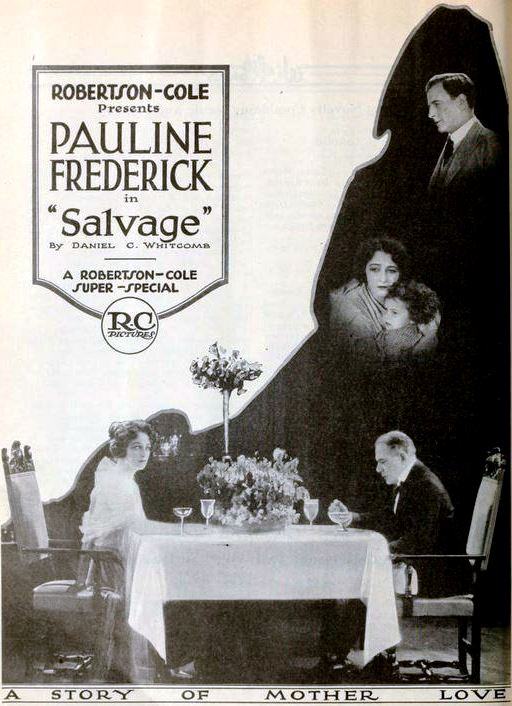
In the pantheon of early 1920s cinema, few films navigate the treacherous waters of socio-economic disparity and maternal instinct with as much raw, unadulterated pathos as Salvage (1921). Directed with a keen eye for the chiaroscuro of the human condition, this film serves as a bridge between the Victorian melodramas of the previous decade and the burgeoning realism that would eventually define the late silent era. While often overshadowed by the more avant-garde experiments of the time, 'Salvage' stands as a monumental testament to the power of the 'fallen woman' narrative, reimagined through a lens of radical redemption.
The film opens not with a whimper, but with a psychological rupture. Bernice Ridgeway’s transition from a woman of means to a tenement dweller is not merely a change of scenery; it is a total erasure of the self. This theme of identity fluidity is a recurring motif in the era, reminiscent of the masquerades found in My Lady Incog., yet 'Salvage' strips away the comedic artifice in favor of a grim, almost nihilistic survivalism. The tenement, rendered in grainy, claustrophobic detail, becomes a character in its own right—a sprawling, indifferent beast that swallows the broken and the forgotten.
Pauline Frederick’s performance is nothing short of alchemical. In an age where silent acting often leaned toward the hyperbolic, Frederick employs a restrained, internalised vocabulary of movement. Her eyes, heavy with the weight of a phantom child, convey more than a thousand intertitles ever could. She captures the precise moment where grief curdles into a desperate, functional madness. When she encounters Kate Martin, the contrast is stark. Kate represents the end-point of poverty—a woman so thoroughly hollowed out by circumstance that suicide appears as the only logical exit. The scene where Bernice assumes Kate’s identity is handled with a chilling pragmatism that challenges the audience's moral compass.
This moral ambiguity is what separates 'Salvage' from contemporary works like The Beautiful Mrs. Reynolds. While the latter focuses on the aestheticization of historical drama, 'Salvage' is rooted in the muck of the present. Frederick’s Bernice is not a saint; she is a scavenger, a woman who builds a new life out of the wreckage of another’s tragedy. This 'salvaging' of a soul is a complex ethical knot that the film refuses to untie easily, forcing the viewer to confront the desperation that drives a woman to steal a name and a child.
Milton Sills provides a sturdy, albeit somber, counterpoint to Frederick’s volatile emotionality. As Fred Martin, the man returning from the purgatory of prison to find his wife replaced by a ghost, Sills avoids the tropes of the 'wronged man.' Instead, he portrays a character defined by a weary acceptance of fate. His decision to maintain Bernice’s secret is not born of romantic attraction—at least not initially—but of a shared understanding of the necessity of deception. They are both outcasts, navigating The Criminal Path of social ostracization, bound together by a lie that becomes more real than the truth.
The chemistry between Sills and Frederick is understated, simmering beneath the surface of their domestic arrangement. It is a relationship built on the ruins of their previous lives. The child, the 'lame' boy who serves as the emotional anchor of the film, represents the possibility of healing. The trope of the physically disabled child being 'cured' by an operation is a common sentimental device in silent cinema, seen in various forms in What Becomes of the Children?, yet here it feels earned. It serves as a physical manifestation of the internal restoration Bernice is undergoing.
Technically, 'Salvage' utilizes the limitations of its era to create an atmosphere of oppressive intimacy. The lighting in the tenement scenes is deliberately harsh, highlighting the textures of peeling wallpaper and the grime of the city. This stands in sharp contrast to the soft-focus, ethereal lighting used in the brief glimpses of Bernice’s former life. This visual dichotomy reinforces the film's central theme: the chasm between the 'haves' and the 'have-nots' is not just financial, but ontological. The cinematography reflects a world divided into those who are seen and those who are merely 'salvage.'
The pacing of the film is deliberate, allowing the psychological weight of the situation to settle. Unlike the frantic energy of adventure serials like Die Herrin der Welt, 'Salvage' is a slow-burn character study. It demands patience from the viewer, rewarding it with a sequence of emotional crescendos that feel both inevitable and shocking. The intertitles, written by Daniel F. Whitcomb, are sparse and poetic, avoiding the flowery prose of the time in favor of direct, impactful dialogue that mirrors the characters' stripped-back existences.
The resolution of 'Salvage' is a masterstroke of melodramatic irony. The revelation that the child Bernice adopted is her own biological son, whom she believed dead, is a twist that would feel contrived in lesser hands. However, within the framework of this narrative, it serves as a cosmic vindication. It suggests that her descent into the tenements was not a mistake, but a necessary pilgrimage to reclaim what was stolen from her. The death of her husband, the man who initiated the lie, provides the final 'salvage'—the restoration of her status and the means to provide for her 'new' family.

This ending elevates the film from a mere tragedy to a story of profound, if bittersweet, triumph. It echoes the redemptive arcs found in The Ninety and Nine, where the lost sheep is finally brought home. Yet, 'Salvage' remains more grounded, more cynical about the costs of such a return. Bernice is no longer the woman she was; she is a synthesis of the wealthy socialite and the tenement survivor, a woman who has looked into the abyss and decided to live there until the abyss gave back what it took.
Viewing 'Salvage' today requires us to look past the conventions of the 1920s and see the timeless struggle at its core. It is a film about the resilience of the maternal bond and the fluid nature of identity in a world that seeks to categorize and discard individuals based on their bank accounts. While it may not have the epic scale of She or the cultural specificity of Dalagang bukid, its focus on the domestic and the psychological makes it a precursor to the great social dramas of the 1930s.
The film’s exploration of the 'black sheep' of society—those who have been cast out by law or by lie—resonates with a modern audience’s understanding of systemic failure. Like the protagonists in Black Sheep or To Please One Woman, Bernice Ridgeway is a woman who must navigate a world designed to keep her down. Her ultimate success is not just a matter of inheritance, but a victory of the spirit. 'Salvage' is more than just a silent movie; it is a cinematic excavation of the human heart, proving that even in the darkest tenement, something precious can be found and saved.
A haunting, evocative journey through the wreckage of a life, 'Salvage' remains a cornerstone of Pauline Frederick’s illustrious career and a vital piece of silent film history that demands modern reappraisal.
IMDb —
1923
Community
Log in to comment.