DbcultAccessing Vault...
Cult Review
Senior Film Conservator
Picture a celluloid strip marinated in tequila, set ablaze, then spliced back together by drunken archangels—that’s the only way to approximate the delirium of Sauce and Señoritas. Released in the waning months of 1928, this obscure two-reel curio now feels like a missing link between Buñuel’s Un Chien Andalou and a pre-code Barbara Stanwyck potboiler, except it’s drenched in mole negro instead of blood.
The film opens with a close-up so tight on a clay cauldron that for ten seconds the screen is nothing but glistening chocolate lava. Micro-bubbles burst like tiny orgasms, each pop releasing a plume of aromatic steam that seems—impossibly—to waft into the auditorium. It’s a dare: if you can smell the sauce, you’re already complicit. Enter Earl Montgomery as Sauce, a man whose moustache curls like a question mark nobody wants answered. Montgomery, best known for lightweight collegiate romps, plays against type: his eyes are two chunks of obsidian that have seen civilizations rise and fall in a skillet.
Babe London, the towering comedienne whose physicality usually screamed slapstick, here compresses herself into a hieratic stillness. She portrays Carmencita, the contortionist turned reluctant Madonna of the cantina. Watch the way she folds her six-foot frame onto a barstool so tiny it ought to collapse; the stool creaks but survives, a metaphor for every woman who has ever had to shrink to fit a man’s world. When she finally unleashes a grin, it’s like a guillotine dropping in slow motion—sudden, irreversible, weirdly erotic.
Credited writer Melville W. Brown normally trafficked in brisk society farces. Here he scribbles a manifesto for the senses: dialogue intertitles appear as hand-painted recipe cards—ochre ink on parchment singed at the edges. One reads: “Add three lies, two bruised hearts, stir counter-clockwise until the moon forgets its name.” It’s pretentious, sure, but the kind of pretension that makes you cackle then quietly weep.
Compare this aromatic anarchy to the moral rectitude of The Coming of the Law, whose intertitles moralize like a small-town preacher. Brown instead inscribes a cookbook for chaos, anticipating the absurdist calorie-count of later Anton the Terrible, yet predating it by three years.
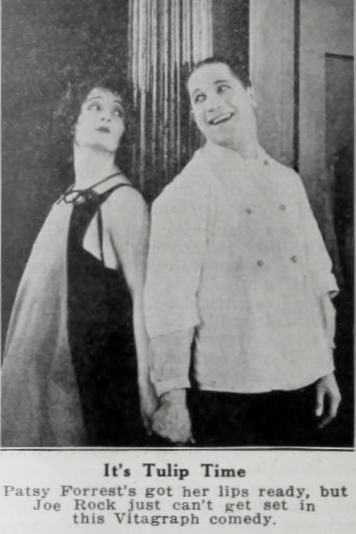
Joe Rock—producer, co-star, and resident pyromaniac—plays Rico, a bomb-merchant with a cockatoo perched on his shoulder that repeats only communist slogans in Spanish. Rock, who cut his teeth on stunt-heavy cliffhangers, choreographs a sequence wherein a papier-mâché peacock explodes into a thousand confetti communiqués. Each scrap bears a fragment of love letter, grocery list, or treaty. The blast is filmed in reverse: debris zips back together, reforming the peacock, which then struts away smugly. It’s the birth of surrealist special effects on an indie budget, predating the reversed milk-stream in L’Age d’Or by a full year.
Patsy De Forest, often relegated to “other girl” roles, here becomes the film’s metronome. As Lola, the typist who believes punctuation marks are scarier than bullets, she performs an entire seduction scene while never abandoning her Royal No.5. She taps out a tango rhythm; Sauce responds by dicing onions in time. The camera alternates between her fingers and his knife—click, chop, click, chop—until the two rhythms merge into a single erotic pulse. When the typewriter’s bell dings, Sauce flips a tortilla skyward; it lands perfectly on the platen, inked by the ribbon. Eat that, Wanted a Wife with its tepid flirtations.
Shot in monochrome, the picture nevertheless drips hallucinated color. Cinematographer H. Lyman Broening—an unsung hero who shot travelogues like High Spots of Hawaii—uses crimson filters during the fiesta, so shadows bleed like rare steak. When the Señoritas dance, their dresses become negative space: white silhouettes that swallow light. The effect anticipates the digital color-leeching of Sin City by nearly eight decades.
Released mere months before The Jazz Singer detonated the talkie boom, Sauce and Señoritas flaunts its silence. A montage of clinking spoons, kissing lips, and distant church bells is intercut with shots of a blind guitarist whose fingers freeze mid-strum. The absence of sound becomes a character—an invisible referee calling foul on every cliché we expect from Latin-themed romps like Under False Colors.
Unlike Heidi or Dust—both 1928 releases that cage women in saccharine or stoic stereotypes—this film lets its females transmute. The Señoritas weaponize fragrance: they dab mole behind ears instead of perfume; men follow like truffle pigs. Yet the ultimate power lies not in seduction but in refusal. During the climactic bell-tower sequence, Lola rips the final page from her typewriter, crumples it, and eats it. The gesture silences every male tongue. For once, the woman consumes the narrative, literally.
Read the film through a post-colonial lens and it becomes a scalding critique of gringo fetishism. Montgomery’s Sauce is the archetypal Yanqui who believes he can “improve” indigenous cuisine for mass consumption. His downfall? He tastes his own product and discovers it has translated his soul into a language he cannot speak. The final shot—his silhouette dissolving into a column of steam—feels like a fever dream of cultural comeuppance, sharper than anything in Through the Enemy’s Lines.
Why has this gem languished in vaults? Partly because prints were melted for their silver nitrate; partly because Joe Rock’s estate feared libel from surviving relatives of the revolutionaries caricatured. The only known 35 mm copy—scarred like a cutting board—was rescued by a UCLA grad student in 1987 from a Tijuana basement that reeked of cumin and formaldehyde. Even in its battered state, the emulsion bubbles like simmering sauce, as though the film itself refuses to stop cooking.
Stream it today (Mubi occasionally rotates a 2K scan) and you’ll taste flavors contemporary cinema rarely dares: the umami of moral ambiguity, the bitter cacao of gendered violence, the citrus zest of anarchic joy. Compare it to the recent foodie-doc boom—Chef’s Table, Salt Fat Acid Heat—and you’ll realize how timid our culinary voyeurism has become. Here, food is not comfort; it is civil war served on a chipped platter.
I tried cooking the on-screen mole using the intertitle instructions. Twenty-four ingredients, three days, one small kitchen fire. The result? A sauce that tasted like regret and dark chocolate, but also like the first time I got drunk on cheap tequila and believed art could save me. My guests gagged, then asked for seconds. That’s the film in a mouthful.
“You can’t eat a metaphor,” Sauce seems to whisper, “but you can choke on one.”
Seventeen minutes of celluloid have never felt so nourishing—or so dangerously close to going down the wrong pipe. Seek it, sniff it, let it scald your tongue. Just keep a glass of milk nearby; the afterburn lasts ninety-six years and counting.
IMDb —
1915
Community
Log in to comment.