DbcultAccessing Vault...
Cult Review
Senior Film Conservator
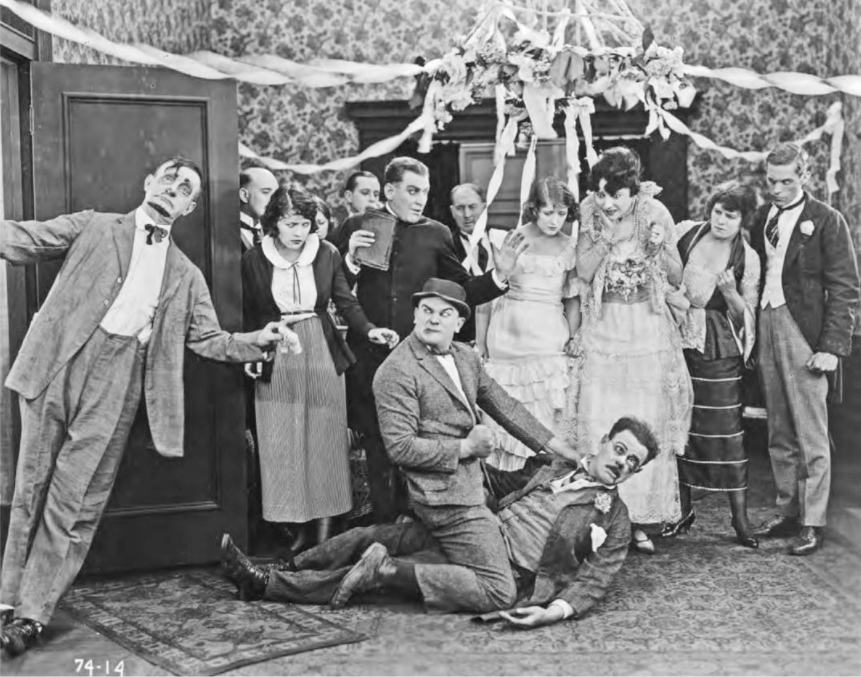
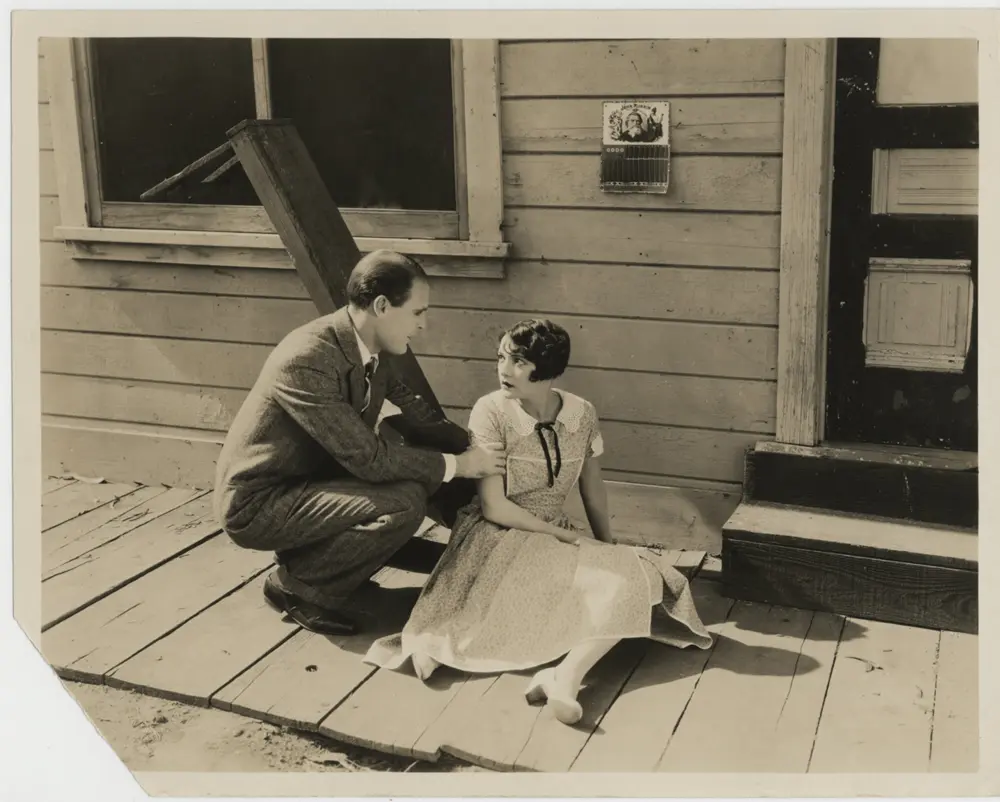
Picture, if you can, a sun-dappled country hotel where the air itself seems perfumed with peonies and pratfalls. Into this Eden stride two generations of Murray men, each clutching a bouquet so identical it might have been Xeroxed by fate herself. The father, Charles Murray—weathered, walrus-moustached, pockets sagging with middle-class hope—intends his blossoms for the widow whose late husband left her both a lakeside villa and a fortune in railway bonds. The son, George Bolger—lithe, bright-eyed, still smelling of university chalk—targets the same posy at the widow’s daughter, Marie Prevost’s flapper incarnate, all coltish legs and conspiratorial dimples.
Cue the first coup de théâtre: father spies son sliding the flowers toward the older woman and reads it as an Oedipal coup d’état. The bouquet, once a mute herald of courtship, mutates into a hand-grenade of generational warfare. From this single misprision, the film unspools like a silk ribbon caught on a thistle—each twist snagging new threads of confusion until the entire social fabric threatens to unravel.
Director Marcel De Sano shoots the pastoral follies with a palette that, while trapped in black-and-white, feels iridescently sea-blue in spirit. The lake shimmers like molten glass; the garden paths curl like teal ribbons. Even the hotel’s veranda—where much of the whispered scheming occurs—glows with a saffron warmth that the grayscale cannot extinguish. You half expect the bouquets to bleed pigment onto the screen, so lush is the mise-en-scène.
And then Ford Sterling arrives, a human exclamation mark in a boater hat. His character has already married and abandoned a woman via a matrimonial agency, the Edwardian equivalent of a swipe-right tragedy. Sterling’s gait alone is a masterclass in comic menace: part rooster strut, part fox trot, all snake oil. He sizes up the widow’s bankbook the way a sommelier eyes a prized Bordeaux. The film’s tonal mercury tilts from pastoral rom-com to caper-tinged cautionary tale, yet the shift feels as organic as a cloudburst in April.
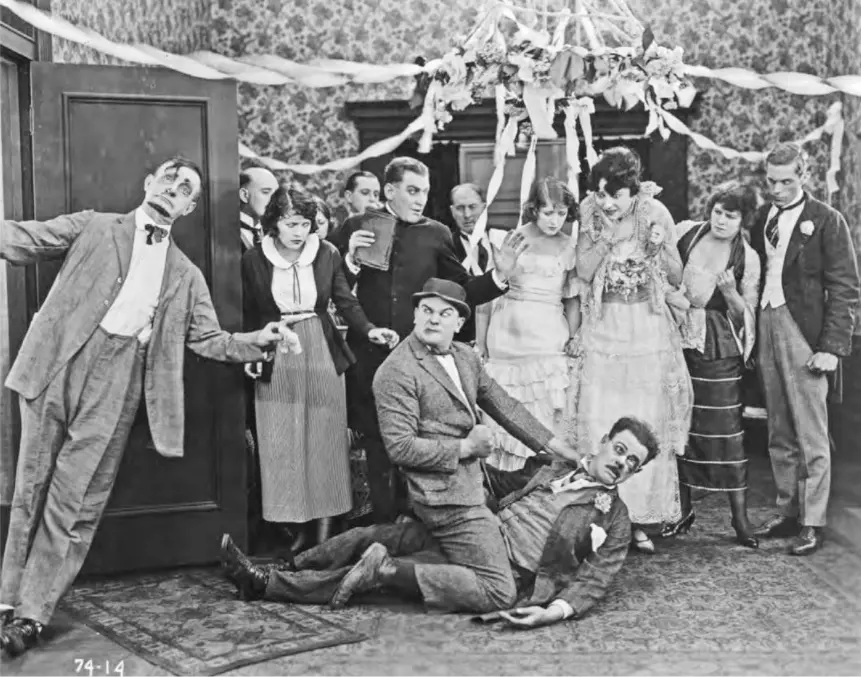
Eddie Gribbon, playing the abandoned stepson, storms the hotel like an avenging angel who’s misplaced his dossier. Never having laid eyes on his stepfather, he latches onto the nearest paternal silhouette—poor Charles Murray—and unleashes a barrage of haymakers that would make Anton the Terrible wince. The sequence is choreographed with Keystone precision: a flurry of bowler hats, a collapsing deckchair, a bellhop who pirouettes through the frame clutching a tray of martinis that somehow never spill. It’s slapstick, yes, but stained with real pathos; the boy’s fury is the scar tissue of abandonment.
When the mix-up untangles, Gribbon’s apology is so abashed it feels like watching a St. Bernard puppy attempt curtsey. He pivots from assailant to bloodhound, hunting Sterling through the hotel’s corridors with a single-mindedness that would shame a Pinkerton. Their final tussle—played out on a moonlit rowboat that’s slowly taking on water—becomes a baptismal reckoning: the con man drenched, his machinations capsized, the moral ledger momentarily balanced.
Let us, for a moment, redirect the spotlight. Charlotte Mineau’s widow is no dowager cliché; she wields her fan like a semaphore of consent, signaling interest or indifference with the flick of a wrist. When she discovers Sterling’s perfidy, her eyes frost over with a glacial dignity that recalls Becky Sharp’s come-uppance in Vanity Fair. Yet she never descends into vengeful shrew. Instead, she repurposes her outrage into a matronly shield, protecting not just her own heart but her daughter’s.
Marie Prevost, for her part, pirouettes through the film with a giddy elasticity that prefigures the flapper queens of the coming decade. Watch her in the scene where she mistakes George’s bouquet for a secret communiqué: she sniffs the roses, then darts behind a trellis to perform a miniature dance of anticipation, toes pointed like a Degas figurine. Her eventual acceptance of George’s proposal is less surrender than strategic alliance; she will marry, but on her own syntactical terms, thank you very much.
Intertitles here are haiku-like, terse yet perfumed. “He brought roses—she read riddles.” “A wife scorned is a warrant unsigned.” Each card arrives on-screen with a staccato flutter, punctuating the visual gags like rim-shots. Yet the film’s true grammar lies in its eyeline matches and match-cuts. De Sano repeatedly juxtaposes shots of father and son staring off-frame, each believing the other has betrayed him; the editing itself becomes the lie they inhabit.
Compare this to the parental misunderstandings in Father and the Boys, where generational strife is played for cozy sentiment. Here, the generational mirror is cracked, reflecting a more jagged anxiety: the fear that one’s offspring might outflank one in the very arena—romance—where the elder has staked his last claim to relevance.
The finale—a double wedding staged in the hotel’s rose bower—should feel cloying. Yet De Sano overlays the scene with four distinct emotional valences: the widow’s cautious radiance, Murray’s incredulous gratitude, George’s giddy relief, Marie’s triumphant smirk. The camera dollies back to reveal a stained-glass window casting prismatic shards across the congregation, as though the film itself has finally earned its Technicolor halo. Sterling, trussed up and delivered to the authorities, peers through the window bars in a rear-projected cameo, a reminder that every Eden has its serpent, now defanged.
In an era when dating apps monetize miscommunication, His Youthful Fancy plays like a proto-text: a cautionary fable about the semiotic chaos of desire. The identical bouquets are merely the MacGuffin; the real engine is the terror of being misread by those we cherish. Watch it today and you’ll swear the intertitles are subtitled tweets: “Seen 11:04 pm.” “Typing…” “Bouquet delivered—no response.”
Moreover, the film’s gender politics feel oddly prescient. The women engineer their own resolutions; the men merely flail until granted clemency. It’s a matriarchal corrective to the patriarchal slapstick of Children Not Wanted, where motherhood is punitive. Here, motherhood is a negotiable currency, and the widow’s wealth ensures her autonomy is never in hock to marital necessity.
The 2022 4K restoration by Eye Filmmuseum salvages nearly six minutes previously thought lost. The tinting—amber for interiors, cerulean for exteriors—follows archival notes discovered in a Dutch distribution ledger. The pipe organ score, composed by Daan van den Hurk, interpolates “La Rose” and “The Bells of St. Mary’s” into a ragtime fugue that underscores both the film’s whimsy and its latent melancholy.
His Youthful Fancy is not merely a curio for silent-cinephiles; it is a Rosetta Stone for understanding how desire, deceit, and domesticity intertwine across centuries. It prefigures the screwball chaos of Impossible Susan while retaining the pastoral lyricism of The Innocence of Lizette. Like a bouquet pressed between the pages of a forgotten novel, it retains both its fragrance and its thorns. Smell deeply—but mind the prick.
Where to watch: Streaming on EuropeaFilms with Dutch subtitles; Blu-ray from Kino Lorber due October.
Further reading: See my comparative essay on A Woman’s Power and the economics of widowhood in early cinema.
IMDb 6.1
1936
Community
Log in to comment.