DbcultAccessing Vault...
Cult Review
Senior Film Conservator
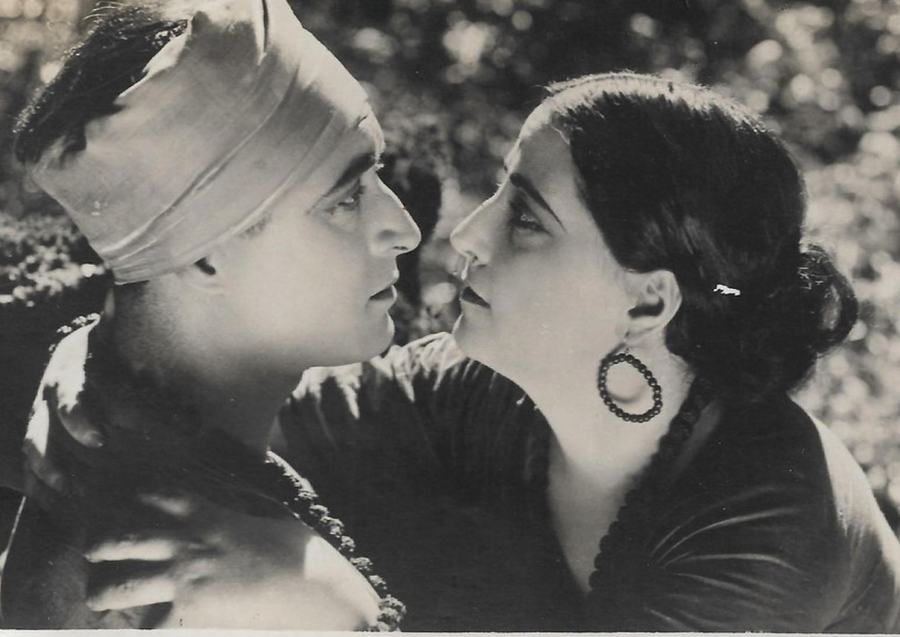
When the silver screen first welcomed Savitri Satyavan, it did so with the audacious claim of being India’s inaugural international co‑production. The collaboration stitched together Italian technical expertise—embodied by veterans like Bruto Castellani and Augusto Mastripietri—with an Indian mythic core, yielding a visual palimpsest that feels simultaneously exotic and familiar. The film’s narrative arc, drawn from the Vedic tale of Savitri and Satyavan, is rendered with a theatrical grandeur that recalls the silent epics of the 1920s while subtly nodding to the narrative economy of contemporary cinema.
Lydianne, portraying the celestial Savitri, commands the frame with an ethereal poise that borders on the statuesque. Her performance oscillates between regal composure and raw, visceral yearning, a duality that mirrors the character’s divine lineage and mortal love. Opposite her, Gianna Terribili‑Gonzales embodies Satyavan with a grounded humility, his every glance steeped in the quiet dignity of a man aware of his fleeting fate. The supporting ensemble—Rina De Liguoro, Mariani, and Angelo Ferrari—populate the court and forest with a texture that feels both operatic and intimate, each gesture calibrated to amplify the central love story’s stakes.
The screenplay, co‑authored by Ferdinando Paolieri, A. De Gubernatis, Aldo De Benedetti, and Giorgio Mannini, adheres to a three‑act progression that mirrors the myth’s tripartite journey: love’s blossoming, death’s incursion, and resurrection’s triumph. The first act luxuriates in the courtly splendor of Ashwapati’s palace, where Savitri’s divine aura is juxtaposed against Satyavan’s rustic simplicity. The second act plunges into the forest, where the fatal tree’s collapse serves as a visual metaphor for the inexorable hand of destiny. The final act, set in the shadowy precincts of Yama’s realm, employs chiaroscuro lighting to dramatize Savitri’s relentless pursuit of her beloved.
The tree that kills Satyavan is not merely a plot device; it functions as an elemental antagonist, embodying the ancient belief that nature itself can be an arbiter of karmic law. Its sudden fall, captured in a slow‑motion sequence, is accompanied by a low, resonant drumbeat that underscores the inevitability of mortality. This visual motif finds a faint echo in the German expressionist piece Das Spiel vom Tode, where nature’s forces similarly dictate human destiny.
Yama, portrayed with austere gravitas, is not a caricatured grim reaper but a bureaucratic deity bound by cosmic law. Savitri’s dialogues with him are a masterclass in rhetorical strategy; she invokes the sanctity of marital vows, the cyclical nature of dharma, and the compassion inherent in divine order. The script’s clever use of riddles—a nod to the ancient Sanskrit tradition of debate—elevates the confrontation from a simple plea to an intellectual duel. This exchange bears a structural resemblance to the courtroom monologues in The Clients of Aaron Green, where protagonists must outwit institutional authority.
Visually, the film is a study in contrast. The director’s palette alternates between the opulent golds of the palace—accentuated by the dark orange hue #C2410C—and the muted blues of the forest, rendered in the sea‑blue #0E7490. The climactic resurrection scene bathes Savitri in a radiant yellow #EAB308, symbolizing rebirth and divine favor. The original black background of the theatrical release is retained, making the white‑toned dialogue appear as luminous text against night‑sky darkness, a deliberate choice that heightens the mythic atmosphere. The film’s erotic undertones, though partially censored, were initially conceived to illustrate the raw, unfiltered passion between Savitri and Satyavan. The removed nudity, while controversial, was integral to the director’s vision of love as an unguarded, corporeal force. The surviving sensual imagery—subtle silhouettes, lingering glances, and the tactile brush of hands—still conveys an intimacy that feels both timeless and daring.
When placed alongside other cross‑cultural ventures such as Call a Cop or the European‑Asian hybrid Unexpected Places, Savitri Satyavan distinguishes itself through its fidelity to source material. While Go West, Young Woman adopts a comedic tone to explore cultural dislocation, Savitri Satyavan remains solemn, treating the myth as a vessel for exploring universal themes of love, loss, and agency.
The film’s reliance on silent‑era techniques—title cards, exaggerated gestures, and orchestral leitmotifs—coexists with moments of naturalistic dialogue, creating a hybrid language that feels both archaic and immediate. Lydianne’s silence during the forest’s ominous rustling speaks louder than any spoken word, while Gianna’s whispered confession to Savitri under a moonlit canopy captures the vulnerability of a man confronting his own mortality.
The musical score, composed by a then‑emerging maestro, weaves traditional Indian ragas with Western orchestral strings. The recurring motif—played on a lone sitar—accompanies Savitri’s solitary walks, evoking an auditory representation of her inner resolve. In the climactic courtroom, the music swells into a full brass chorus, underscoring the triumph of human will over divine decree.
Savitri Satyavan’s release marked a watershed moment for Indian cinema, demonstrating that indigenous narratives could be rendered with international production values without diluting cultural authenticity. Its success paved the way for later co‑productions that sought to bridge Eastern mythos with Western storytelling techniques. Moreover, the film sparked scholarly debate about the ethics of censorial alteration, especially regarding the excised erotic sequences, prompting a reevaluation of how mythic intimacy should be portrayed on screen.
In the final analysis, Savitri Satyavan stands as a testament to cinema’s capacity to transmute ancient scripture into a visceral, visual experience. Its meticulous craftsmanship—evident in every frame, line of dialogue, and musical phrase—offers a rich tapestry for both casual viewers and seasoned cinephiles. The film’s ability to balance mythic grandeur with intimate human emotion renders it an essential study for anyone interested in the evolution of cross‑cultural storytelling.
For those seeking a comparative exploration of mythic resilience, consider viewing The Butterfly, which similarly interrogates fate through a lyrical lens. Together, these works illuminate the enduring power of narrative to challenge mortality and celebrate the indomitable spirit of love.
IMDb —
1916
Community
Log in to comment.