DbcultAccessing Vault...
Cult Review
Senior Film Conservator
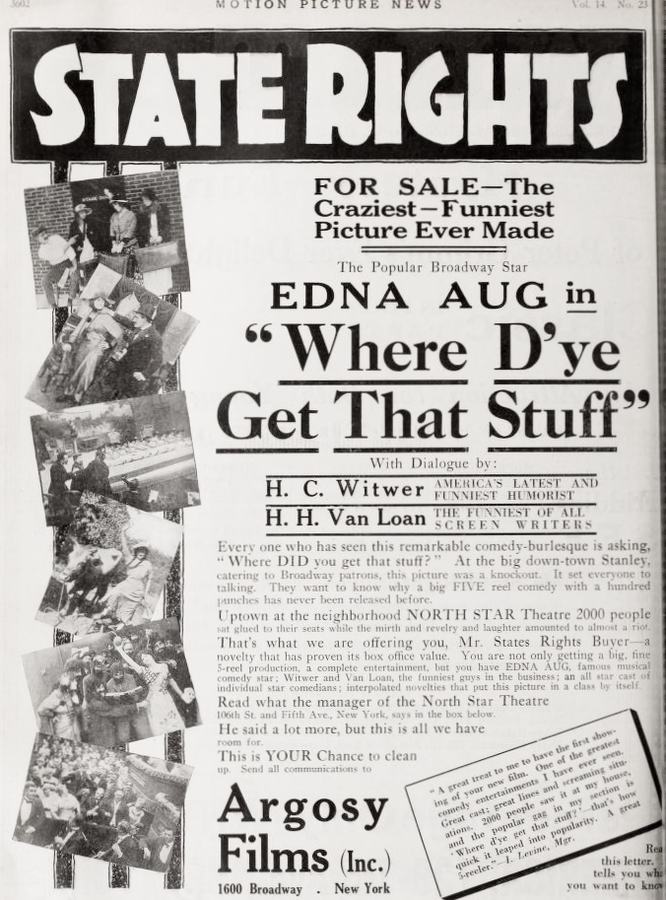
To approach the 1916 silent feature Where D’Ye Get That Stuff? is to step into a bygone era of narrative experimentation where the boundaries between slapstick comedy and harrowing social drama remained fluid. Set in the curiously named European town of Eczema, the film presents a landscape that feels both localized and allegorical. While the name might evoke a visceral reaction in modern audiences, in the context of early cinema, it serves as a bizarrely satirical backdrop for a story that is surprisingly grim. Unlike the frantic, kinetic energy found in contemporary Keystone Comedies, this production seeks a more grounded, albeit melodramatic, footing.
The film’s protagonist, Sallie, played with remarkable restraint by Edna Aug, represents the archetypal working-class woman of the period. Her position at a soda fountain—a quintessential hub of early 20th-century social life—places her at the intersection of various social strata. It is here that the mundane meets the macabre. The writers, H.H. Van Loan and H.C. Witwer, utilize this setting to anchor a plot that quickly spirals into a labyrinth of white slavery and homicide, reflecting the pervasive "white slave traffic" moral panic that gripped the global zeitgeist during this era.
Edna Aug’s performance is nothing short of a revelation. In an age where silent film acting often devolved into exaggerated gesticulation, Aug employs a subtlety that anticipates the naturalism of later decades. Her Sallie is not merely a victim of circumstance but a witness to the encroaching darkness of Eczema’s underworld. When compared to the ethereal or overtly stylized performances in films like The She Devil, Aug’s portrayal feels refreshingly tangible. She navigates the shift from the lighthearted banter of the soda shop to the claustrophobic dread of a murder plot with a seamless psychological transition.
The chemistry—or lack thereof—between Sallie and the corrupt forces of the town highlights the film's cynical view of authority. The police in Eczema are not the bumbling figures of farce, but rather entities that are either complicit or dangerously incompetent. This thematic cynicism aligns the film more closely with the gritty realism of Martin Eden than with the patriotic fervor seen in The Spirit of '17. Aug’s ability to convey this disillusionment through mere glances is a testament to her mastery of the silent medium.
The narrative architecture provided by H.H. Van Loan and H.C. Witwer is remarkably dense for a production of this vintage. Van Loan, known for his ability to construct intricate plots, finds a perfect partner in Witwer, whose background in short stories often infused his work with a punchy, rhythmic quality. Together, they eschew the linear simplicity often found in 1916 cinema, opting instead for a multi-threaded conflict that pits Sallie against a white slaver whose presence feels genuinely menacing. This is not the cartoonish villainy of a stage play but a predatory force that feels symptomatic of a larger systemic decay.
The inclusion of a murder plot adds a layer of noir-ish intrigue that predates the formalization of the genre. While films like The Jury of Fate explored destiny and consequence through a more mystical lens, Where D’Ye Get That Stuff? keeps its feet firmly planted in the mud and grime of its fictional town. The dialogue cards, likely influenced by Witwer’s sharp wit, provide a linguistic texture that balances the visual grimness with a certain street-smart cynicism.
Visually, the film employs a chiaroscuro-lite approach, using the limitations of early film stock to create a sense of pervasive shadow. The soda fountain, initially presented as a bright haven of consumerist joy, becomes increasingly shadowed as the slaver’s influence grows. This visual storytelling is reminiscent of the atmospheric tension in The Street of Seven Stars, though it trades that film’s romanticism for a more visceral sense of peril. The camera work, while static by modern standards, utilizes the frame to trap Sallie, emphasizing her isolation within the community of Eczema.
Furthermore, the pacing of the film is deliberate. It doesn't rush toward its climax but allows the tension to simmer, much like the slow-burn narratives of The Catspaw. This patience allows the audience to fully inhabit Sallie’s world, making the eventual eruption of violence and the resolution of the murder plot feel earned rather than manufactured. The film understands that for the stakes to matter, the environment must feel lived-in, no matter how strangely named it may be.
To fully appreciate Where D’Ye Get That Stuff?, one must consider the year of its release. In 1916, the world was embroiled in the Great War, a fact that influenced every facet of cultural production. While some films like On the Firing Line with the Germans or In Defense of a Nation dealt directly with the conflict, others used domestic stories to explore themes of internal rot and the fragility of safety. Eczema, though European in setting, serves as a surrogate for any town where the marginalized are exploited by those in power.
The "white slavery" narrative was a common trope used to express anxieties about urbanization and the changing role of women in the workforce. By placing Sallie in a public-facing job at a soda fountain, the film comments on the vulnerability of the "new woman." She is accessible, visible, and therefore, in the logic of the era’s melodrama, a target. This thematic depth elevates the film above mere exploitation, aligning it with the more serious-minded explorations of human nature found in An Odyssey of the North.
Reflecting on the film’s title, one might find it an odd choice for such a dark story. It suggests a flippancy that the content largely rejects. Perhaps it is a meta-commentary on the origins of the town’s corruption or a colloquialism that has lost its specific cultural resonance over the century. Regardless, the film remains a fascinating artifact. It lacks the overt sentimentality of The Sunbeam or the straightforward heroism of Atta Boy's Last Race, opting instead for a more complex, ambiguous moral landscape.
In the broader canon of silent cinema, Where D’Ye Get That Stuff? stands as a precursor to the gritty crime dramas that would eventually dominate the sound era. It shares a certain DNA with European psychological thrillers like De lefvande dödas klubb, focusing on the hidden lives and secret sins of a seemingly quiet community. Even when compared to the lighter fare of The Lost Bridegroom, this film’s commitment to its darker themes is palpable.
While the director’s name is often overshadowed by the writing duo of Van Loan and Witwer, the visual cohesion of the film suggests a singular vision. The use of location shooting in Eczema (or its California-based approximation) provides a texture that studio-bound productions often lack. The dusty streets and the cluttered interior of the soda fountain create a sense of place that is essential for the film’s tension. It is a world where one can almost smell the ozone and the syrup, a sensory detail that is rare in the silent era.
The editing, too, deserves mention. The cross-cutting between Sallie’s work life and the clandestine meetings of the murder conspirators creates a rhythmic urgency. This technique, while popularized by D.W. Griffith, is used here with a more surgical precision, focusing on character psychology rather than just grand spectacle. It is a more intimate form of suspense, one that would be echoed in the later works of the 1920s but is already present here in nascent form. The film doesn't need the overt patriotism of American Maid to find its soul; it finds it in the quiet, desperate struggle of a woman trying to navigate a world that has decided she is expendable.
Where D’Ye Get That Stuff? is a film that defies easy categorization. It is a social document, a crime thriller, and a character study all rolled into one. Edna Aug’s performance remains the heart of the piece, a beacon of human complexity in a narrative that could have easily descended into caricature. The town of Eczema, with its strange name and darker secrets, serves as a reminder that the history of cinema is filled with these hidden gems—films that pushed the boundaries of what was possible in visual storytelling long before the advent of synchronized sound.
For the modern viewer, the film offers a window into the anxieties of 1916, presented with a level of craft that remains impressive. It is a testament to the enduring power of the silent image and the ability of a well-told story to transcend the limitations of its time. Whether viewed as a precursor to noir or as a unique example of early social realism, Where D’Ye Get That Stuff? demands to be remembered, not just for its title, but for the visceral, uncompromising story it tells.
IMDb 6.4
1932
Community
Log in to comment.