DbcultAccessing Vault...
Cult Review
Senior Film Conservator
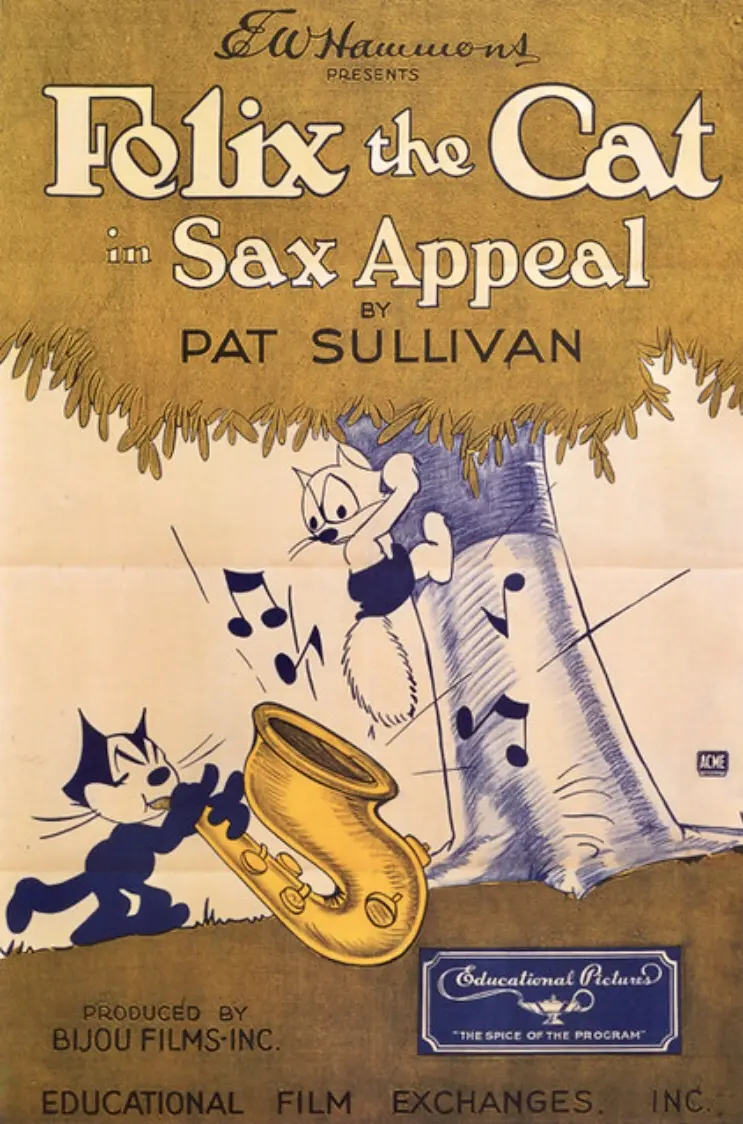
Is 'Sax Appeal' worth watching today? Short answer: yes, but with significant caveats. This early Felix the Cat short, a product of Otto Messmer's fertile imagination, offers a fascinating, if frenetic, glimpse into the foundational years of animated storytelling.
It’s a historical artifact that demands contextual understanding, rather than a purely entertaining diversion for modern audiences. This film is unequivocally for animation historians, cinephiles interested in the roots of visual comedy, and those with a high tolerance for repetitive, almost experimental, humor. It is decidedly NOT for viewers seeking intricate plots, sophisticated character development, or high-fidelity visuals.
Otto Messmer’s 'Sax Appeal' stands as a testament to the raw, unbridled creativity that defined the silent era of animation. Released at a time when the medium itself was still finding its voice – or, in this case, its cacophony – the short encapsulates the anarchic spirit that Felix the Cat so famously embodied. It’s a film that doesn't just tell a story; it performs a visceral experiment in comedic exasperation, pushing its iconic protagonist to the very edge of his animated sanity.
The brilliance of Messmer's work often lay in its simplicity, a directness that allowed visual gags to land with an almost primal force. 'Sax Appeal' is no exception, crafting a narrative arc built entirely on the escalating torment of its hero. This isn't a story of grand adventure or moral quandaries; it's a relentless, singular focus on a universal annoyance amplified to absurd proportions. The film works as a pure distillation of comedic frustration, a concept that still resonates, albeit with a very different aesthetic, in contemporary animation.
This film works because... it masterfully employs repetition and visual escalation to build comedic tension, showcasing Felix the Cat's iconic expressiveness and Messmer's foundational understanding of animated character psychology.
This film fails because... its singular, relentless gag can become tiresome for modern viewers unaccustomed to the pacing and stylistic conventions of silent, early-era animation, lacking narrative depth beyond its central premise.
You should watch it if... you are a student of animation history, a Felix the Cat enthusiast, or someone who appreciates the raw, experimental humor and visual ingenuity of the silent film era, understanding its historical context is key to its appreciation.
The plot of 'Sax Appeal' is disarmingly simple, almost deceptively so. Felix the Cat, a creature typically defined by his unflappable resourcefulness, finds himself utterly undone by the ceaseless, grating sound of a saxophone. This isn't just background noise; it's an active, invasive presence that invades his domestic peace. Messmer doesn't waste a single frame on preamble. We are thrust immediately into Felix’s sonic hell, a choice that establishes the film's frantic, almost claustrophobic tone from its opening moments.
The pacing is a relentless march towards madness. Each attempt by Felix to escape or neutralize the source of the noise is met with an even more absurd, more inescapable manifestation of the saxophone. The radio, usually a source of diverse entertainment, becomes an echo chamber for the very sound he despises. This gag, while primitive, is remarkably effective in conveying Felix's mounting desperation. It’s a cruel joke, played out with a straight face, and it’s a testament to Messmer's comedic timing that it still elicits a wince, even today.
The destruction of the radio is a pivotal moment, a burst of cathartic violence that momentarily satisfies, only to be immediately undercut. Felix’s subsequent decision to bury the offending instrument feels like a desperate, almost ritualistic act of exorcism. But in Messmer's world, the universe conspires against Felix. The emergence of a musically inclined mole, unearthing the sax and continuing the torment, is a stroke of darkly comedic genius. It transforms the inanimate object into a sentient, almost malevolent entity, an inescapable force of nature. This escalation of absurdity is where 'Sax Appeal' truly shines, demonstrating a sophisticated understanding of comedic rhythm, even within the confines of a silent, black-and-white medium.
Messmer's direction in 'Sax Appeal' is characterized by its kinetic energy and bold, graphic simplicity. The animation, while rudimentary by modern standards, possesses an undeniable charm and efficiency. Felix himself is a masterclass in minimalist character design. His large, expressive eyes and malleable body communicate volumes with subtle shifts. When the sax music begins, Felix's ears flatten, his tail droops, and his entire posture sags under the weight of the invisible sound. These visual cues are immediate, universal, and require no intertitles to convey his suffering.
Consider the scene where Felix attempts to silence the radio. The frantic scribbles and lines that emanate from the radio speaker visually represent the offending sound, a brilliant workaround for the limitations of silent film. When Felix smashes the radio, the resulting explosion of fragmented lines is both violent and comically abstract. This is not realistic animation; it's symbolic, a visual shorthand for chaos and destruction. Messmer understood that animation's power lay not in replicating reality, but in distorting it for expressive effect.
The visual gag of the mole playing the saxophone is another highlight. The unexpected twist, the sheer audacity of a subterranean creature continuing the torment, elevates the film from mere slapstick to a kind of surrealist nightmare. The mole's tiny, determined performance, contrasted with Felix's wide-eyed horror, creates a dynamic that is both hilarious and unsettling. This moment, in particular, showcases Messmer's willingness to embrace the truly bizarre, pushing the boundaries of what was considered acceptable or even comprehensible in early cartoons. It’s a bizarre, unsettling piece, and utterly captivating for its audacity.
The 'cinematography' of 'Sax Appeal' is, of course, a misnomer in the traditional sense, but the principles of visual storytelling are very much at play. Messmer uses static frames for stability, but within those frames, Felix's movements are fluid and dynamic. The camera remains largely fixed, allowing the animation itself to dictate the visual rhythm. The focus is always on Felix's reactions, his escalating frustration, creating an intimate, if uncomfortable, connection with the character. The stark black-and-white palette also contributes to the film's stark, almost expressionistic portrayal of distress.
While 'Sax Appeal' doesn't feature traditional 'acting,' Otto Messmer's genius lies in his ability to imbue Felix the Cat with a distinct, relatable personality through animation alone. Felix, voiced in later years but silent here, 'performs' through his exaggerated expressions, his frantic movements, and his increasingly desperate problem-solving. He is the Everyman driven mad by an inescapable annoyance, a character archetype that transcends the limitations of his medium.
Felix's transformation from mildly annoyed to utterly unhinged is the core of the film's comedic power. His initial attempts to ignore the noise, followed by his more aggressive actions, mirror a very human response to irritation. The sheer physicality of his frustration, the way he literally twists and contorts under the auditory assault, is a testament to Messmer's skill. He makes us believe in Felix's suffering, even as we laugh at its extremity.
This focus on character reaction over complex narrative is a hallmark of early animation. Unlike, say, the more character-driven narratives emerging in later decades, Messmer's Felix shorts often centered on a single, compelling gag or situation that allowed Felix to showcase his personality through action. Compare it to other contemporary shorts like Hot Dog or The Luck o' the Foolish, which often relied on broader, less nuanced characterizations. Felix, even in his simplest forms, always felt more alive.
Messmer's genius wasn't in subtlety, but in relentless, almost cruel, repetition. He understood that sometimes, the most effective humor comes from pushing a simple premise to its absolute breaking point, and then beyond. This film is a prime example of that philosophy in action. It works. But it’s flawed.
For the casual viewer seeking modern entertainment, 'Sax Appeal' might feel like a relic. Its humor is repetitive. Its animation is primitive. The plot is thin. It lacks sound and color.
However, for those with an appreciation for film history and the pioneering efforts of early animators, it is undeniably worth watching. It offers a direct window into the creative mind of Otto Messmer and the foundational elements of character animation. It’s a historical document of immense value. It demonstrates how powerful simple visual gags can be. It showcases Felix the Cat at his most iconic. It’s a masterclass in silent comedic timing.
It’s a foundational text for understanding how cartoons evolved from simple moving drawings into sophisticated narrative forms. You'll gain insight into the techniques and storytelling approaches that laid the groundwork for everything that followed, from Disney to Looney Tunes. It’s a short, accessible piece of history that, despite its age, still manages to provoke laughter and a profound sense of animated empathy for its tormented feline hero.
'Sax Appeal' is more than just a cartoon; it's a vibrant, if noisy, piece of cinematic archaeology. It’s a film that demands to be viewed through the lens of its era, not as a direct competitor to today’s animated blockbusters, but as a crucial progenitor. Otto Messmer, with his inimitable Felix the Cat, crafted a short that is both absurdly funny and surprisingly unsettling, a testament to the power of a simple idea executed with relentless conviction.
While its repetitive nature might test the patience of some, its historical significance and its sheer, unadulterated commitment to its singular gag make it an essential watch for anyone serious about understanding the evolution of animation. It’s a raw, energetic burst of early 20th-century humor, a silent scream against the tyranny of noise, and a fascinating look at how foundational visual storytelling could be, even without the benefit of sound. 'Sax Appeal' doesn't just hold up; it stands as a loud, proud, and profoundly influential piece of animated history. Give it a watch, but perhaps keep the volume down on your own saxophone.
IMDb —
1926
Community
Log in to comment.