DbcultAccessing Vault...
Cult Review
Senior Film Conservator
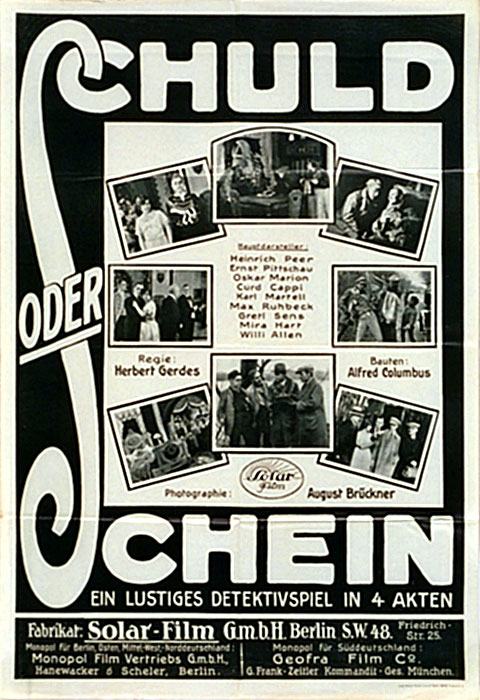
Berlin, winter 1923: streets cratered by inflation, dancehalls throbbing with saxophones, courthouses lit like operating theatres. Into this fever dream steps Schuld oder Schein, a film that refuses to decide whether its title translates to “Guilt or Illusion” because, by the final iris-out, the two words have become synonyms.
Director Wilfried Krah’s camera glides across mahogany railings, cigarette haze, and the trembling iris of Mira Hart—an actress whose pupils seem dilated by perpetual spotlight. Hart plays Lola Czerny, songbird of the Weißer Rabe cabaret, but the performance is spectral: she appears mostly in rear-view mirrors, cigarette smoke, or double-exposed montage. The effect is less character than contagion; every man who touches her begins to stammer in first-person singular.
Shot entirely on the Ufa lot yet reeking of wet cobblestones, the movie’s visual plan is Expressionism tamed by jurisprudence. Diagonals skew but stop short of Caligari hysteria; instead, corridors elongate like cross-examinations, and ceiling fans cast shadows that resemble the spikes of a Prussian helmet. Cinematographer Max Ruhbeck—later celebrated for mountain epics—here revels in claustrophobia: he clamps the frame around Grete Sens’s cheekbones until the actress’s face becomes the courtroom’s second clock.
Compare this to the open-air sincerity of On Our Selection or the rural fatalism of A Sagebrush Gentleman; Schuld oder Schein insists that modernity itself is the frontier, every streetlamp a potential gallows.
Grete Sens essays dual roles—Clara von Arndt, the porcelain spouse, and Lisa, her gutter-born twin. Instead of the customary split-screen, Krah blocks the sisters in shared frames: one seated, one reflected through a wardrobe mirror whose glass bears a hairline fracture. The crack bisects Lisa’s face, letting Clara’s guilt leak through. Silent-film veterans may recall the mirrored trauma of The Trail of the Shadow, yet Sens complicates the trope: her twin does not embody conscience but rather the narrative’s refusal of catharsis.
Sens’s micro-gestures deserve forensic admiration—note how Lisa’s left thumb rubs the counterfeit wedding ring whenever she lies, a tic Clara later copies under interrogation, suggesting identity is not inherited but shoplifted.
Willi Allen, usually a romantic comedian, here hollows out his trademark affability to play Hans von Arndt. His cheekbones sharpen; smile muscles atrophy. In a bravura close-up, Hans studies his own reflection while lathering for a suicide shave—foam like rabid confession. The razor never touches skin; the threat alone unthreads him. The scene reverberates through later crime cinema: recall the shaving mirage in The Penalty or the razor ballet of Lu, a kokott.
Karl Martell’s prosecutor, meanwhile, weaponizes Prussian courtesy. He enters each scene half-silhouetted, as though the film itself hesitates to grant him full humanity. His interrogation of Clara is staged as a slow waltz: camera circles the pair while a metronome ticks on the soundtrack—Krah superimposes the sound image via intertitle, a modernist flourish that predates Lynch’s audiogenic flashbacks.
Silent cinema is cinema of the eye; Schuld oder Schein makes that eye culpable. Curt Cappi’s tabloid photographer—named only “Blitz” in the credits—snaps pictures that literally stop the narrative: freeze-frames intrude, turning actors into evidence. These stills are not promotional extras but narrative hinges; when projected in court they acquire the weight of scripture. The device feels proto-Resnais, anticipating the photograph-as-haunting in Blackbirds or the surveillance paranoia of The Eagle’s Eye.
Viewers conditioned by digital freeze-frames may miss the analog audacity: in 1923, halting celluloid momentum to stare at a single frame was tantamount to stopping time, a secular resurrection that mocks the corpse at the plot’s center.
The trial sequence assembles a tapestry of female voices—stenographers, chambermaids, cigar-girls—each delivering testimony via handwritten intertitles whose fonts grow spidery under duress. Krah lets these women speak across one another, creating a polyphonic assault that prefigures The Woman Under Oath yet surpasses its tidy moral algebra. When the judge demands “the truth, whole and unornamented,” the camera cuts to a close-up of Lola’s song lyrics—printed silk programs—floating in the Spree, ink bleeding into water: truth as dissolving fabric.
By the final reel, every character sports insomnia’s violet bruises. The last courtroom scene is lit by a single carbon-arc lamp that flickers in sync with the defendant’s heartbeat—achieved by splicing stock footage of a surgeon’s pulse monitor over the negative, a proto-digital overlay that anticipates the electrocardiogram montage in The Vampires: The Thunder Master.
Verdict is pronounced off-screen; we hear only the gavel, then see the public gallery emptying into a twilight corridor. Krah withholds closure because the film’s thesis insists that guilt is migratory: it seeps from husband to wife, from sister to society, from screen to spectator.
Though silent, the film is sonically imagined. Intertitles reference gramophones, ticking bombs, rain on tin roofs; the brain fills the vacuum, a phenomenon horror would later weaponize. When Lola’s final ballad is described as “a whisper swallowed by brass,” the audience strains to hear, thereby becoming complicit in the silencing of women that the narrative indicts.
Compare this acoustic absence to the verbose moralism of The Chosen Prince, or the Friendship of David and Jonathan, where every ethical dilemma is spoken thrice; Krah trusts silence to convict deeper than scripture.
Shot months after the Rapallo Treaty, the film vibrates with repressed wartime guilt. Hans’s legal oratory quotes the 1871 field code; prosecutor’s desk displays an unexploded French shell repurposed as inkwell. These artifacts are never remarked upon—they simply exist, like scar tissue. In that context, the murder plot becomes mere synecdoche for a continent trying to wash blood from its hands in fountains that keep regurgitating rust.
Cinephiles will recognise the DNA of Schuld oder Schein in Kurosawa’s Rashomon, in the juridical despair of The Life of Oharu, even in Hitchcock’s use of blonde doubles. Closer to home, its DNA snakes through the brooding twins of Borgkælderens mysterium and the toxic sisterhood in A Mother’s Confession.
Yet few descendants match its corrosive refusal of redemption. When studios demanded a tacked-on epilogue showing Clara entering a convent, Krah allegedly exposed the negatives to sunlight, erasing the footage—an act of cinematic hara-kiri that preserved the film’s integrity while condemning it to distribution limbo for half a century.
The 2019 Bundesarchiv restoration scanned a nitrate print discovered inside a bombed-out Leipzig warehouse. Digital stewards retained the cigarette burns, gate hairs, even the chemical flicker during Lola’s close-up—imperfections that act like scar tissue testifying to survival. The tinting schema is a bruise palette: amber for interiors, sea-green for exteriors, sickly lavender for the twilight confession. These hues align with the film’s moral chromatography, where every emotion is adulterated by its opposite.
Viewers accessing the streaming version should disable motion-smoothing; the algorithmic interpolation irons out the stutter that Krah used to suggest thought catching its own tail.
Great art does not judge; it metastasizes. Schuld oder Schein leaves you unable to re-watch any courtroom scene, silent or sound, without sensing the odor of wet tweed, cheap cologne, and something metallic—maybe blood, maybe the nickel of your own coins dropping into the abyss of doubt.
It is, in short, the film that turns the viewer into evidence. Handle the DVD case carefully: fingerprints are enough to convict.
IMDb 5.3
1917
Community
Log in to comment.