DbcultAccessing Vault...
Cult Review
Senior Film Conservator
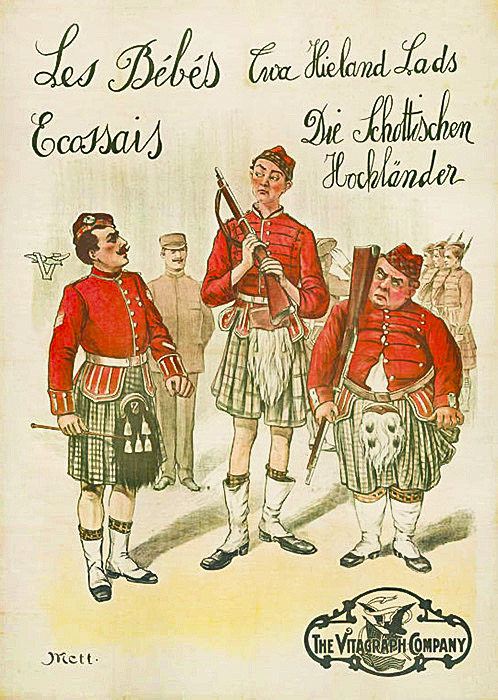
A celluloid ceilidh of innocence pick-pocketed by the big city
Charles Brown’s 1914 one-reeler arrives like a moonlit strathspey played on a nickelodeon—at once jaunty and wistful, nostalgic for a homeland that never quite existed, yet razor-sharp in its lampoon of metropolitan rapacity. The film, brisk even by Mutoscope standards, compresses an immigrant epic into a brisk twelve minutes, trading ethnographic sincerity for carnival exaggeration. What emerges is less a narrative than a feverish postcard: tartan against tarmac, bagpipe drones swallowed by the El’s screech.
Templar Saxe’s Hugh carries the wide-eyed bewilderment of a stag suddenly spotlighted on Broadway; his gait is half gaiter, half gasp. Opposite him, Hughie Mack’s Willie embodies the slyer archetype—eyes narrowed like a gambler counting cards, yet still soft enough to be fleeced twice in one afternoon. Their chemistry, calibrated to the pantomime register demanded by intertitles, nonetheless crackles with improvisational asides: a double-take here, a conspiratorial elbow there, gestures that pirouette beyond the edges of the iris-in.
The city itself is the third protagonist, rendered through matte paintings that billow like wet watercolors and location shots prowling around Herald Square. Brown’s camera, tethered to a hand-cranked whimsy, lingers on elevated shadows that devour the frame—an Expressionist premonition amid Keystone slapstick. When the con man glides into view, his top-hat silhouette occludes the sun, turning the street into a proscenium of moral peril. The ensuing banquet is a bravura set piece: oysters demolished, champagne cascades, the camera dollying back to reveal towers of plates teetering like capitalist excess itself. The moment Hugh’s last coin clinks onto the silver, the soundtrack—imagined, of course—seems to echo with the hollow clang of a church bell tolling across Loch Katrine.
Yet the film’s sartorial sleight-of-hand is where its politics truly hum. Hugh’s divestment of his trousers functions as both humiliation and liberation; the pawnshop transaction becomes a secular baptism. By surrendering the garment most associated with assimilation, he sheds the immigrant’s burden of camouflage. Later, when he strides onto the platform clad in full Highland regalia, the kilt ceases to be folksy ornament and transmutes into a banner of defiant self-sovereignty. In 1914, amid debates over Scottish Home Rule and waves of émigrés refashioning themselves in America, the image lands like a gauntlet hurled at the feet of monoculturalism.
Borrowing the chase grammar honed by Behind the Scenes, Brown orchestrates a Keystone-style scrum that barrels from newsstand to Caledonian clubhouse, each cut a syncopated snare beat. But unlike Sennett’s anarchic mobs, this crowd is stratified: society matrons clutching poodles, street urchins pirouetting for pennies, a beat cop whose nightstick doubles as baton for an unseen brass band. The mise-en-scène teems with micro-narratives; every derby hat hides a miniature morality play.
Equally telling is the village’s response: women herded indoors, shutters bolted, as if the mere anticipation of trouser-less Hugh might unmoor the social fabric. The film slyly critiques this patriarchal panic; the locked matrons become prisoners of their own moral scaffolding. When they finally emerge, rushing toward Hugh with aprons flapping like flags of truce, their jubilation is both release and reclamation—a matriarchal reabsorption of the prodigal.
One cannot ignore the film’s flirtation with tartanry—that commercially distilled iconography of shortbread tins and Royal Mile postcards. Yet Brown complicates the kitsch. By foregrounding the Caledonian Club as a refuge, he nods to diaspora networks that weaponized nostalgia for mutual aid. In the wake of Highland Clearances, such clubs funded schools, churches, and political agitation; thus, Hugh’s ascent from street hawker to club steward reads less as escapism than as allegory for ethnic solidarity underwriting social mobility.
Compare Hugh’s trajectory with the remittance wastrel in The Remittance Man, whose allowance doubles as leash; both migrants confront the empire’s periphery at the empire’s core, yet Hugh engineers agency through wardrobe subversion rather than inherited cash. Or juxtapose the letter-home motif with A Change of Heart, where correspondence triggers equally seismic domestic upheaval. Brown, aware of such narrative rhymes, keeps his tone puckish rather than tragic, ensuring the film’s aftertaste is honeyed, not bitter.
Surviving prints—housed in the BFI’s vault and Rochester’s Dryden Theatre—bear the scars of nitrate shrinkage: emulsion spidering like frost across heather. Yet these blemishes amplify authenticity; every flicker feels like peat smoke curling off a distant fire. Contemporary accompanists frequently score the picture with fiddle reels overlaid by city-field recordings, a sonic palimpsest that mirrors the film’s cultural layering. In 2019, the Pordenone Silent Festival screened a 2K scan accompanied by a live trio who segued from "The Bonnie Banks o’ Loch Lomond" to stride-piano, encapsulating the film’s temporal shuttle.
Ultimately, Scotland Forever endures because it stages identity as performance yet refuses to mock the performer. Hugh’s kilted crescendo is no mere sartorial punchline; it is reclamation, a refusal to translate himself into the lingua franca of Anglo-conformity. In an era when immigration debates still weaponize dress codes—from hoodies to hijabs—the film’s riposte feels startlingly contemporary: the garment does not besmirch the citizen; rather, the citizen ennobles the garment. As the end title card iris-in closes, one senses Willie’s epiphany radiating outward, a pebble dropped in Loch Ness sending rings across a century. We, the spectators, are left to inventory our own wardrobes—and wonder which threads we’ve donned merely to be let through the gate.
Verdict: a compact masterpiece whose pleats of humor, politics, and poignancy continue to swing with every viewing—five sporrans out of five.
IMDb 3.9
1921
Community
Log in to comment.