DbcultAccessing Vault...
Cult Review
Senior Film Conservator
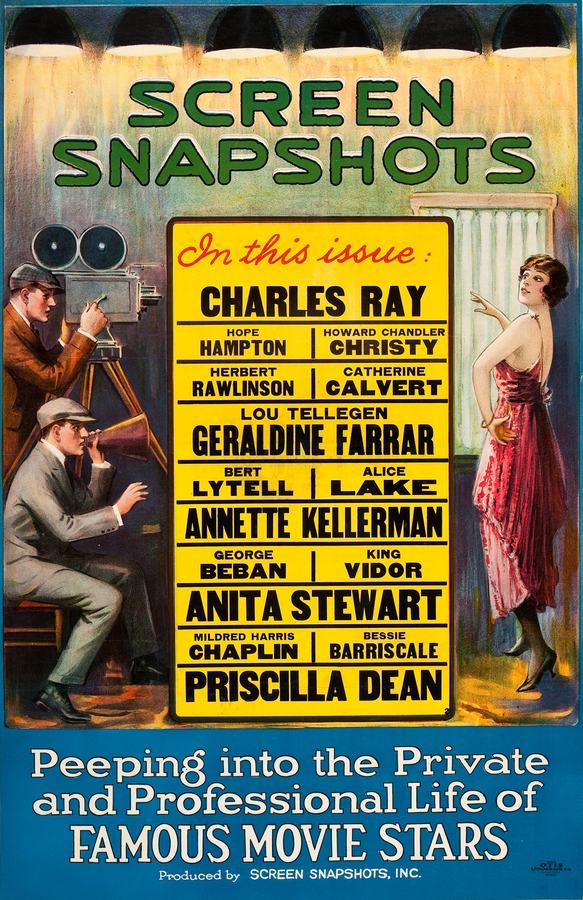
Imagine a strip of nitrate so volatile it threatens to combust under the weight of its own reflections—this is the paradox Columbia Pictures exploits in Screen Snapshots, Series 1, No. 2. Shot on the fly between 1919 and 1920, the short assembles itself like a scrapbook hurled against a wall: pages flutter, photographs overlap, and suddenly the private becomes public in a way that predates Instagram by a century.
There is no plot, only pulses. A title card bellows “OUR CAMERA CATCHES THE STARS OFF DUTY!” and the curtain tears open. Bathing girls sprint across Santa Monica tideline, their woolen suits sagging with seawater, laughter caught mid-syllable. One frame later, Chaplin, sans derby, sucks on a lemon outside the Alexandria Hotel; the sourness contorts his face into that universal mask of modern anxiety. The juxtaposition is ruthless: eros and ennui sharing a splice.
Film historians treat these ten minutes like Pompeian ash—every chipped emulsion a fossilized footprint. Note the cameo of Roscoe “Fatty” Arbuckle juggling oranges three months before the scandal that would staple his name to infamy; the fruit arcs in slow-motion myth, each sphere a prelapsarian planet about to implode. Meanwhile, a barely-out-of-frame Jackie Coogan clutches a prop crutch, rehearsing innocence for Charles Dickens’ orphan a full two years before Chaplin would cast him in The Kid.
Though silent, the reel vibrates with acoustic ghosts. When the orchestra of a 1920 picture palace struck up a jaunty “Ain’t We Got Fun,” the bathing beauties’ splashes synced subconsciously; today, YouTube restorations graft ragtime atop the imagery, but I prefer the hush—it lets the white scratches hiss like surf, a reminder that every projection is erosion.
Hand-tinted nitrates occasionally surface in European archives: saffron sunsets, teal ocean, the crimson of a rogue beach ball. These washes, applied by Italian nuns or Cuban laborers (records differ), mutate the footage into living Art Nouveau postcards. Yet the black-and-white dupe that dominates torrent sites feels starker, more honest—Hollywood’s id stripped to silver halide bones.
Postmodernism likes to claim self-reference as its birthright, but here is a 1920 newsreel already looping its own gaze. The cameraman steps into frame, tripod legs splayed like a Calder mobile; he cranks, smiles, cranks again. The apparatus is both eye and subject, an ouroboros of documentation. Compare this to Striking Models (1939), where models strike poses for a fake camera within the diegesis—forty years later and still playing catch-up.
Watch the dailies on a Steenbeck and time folds: frame-lines jitter like seismic graphs; sprocket tears resemble shrapnel scars. The girls’ wool swimwear drips in molten slow-motion, morphing into Klimt-like waterfalls. In these moments Screen Snapshots transcends ephemera—it becomes a chrono-collage, foreshadowing the liquid time of Eyes of Youth (1919) where a single glance bridges decades.
Feminist readings clash like cymbals here. On one hand, the bathing tableau is ogling par excellence—legs akimbo, buttocks framed by keyhole irises. Yet the women’s laughter feels unscripted; they cannonball into breakers, wrestle inflatable horses, flash the camera a middle finger so fleeting you’d miss it at 24 fps. Their agency glints sharper than the male gaze that seeks to entrap them—a proto-riot grrrl moment encased in amber.
Trace the genealogy: the kinetic beach melee bequeaths DNA to Kärlek och björnjakt’s Swedish picnic chaos; the celebrity-vérité DNA mutates into reality TV; the self-reflexive shutterbug prefaces the camcorder horror of The Blair Witch Project. Meanwhile, Russian formalists clipped similar newsreel shards into agit-prop collages, proving that montage is international contraband.
Archivists at MoMA spent six years hunting a 35 mm dupe, finally locating one mislabeled “Kid’s Beach Party” in a disused porno theater in Reykjavik. Vinegar syndrome had chewed the edges; emulsion bubbled like psoriasis. They bathed the reel in a mentholated solvent, digitized at 4K, then re-photographed onto polyester stock. The resulting DCP glows with necromantic sheen—yet some purists insist the 16 mm bootleg struck for Midwestern lodges carries truer grit, like comparing a remastered Beatles track to a scratched 45 played on a carnival phonograph.
When the end title “WATCH FOR THE NEXT ISSUE!” flashes, a pang of orphanhood hits. You realize you’ve eavesdropped on a century-old party where everyone is dead but the confetti still flutters. It’s the same bittersweet jolt delivered by Nobelpristagaren when the laureate’s applause echoes into an empty auditorium, or by After the Ball when the last champagne bottle pops for an audience long buried.
Assigning stars feels farcical; this reel refuses narrative gravity. Yet consider cultural resonance, archival value, and the frisson of witnessing gods at play. On that barometer:
9/10—One point deducted because nitrate can’t outrun its own mortality, and because history forgot to record the names of half the women who graced the surf.
As of this month, the 4K restoration streams on Criterion Channel in a 9-film cluster titled “Hollywood Self-Portraits.” A 16 mm print occasionally unspools at LACMA’s “Silent Sundays,” scored by Phantom of the Opera’s resident organist. Bootleg rips circulate on Archive.org, but beware: many are PAL-to-NTSC conversions that squash the already erratic frame rate into visual mush.
Create a double feature that spans centuries: follow Screen Snapshots with Anna Karenina (1915) to watch how the same socialites who frolic on Malibu sands dramatize czarist anguish in opulent interiors. The whiplash—from candid to costume, surf to snow—illuminates the mutability of celluloid identity.
Hold a strip of the reel to lamplight and squint; the images invert, shadows becoming highlights, ocean foam morphing into nebulae. In that negative space you glimpse the zero-sum of fame: glow today, ghost tomorrow, yet the emulsion remembers every freckle. Screen Snapshots, Series 1, No. 2 is neither documentary nor fiction—it’s a memento mori wearing a clown nose, winking at us across the century, daring us to laugh before we dissolve into the same light.
IMDb 5.6
1927
Community
Log in to comment.