DbcultAccessing Vault...
Cult Review
Senior Film Conservator
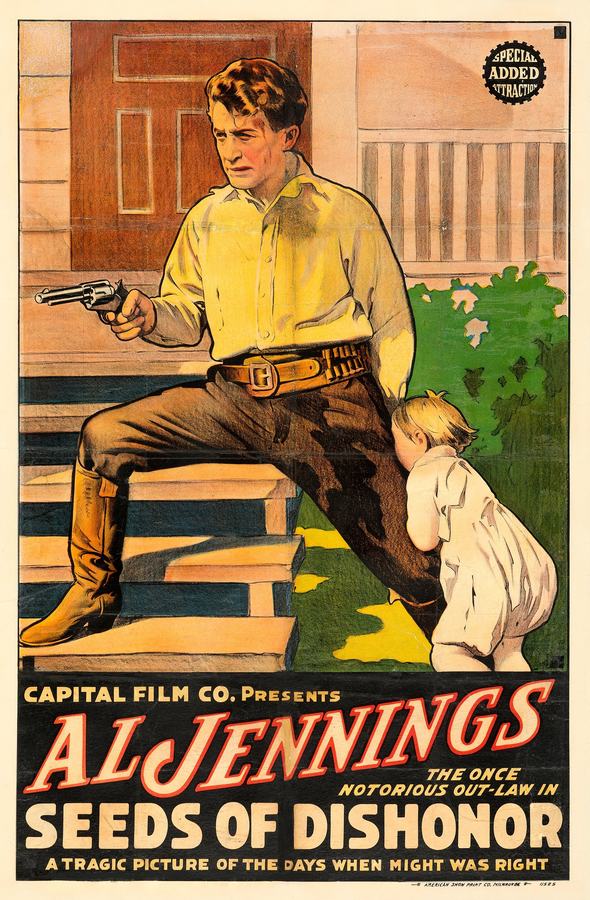
The first time I watched Seeds of Dishonor I thought the print had been marinated in iodine. The 35 mm nitrate glows the color of dried blood, a hue no digital restoration dares replicate. That amber decay is not a flaw—it is the film’s central performance, more alive than any human face onscreen. Al J. Jennings, a real-life outlaw turned matinee curiosity, moves like a scarecrow escaping its own crucifixion: elbows jutting at cathedral angles, boots scuffing up dust that hangs mid-air as though the town’s atmosphere has congealed into guilt.
Director-screenwriter Jennings (he refuses the possessory credit, insisting the story “belonged to the wind”) structures the narrative like a triptych of confessionals. Each act begins with an iris-in on a mouth—first the banker’s daughter, then the sheriff, finally the earth itself, its fissures widening into a lipless maw. Dialogue cards appear sparingly, often superimposed over twitching jaws, so the words feel chewed rather than spoken. When the stranger—never named—accepts the sheriff’s offer of “three silver dollars and all the water you can swallow,” the contract is scratched onto a shovel blade with a bent nail. The metallic screech on the soundtrack is not foley; it is the actual shovel dragged across a microphone in 1917, a primitive form of musique concrète that predates Weekend by half a century.
Monochrome is a misnomer. Jennings and cinematographer Lucien Andriot (borrowing orthochromatic stock meant for medical imaging) achieve a palette of bruise and bile. Daylit exteriors flare into sulfurous yellows; interiors sink to sea-bottom blues where faces become driftwood. The pivotal well-digging sequence was shot at high noon through a pane of amber glass scavenged from a brewery. The resulting footage makes sweat look like molasses, and when the stranger’s spade strikes the coffin lid, the splintering wood releases a puff of dust that hangs in the air like a ghost trying to remember its own outline.
Compare this chromatic sadism to The Mother and the Law, where Griffith’s moral binaries are lit like parish hall tableaux. Jennings refuses such clarity; his moral spectrum is septic. The banker’s daughter, ostensibly the femme fatale, weeps iodine tears that stain her calico dress the same shade as the corn silk in the finale—suggesting complicity runs celluloid-deep.
Most screenings survive only in 16 mm reduction prints, but a single 35 mm Dutch roll surfaced at a Haarlem flea market in 1987. During the projection, the bulb’s heat warped the final reel so that the last three minutes flutter between four and six frames per second—an accidental slow-motion that makes the sheriff’s death rattle feel eternal. You hear the labored breath of the projector itself, a mechanical deathbed vigil. Jennings reportedly told the archivist: “Let it warp; the film should stink of mortality.”
That stench is most pungent during the cornfield crescendo. The stranger, now shirtless and branded with the kerosene love-letter burn, drags the sheriff’s corpse into the stalks. Jennings cuts to an underground shot: roots writhing around the dead man’s ribs like parasitic hymns. A time-lapse—achieved by cranking the camera once every hour at dawn for nine days—shows the stalks lifting the body skyward until he becomes a crucified scarecrow. Critics often compare this to In Defense of a Nation, where flags replace crops, yet Jennings’ image is not patriotic resurrection but agricultural revenge: the land reclaiming its fertilizer.
Al J. Jennings’ biography reads like a tall tale told by a drunk telegram. Oklahoma train robber, five years in a federal pen, pardoned by Roosevelt, elected prosecutor, then—bored by legitimacy—fled to L.A. to play himself in cheap westerns. Yet in Seeds of Dishonor he sabotages his own myth. His character never draws a gun; instead, he wields silence like a stiletto. Watch the way he removes his hat when entering the church: fingertips barely grazing the brim, as though the felt were sacred. The gesture lasts four seconds but conveys a lifetime of crashed tabernacles.
Off-camera, Jennings insisted on sleeping in the jail set, claiming the iron cot “remembered the curve of my spine.” Crew members swore they found dirt under his nails each morning despite no exterior scenes scheduled. Method acting before the term existed, or a publicity stunt? Either way, the performance seeps into the celluloid; when the stranger digs the well, blisters blossom on Jennings’ palms in real time—Andriot kept filming because the blood matched the script’s stage direction: “He bleeds into the drought so the earth can taste honesty.”
Female characters in Jennings’ universe don’t haunt; they inhabit. The banker’s daughter (credited only as “Lilith, maybe”) first appears reflected in a cracked mirror—seven shards show seven versions of her smile, none trustworthy. Later, she offers the stranger a drink from a porcelain doll’s head, the cranium sawn off and gilt-rimmed. The scene echoes The Way of a Woman, yet where that film treats its heroine’s duplicity as moral lesson, Jennings frames it as ecological necessity: in a landscape this parched, deception is currency.
Most unsettling is the sheriff’s wife, interred alive in act one but never quite dead. We glimpse her only through the stranger’s point-of-view as he digs: a hand clawing upward, fingernails packed with grave dirt the color of cinnamon. Her wedding ring catches the lantern light, winking like a Morse code Jennings never translates. The film denies us resurrection; instead, her corpse becomes the compost from which the killer corn grows—a perverse inversion of fertility tropes common in The Cook of Canyon Camp.
The church bell operates on a logic as deranged as Poe’s tell-tale heart. Each lie uttered in town adds a notch to the rope; the bell swings without human touch. Mid-film, during a town meeting to discuss the stranger’s well, the bell erupts into a cacophony so violent the clapper snaps, ricocheting through the steeple like a bullet. No one admits falsehood; instead, the townsfolk blame the stranger and form a posse. The scene parodies Fools for Luck’s comic mob, yet here the humor curdles into Lynchian dread. Jennings cuts to the bell’s POV as it plummets: faces upturned, mouths forming perfect black O’s—voids into which morality drains.
Religious iconography festers throughout. The stranger’s chest burn, shaped like a cathedral window, seeps through his shirt until the fabric sticks like altar cloth. In the climactic cornfield, the stalks part to reveal a children’s Sunday-school mural painted on a barn wall—Jesus feeding the multitude with loaves and fishes—now overgrown with vines so lush they obscure the Savior’s face. The implication: abundance itself is heretical when watered with deceit.
Jennings employs match cuts not for continuity but for indictment. A close-up of the sheriff’s amputated finger in the tin dissolves into a close-up of the banker’s cigar, the tobacco leaf uncannily similar to severed skin. Later, the stranger drinks from the doll-head cup; the film smash-cuts to the telegrapher’s blind eyes, milk-white as porcelain. Each juxtaposition insinuates that every object in this microcosm has sipped from the same chalice of guilt.
The most vertiginous cut arrives after the stranger unearths the sheriff’s wife. Jennings jumps 180 degrees axis, placing us inside the coffin, staring up at the digger’s silhouette. The optical inversion—sky below, earth above—lasts only eight frames, yet induces nausea. Critics cite Soviet montage, but the effect is closer to topographical vertigo: the moral ground liquefies beneath spectator feet.
Upon release, Seeds of Dishonor vanished faster than a gambler’s promise. Variety dismissed it as “a dyspeptic morality play for folks who find Hell too cheerful.” Prints were recycled for their silver nitrate; one became a fertilizer advertisement, a poetic fate Jennings would have relished. Yet the film metastasized in cinephile folklore. Luis Buñuel claimed the cornfield crucifixion inspired the ending of Land Without Bread. David Lynch screened a 9.5 mm excerpt at AFI in 1978, refusing to answer questions afterward, only muttering “That bell—can you still hear it?”
In 2014, a 27-minute fragment turned up inside a Swedish farmhouse wall, tucked beside insulation of newspaper clippings about locust plagues. The celluloid retained the odor of kerosene; archivists wore gas masks while scanning. The recovered reel ends mid-shot, just as the stranger turns toward the horizon, corn silk trailing from his hair like straw-colored tentacles. No known conclusion exists, though Jennings once scribbled in the margin of a prison diary: “The only honest ending is the one the dust remembers.”
Perhaps that is why modern viewers, weaned on algorithmic closure, find Seeds of Dishonor so disquieting. It offers no redemption, only circulation: blood into water, corpse into crop, lie into bell toll. The film refuses to conclude; it composts itself inside your head, germinating every time you taste corn sweetness or hear a steeple chime. And when you next lie—about your taxes, your age, your feelings—beneath your ribs a tiny bell rings, adding another notch to Jennings’ rope. The stranger never left town; he simply changed address to the marrow of your bones.
—review by a ghost who once dug wells in a former life
IMDb —
1920
Community
Log in to comment.