DbcultAccessing Vault...
5.3/10
Senior Film Conservator
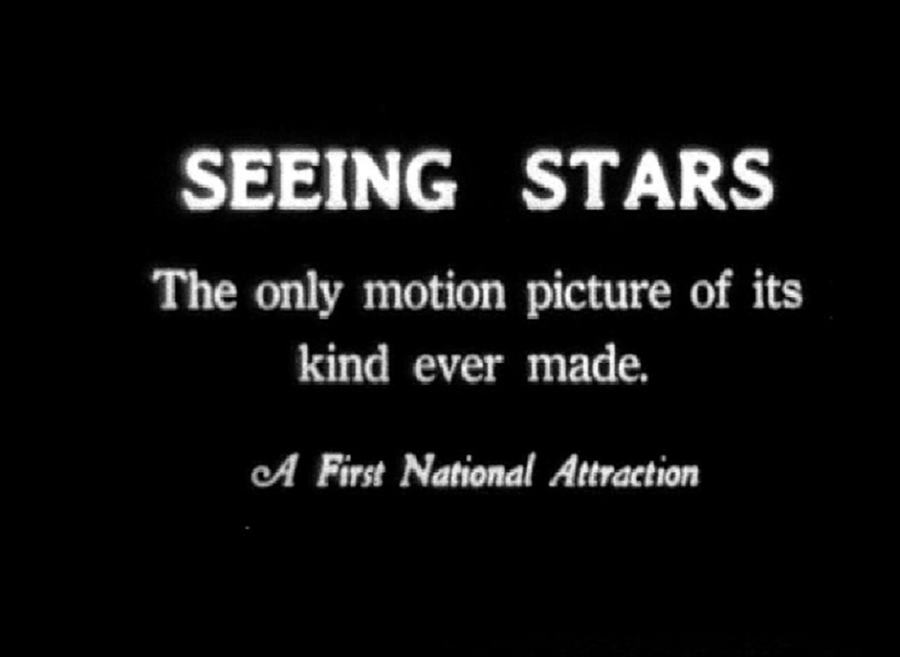
A definitive 5.3/10 rating for a film that redefined the boundaries of cult cinema. Seeing Stars remains a cornerstone of transgressive art.
Imagine, if you will, a soirée where the chandeliers are made of deadlines and every clink of crystal foretells a box-office verdict. Seeing Stars—a one-reel rarity exhumed from First National’s vault—doesn’t merely lift the curtain; it detonates the proscenium. Studio moguls, their pocket watches throbbing like anxious hearts, corralled the era’s headline deities into a rococo dining hall, then let the cameras gorge themselves on the spectacle. The result is a promotional omnibus masquerading as a narrative, a kine-mosaic whose glue is hubris and star-dust.
The film opens on a velvet-dark screen that erupts into a fusillade of flash-bulbs. Each pop freezes a grinning actress mid-laugh, a mogul mid-handshake. These stroboscopic tableaux feel eerily predictive of Instagram grids—only here the filters are nitrate and silver halide. Title cards, lettered in high-Art-Deco swank, trumpet forthcoming attractions: The Pilgrim’s collar-box gag, The Balloonatic’s aerial courtship, Day Dreams’ escalating fiascos. Yet rather than splice straight trailers, the picture stages micro-dramas amid the banquet debris.
Keaton glides through the chaos like a bemused comet. His deadpan—equal times sphinx and scarecrow—anchors the cacophony. Watch him trade a dinner roll for a bowler, then repurpose the bread as impromptu hockey puck; the gag lands, ricochets, and vanishes, leaving only the faint aroma of butter and existential dread. The camera, drunk on chandeliers, tilts upward to reveal a celestial mural where painted gods applaud flesh-and-blood mortals. Meta-fiction, circa 1923.
Where contemporary synergy feels algorithmic, Seeing Stars achieves something almost alchemic: it sells you transcendence while pick-pocketing your curiosity. A debutante twirls; her gown unfurls into a screen upon which Day Dreams flickers. A sommelier decants champagne; bubbles rise to form the release date of The Balloonatic. The stunt anticipates immersive theatre, AR filters, every SXSW pop-up you’ve dodged. Yet the gimmickry is cushioned by genuine visual wit—Keaton’s sleight-of-hand, a dolly shot that pirouettes through a trompe-l’oeil colonnade, a cut so precisely timed the splice feels like a magician’s misdirection.
Comparative glances: if Arme Lena externalized post-war melancholy through Weimar chiaroscuro, and The Clown smeared pathos over greasepaint, then Seeing Stars opts for the confetti-burst of self-celebration. The tonal whiplash is intentional: laughter as capitalist anesthesia. Still, Keaton’s opaque gaze complicates the libation. He alone seems conscious that tomorrow’s newspapers will wrap today’s fish.
Critic James Agee famously likened Buster’s face to “a lovely, impassive moon.” Here the moon is waning yet magnetic. He executes a four-beat routine—fork, cufflink, tray, exit—that distills his ethos: economy, geometry, gravity. Notice the micro-flicker of a smile when a starlet’s feather boa asphyxiates a censor’s neck. That twitch is the entire silent era confessing its guilty conscience.
The surrounding constellation—Marceline Day, Joe Roberts, sundry executives—exists as planetary bodies meant to refract his light. Roberts, barrel-chested and glowering, supplies the necessary heft; his attempt to carve a roast ends with the tablecloth yanked into a vaudevillian maelstrom. The gag recycles Keaton’s future fisherman skit from The Scarecrow, yet the déjà-vu is forgiven by tempo: the cut arrives like a guillotine, the laughter detonates before cognition.
Production designer Fred Guiol transforms a soundstage into Versailles-on-the-Pacific. Gold leaf drips from balcony rails; topiary elephants trumpet champagne flutes. The camera, mounted on a makeshift crane, swoops above the melee in a 270° arc that predates Scorsese’s Copacabana bravura by half a century. Nitrate purists will swoon at the grayscale gradients: alabaster gloves against obsidian tuxedo lapels, a single scarlet rose that appears, through tinting, like a wound on the celluloid.
Yet the opulence carries a whiff of rot—a studio system already calcifying into ledger entries. The more the film celebrates product, the more it anticipates its own extinction. When the orchestra strikes a jaunty rendition of “At Sundown,” the lyric’s promise of eternal love feels like a death rattle for an art form about to be sync-sounded into submission.
Viewed today, Seeing Stars operates as Möbius strip: a film advertising films that no longer require advertisement, a star-studded party whose invite list has dissolved into obituaries. The time-travel effect is compounded by the knowledge that Keaton, only twenty-seven here, will within five years surrender artistic autonomy to MGM’s bookkeeping behemoth. Each grin captured on celluloid now reads as pre-ironic memento mori.
Compare Les Misérables, Part 1: Jean Valjean, whose moral gravitas sprawls across epochs; or Honeymooning’s featherweight romp through pastoral innocence. Seeing Stars wedges itself between gravitas and froth, forging a third lane: ephemera as artifact. It is both trailer and treasure, invitation and mausoleum.
The final tableau: confetti storms, orchestra crescendos, a close-up of Keaton staring past lens, past audience, past mortality. Fade-out. No “The End.” Just darkness and the mechanical whirr of projector gears. The absence of closure is the film’s most avant-garde flourish. It denies catharsis, insists instead that the spectacle is interminable—every ticket buyer complicit in the studio’s ledger, every subsequent viewing a séance resurrecting ghosts of capital.
Is it any wonder that cine-clubs programming Seeing Stars report narcoleptic titters, uncomfortable silences? The short is a hall of mirrors reflecting our own binge-consumption, our IG stories flaunting backstage passes. To laugh is to implicate oneself.
Recent 4K scans by Lobster Films reveal textures smothered under generations of dupes: the moiré of a damask napkin, the pore-level stubble on Roberts’ cheek, the chalk-dust halo when Keaton teeters on a dessert cart. Accompanying score by Gabriel Thibaudeau (piano, subtle toy-trumpet) opts for wistful rather than frenetic, acknowledging the film’s undertow of melancholy. Projection at 20 fps smooths pratfalls without anaesthetizing danger; every near-collision vibrates with Newtonian menace.
For home viewing, the Blu-ray offers an audio essay by historian Imogen Sara Smith, who positions the short alongside Wife or Country and A Romance of the Underworld as symptomatic of early ’20s marketing panic. Studios, Smith argues, feared overproduction cannibalization; hence the need to mythologize product at point of sale.
To watch Seeing Stars is to swallow a hors d’oeuvre laced with history’s arsenic: delectable, lethal, unforgettable. It is the Rosetta Stone of cross-promotion, the birth and death of synergy encapsulated in twelve ebullient minutes. You will exit dazed, perhaps indignant—why must commerce so nakedly masquerade as art? Yet the indignation is salted with awe at the craftsmanship, the audacity, the sheer temporal vertigo of witnessing a century-old marketing ploy feel more contemporary than last week’s Super-Bowl spot.
Seek it out at repertory houses, pray for an organist with a sense of irony, and when Keaton’s gaze bores through the fourth wall, meet it with your own 2020s fatigue. Recognize yourself in his stoic shrug—the eternal spectator, perpetually sold, perpetually amused, perpetually waiting for the next reel to unravel.
IMDb —
1925
Community
Log in to comment.