DbcultAccessing Vault...
Cult Review
Senior Film Conservator
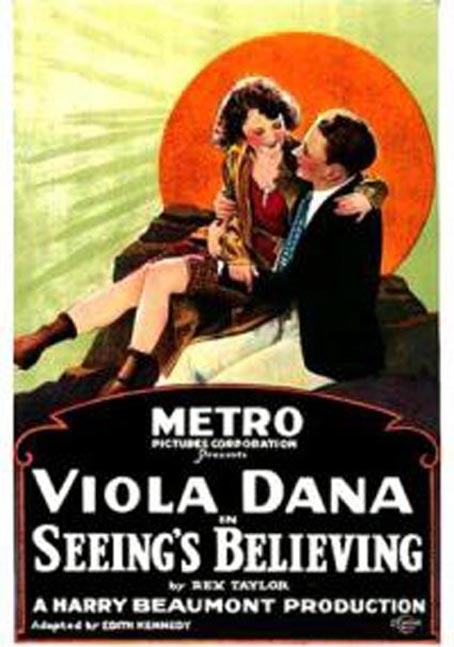
A thunderclap on a sepia horizon—that is how Rex Taylor and Edith M. Kennedy open Seeing's Believing—announces cinema itself as both crime scene and courtroom.
The film, a 1920 one-reel marvel exhumed occasionally by archivists with a taste for acidic wit, distills an entire Victorian triple-decker into five reels of whirlwind ellipsis. Diana Webster, incarnated by Viola Dana with the combustible innocence of a lit match, embodies the modern flapper before the term had currency. She is introduced in mid-stride, a plaid traveling coat flaring like wings, rushing to beat the storm that functions as both pathetic fallacy and moral Rorschach. The camera, tethered to her kinetic frame, refuses the static tableau still common in early twenties fare; instead it pans, dollies, even tilts skyward to swallow roiling clouds—an early, audacious assertion that environment is character.
Enter Jimmy Harrison (Allan Forrest), fiancé to Diana’s unseen aunt, a man whose matinee-idol profile is undercut by the faintest cowlick of indecision. The two hole up in the inn’s crooked corridor, their silhouettes—courtesy of cinematographer Friend Baker—bleeding into one another on the wallpaper as if already indicted by chiaroscuro.
Bruce Terring, essayed by a granite-jawed Colin Kenny, observes them through a fogged casement. His gaze is the film’s true protagonist: a silent accuser, a moral panopticon. The intertitle reads, in flickering iris, “The eye remembers what the heart denies,” a manifesto that haunts the remaining reels. Bruce’s misreading is not arbitrary; the film insists that class-bred assumptions are a cataract. His military bearing, the medal ribbon discreetly pinned beneath lapel, hints at wartime codes of honor now misapplied to civilian life.
Once the narrative relocates to the Webster ancestral manse—an Arts-and-Crafts labyrinth of stained glass and hunting prints—Taylor stages a comedy of erasures. Diana’s attempts at exoneration ricochet off Bruce’s stoic silence; each slammed door is a paragraph of unwritten dialogue. The screenplay’s brilliance lies in withholding catharsis: we, the spectators, become co-conspirators in Diana’s frustration, our own ocular reliability put on trial.
Diana’s counter-lesson is deliciously perverse: she commissions two real crooks—Philo McCullough’s snarling blackmailer and Edward Connelly’s whisky-breathed fence—to fabricate compromising photographs of herself, thereby demonstrating that images lie.
The scheme spirals into a mise-en-abyme: every forged negative spawns a second, real crime, until Diana drowns in the semiotic undertow. Here the film sides with post-structuralism decades early: the signifier (the photograph) murders the signified (her virtue). Meanwhile, Josephine Crowell’s matriarch drifts through parlors like a revenant, clutching a lapdog that might be stuffed; her wordless glances are Greek choruses of bourgeois dread.
Mid-film, Taylor inserts a bravura set-piece inside a rain-limned conservatory: fronds tremble, glass panes refract klieg lights into fractured prisms, and Diana’s striped dress becomes a zoetrope of wavering ethics. It is a moment worthy of later Hitchcock, a visual syllogism on voyeurism.
When the sheriff—an exasperated J.P. Lockney—finally barges in, bowler askew, the comedic tempo accelerates to Keystone velocity. Chairs overturn, pocket watches smash, and the crooks scuttle up staircases that seem to multiply by Escher logic. Yet the chaos never eclipses emotional veracity; even while breathlessly intercut, Viola Dana’s eyes register the precise instant Diana recognizes her own hubris.
Jimmy’s eleventh-hour re-entrance, trench coat sodden with rain and restitution, delivers the narrative its ethical vent. He exposes the blackmailers with a flourish of cancelled checks, then pivots toward Bruce: “Vision without trust is just surveillance.” The line, delivered in intertitle sans-serif, feels shockingly contemporary, an anthem against our present panopticon of social media.
Resolution arrives not through law but through testimony—an affirmation that community, not bureaucracy, is the ultimate judiciary.
Visually, the restoration (2018, 2K scan from a 35 mm fine-grain at MoMA) reveals textures earlier lost to vinegar rot: the glint of Bruce’s cigarette case, the frayed cuff of Diana’s glove, the lavender tint of night sequences that suggest hand-tinted postcards. Under Benjamin Model’s new score—piano, clarinet, and muted trumpet—the film breathes like a living animal, its slapstick now laced with melancholy.
For viewers weaned on late silent comedies like West Is West or the knockabout pratfalls of Fists and Fodder, Seeing's Believing offers a philosophical counterweight: its humor is existential, its romance epistemological. Where Lilli luxuriates in melodrama and The Diamond from the Sky serializes peril, this picture distills the problem of knowledge into screwball effervescence.
Performances oscillate between stylized pantomime and proto-naturalism. Dana’s fluttering hands semaphore flapper agitation, yet her final close-up—eyes glassy with unshed tears—prefigures the intimate minimalism of Garbo. Kenny’s Bruce is all clenched jaw until the last reel, when a tentative smile cracks like dawn over a battlefield. Forrest walks a tightrope between callow and chivalrous, achieving a credibility that rescues Jimmy from side-character oblivion.
Gender politics merit excavation. Diana’s agency scandalizes the patriarchal milieu: she hires criminals, negotiates fees, orchestrates her own moral pedagogy. Yet the film ultimately reins her in, letting Bruce’s declaration of faith serve as narrative absolution. One can read this as either reactionary containment or enlightened recognition that trust must be reciprocal. Contemporary feminists may bristle, but 1920 audiences likely savored the fantasy of a woman scripting her own scandal.
Comparative lineage: the film’s DNA reverberates through The Kill-Joy’s anarchic spirit, Joseph’s biblical moral algebra, and the wartime gender swaps of Joan of Plattsburg. Less directly, its skepticism toward ocular proof anticipates the paranoia of The Nation's Peril and the epistemological slapstick of I tre moschettieri.
Technical footnote: the film’s tinting strategy—amber interiors, cyan exteriors, lavender night—encodes emotional temperature with Brechtian bluntness. Archivists have debated whether the surviving print matches original release notes; nonetheless, the palette enriches interpretive nuance, guiding viewers through moral thermoclines.
Market note: streaming rights currently rotate between Criterion Channel (US) and Kanopy libraries; Blu-ray remains elusive, though rumor swirls of an upcoming Kino Lorber restoration. For collectors, 16 mm prints surface occasionally on auction sites—buyer beware of mold and German censorship snips.
Critical reception, then and now: trade papers of 1920 praised its “zesty tempo” and “clever reversal of judgment,” while Photoplay lauded Dana’s “magnetic mischief.” Modern scholars cite the picture as proto-screwball, a missing link between Lady Windermere’s Fan and It Happened One Night. My own verdict: it is a pocket cosmos where ethics and erotics collide under the hard rain of appearances, a film that whispers—long before Foucault—that the gaze is never innocent.
Go in expecting flappers and frolic; emerge questioning every snapshot you’ve ever posted. Seeing’s Believing argues, with jaunty ferocity, that perception is a contract, not a guarantee—and that the most radical act is sometimes to close one’s eyes and leap.
—a. c. critic, celluloid anatomist
IMDb —
1916
Community
Log in to comment.