DbcultAccessing Vault...
6.6/10
Senior Film Conservator
A definitive 6.6/10 rating for a film that redefined the boundaries of cult cinema. Segodnya remains a cornerstone of transgressive art.
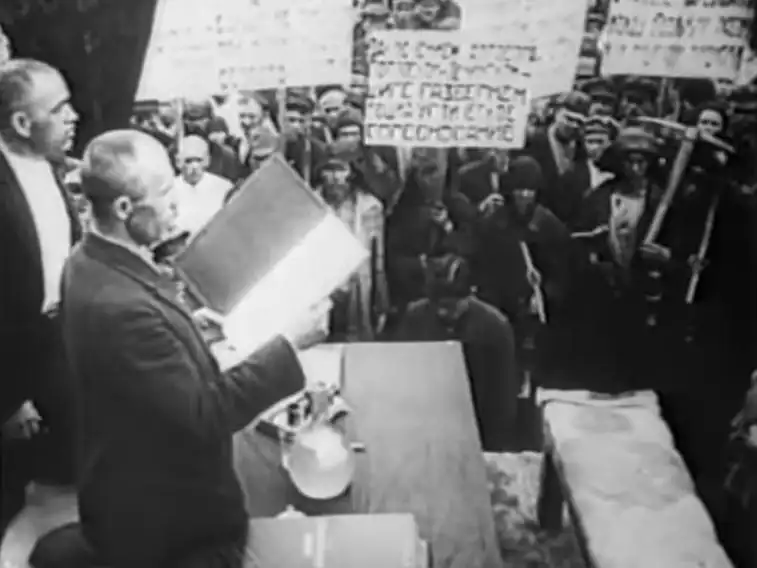
Alright, so if you're thinking about watching Esfir Shub's 1929 film, Segodnya, let's get one thing straight: this isn't your cozy Sunday afternoon movie. Not even close. If you're a film student, a historian, or just deeply curious about how cinema was used to really, *really* push a political idea, then yes, give it a shot. It’s a document.
But if you just want a story, or something to chill out with, then you’re probably gonna hate it. This film is like a lecture, but one delivered with a megaphone and a rapid-fire slideshow. 📣
From the first few frames, you know exactly what Segodnya is doing. It wants to show you how utterly fantastic communism is and, by contrast, how miserable and broken capitalism is. There’s no ambiguity here. None at all.
Shub, a pioneering editor, stitches together these incredible contrasts. One moment, you’re seeing _happy, bustling Soviet workers_ constructing something grand, full of purpose. Then, *bam!* It cuts to images of _desperate, unemployed men_ loitering on cold, grey capitalist streets. The message is hammered in, repeatedly.
It’s almost relentless. Children playing in sunny Soviet parks appear right after grim, hungry faces from the West. The film really goes for broke with these juxtapositions. You can almost feel the movie trying to convince you this moment matters, over and over.
The intertitles, those big blocks of text on screen, don't help soften the blow either. They don’t just set the scene; they *tell* you exactly what to think. No room for your own interpretation here. It's like having a narrator shout the moral directly into your ear. 🗣️
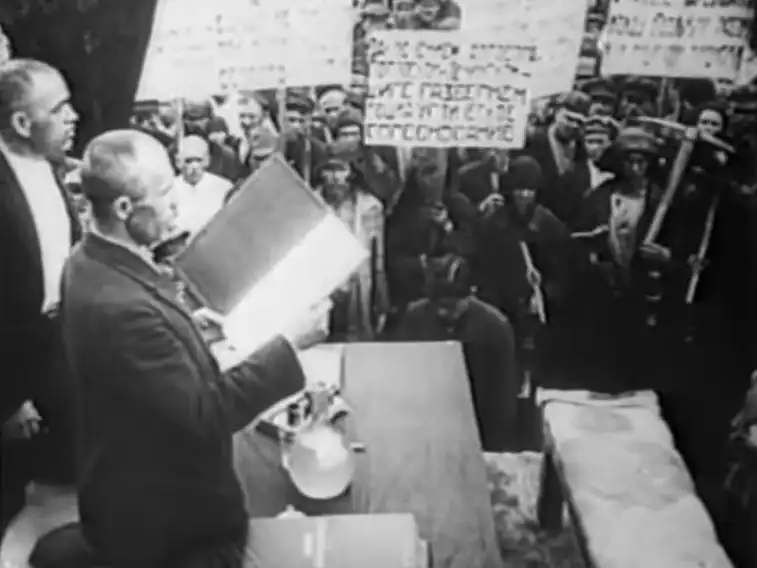
Despite the heavy-handed message, some of the individual shots are genuinely captivating. There’s a raw power in seeing everyday life from nearly a century ago, even if it's been curated for a specific point. The faces, the street scenes, the industrial machinery – it's a glimpse into a world that feels so very far away.
Shub's editing is _fast_ for its time. She really knew how to play with tempo, creating a feeling of urgency and momentum when showing Soviet progress. Then, the capitalist scenes slow down, sometimes holding on a single, bleak image a bit too long until it feels almost awkward, just to emphasize the despair.
There's this one part, I remember, where it shows a grand parade, just *bursting* with energy and people. Then it cuts to an almost eerily quiet shot of an empty factory in a different country. The silence after all that noise is really striking. It sticks with you. 🏭
The film doesn't really have characters or a plot in the usual sense. It's more like a visual argument. So if you're expecting a narrative arc, you'll be disappointed. This is pure, unadulterated visual rhetoric.
It makes you think about how images, even today, can be weaponized. How easy it is to frame things, to show only one side. Segodnya is a masterclass in that, for better or worse. It's a reminder of a very specific time and place, and how fiercely some believed in their vision for the future.
Watching it, you realize how much propaganda has evolved, but also how some core techniques haven't really changed. Just the tools got fancier. It's a *bold* film, definitely not subtle, but a fascinating piece of cinematic history all the same. Don't expect to be entertained, but do expect to see something _purposeful_.
IMDb —
1919
Community
Log in to comment.