DbcultAccessing Vault...
Cult Review
Senior Film Conservator
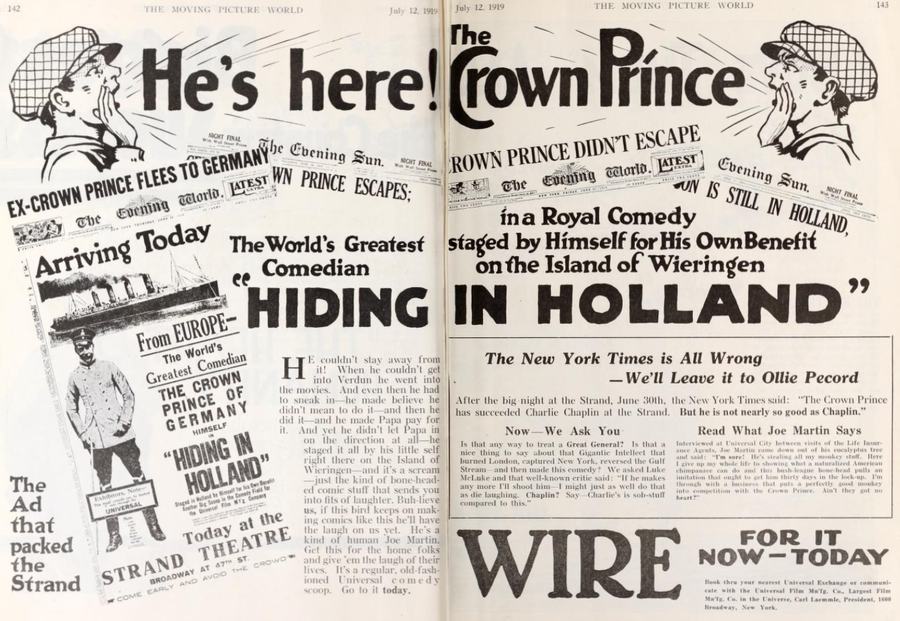
There is a peculiar, almost predatory thrill in watching Hiding in Holland. It isn't merely the historical weight of its subject—the displacement of the Hohenzollern dynasty—but the sheer, audacious methodology of its creation. In an era where cinema was still largely wrestling with the proscenium arch of the theater, this 'verity' film opted for the cramped, dusty interior of a cart. It is a proto-documentary that feels more like a heist movie, where the loot isn't gold, but the unguarded image of a man who was, until very recently, one of the most powerful figures in Europe.
The central conceit of the film—a cameraman hiding in a cart to observe the former Crown Prince—transforms the act of filming into an act of espionage. This isn't the carefully curated propaganda we see in ME, der Kaiser!, where the image is a tool of statecraft. Instead, Hiding in Holland is a film of apertures and limitations. The framing is dictated not by aesthetic preference, but by the physical constraints of the hiding spot. This creates a raw, jittery energy that anticipates the French New Wave by decades. We are not just watching the Prince; we are sharing the cameraman's pulse, the frantic adjustment of the lens as the target moves in and out of the narrow field of vision.
The Dutch landscape, usually portrayed with a certain tulip-scented romanticism, here becomes a neutral, almost sterile backdrop for a fallen titan. There is a profound sense of the 'uncanny' as we see the Prince navigating these flat horizons. Unlike the heightened drama of The House of Hate, the tension in this film is found in the silence. It is the tension of a man trying to be invisible, being watched by a camera that is itself trying to be invisible. The layers of concealment are fascinating; it is a cinematic onion of secrecy.
What does a prince look like when the crown has been stripped away? Hiding in Holland provides an answer that is both mundane and haunting. The Prince’s movements lack the choreographed precision of his former life. There is a slouch to the shoulders, a way of looking at the horizon that suggests a man searching for a future that no longer exists. The film captures the transition from a historical figure to a mere mortal. In many ways, it shares a thematic DNA with The Gray Horizon, where the boundaries of identity are blurred by circumstance and the weight of the past.
The grain of the film stock adds a layer of grit to the proceedings. The flickering light, filtered through the cart's wooden slats, creates a rhythmic strobe effect that underscores the Prince’s disorientation. This isn't the polished narrative of Redeeming Love; there is no redemption here, only the cold, hard fact of survival. The Prince is a ghost haunting his own life, and the camera is the medium through which we witness his haunting. The lack of traditional intertitles or a driving score allows the visual information to breathe, forcing the audience to interpret the Prince's psyche through the tilt of his head or the way he handles his luggage.
One cannot discuss this film without acknowledging the technical prowess required to pull it off. The cameraman, likely sweating in the airless dark of the cart, had to maintain focus and exposure while being jostled by the uneven Dutch roads. This physical labor is palpable in every frame. It is a far cry from the studio-bound comfort of Betty of Greystone. Here, the camera is a weapon, a tool of exposure that breaks the unspoken contract between the public and the private individual.
The ethical questions raised are surprisingly modern. Do we have the right to film a man in his lowest moment? Does the historical significance of the Crown Prince justify this invasion of his privacy? The film doesn't answer these questions; it merely presents the evidence. It occupies a space similar to The Pitfall, where the viewer is made an accomplice to the act of observation. We are the ones peeking through the slats, and there is a guilty pleasure in our proximity to this fallen icon.
"The lens in Hiding in Holland is not a window, but a keyhole. It reduces the grand narrative of the Great War to the scale of a single, fleeing man, turning history into a series of stolen moments and whispered visuals."
The cinematography, though restricted, manages to capture the unique light of the Low Countries. The sea blue (#0E7490) of the distant dikes and the pale, overcast skies create a melancholic atmosphere that mirrors the Prince’s internal state. There is a recurring motif of wheels—the wheels of the cart, the wheels of the Prince's carriage, the metaphorical wheels of history. These circles suggest a cycle of rise and fall that is as inevitable as the tides. This rhythmic visual language is far more sophisticated than the melodramatic beats of Cheating the Public.
The film also serves as an accidental ethnography of post-war Holland. We see the faces of the locals as they watch the procession pass. Some are curious, some are indifferent, and some seem to sense the gravity of the moment. These background figures provide a grounding reality to the Prince’s flight. They are the 'whoozitts' of history, much like the characters in The Wanderer and the Whoozitt, living their lives in the shadow of giants without ever fully understanding the scale of the drama unfolding before them.
As we look back at Hiding in Holland, its influence on the documentary form is undeniable. It rejects the staged 'actuality' of early cinema for something more visceral and honest. It shares a certain restlessness with Das wandernde Auge, where the camera itself becomes a character with its own motivations and limitations. The 'wandering eye' here is trapped in a cart, but its vision is far-reaching.
The film’s conclusion—if one can call it that—is a masterclass in ambiguity. There is no grand speech, no final confrontation. The Prince simply continues his journey, and the camera continues its vigil. It is a reminder that history doesn't always end with a bang or a whimper; sometimes, it just disappears down a dusty road, watched by a man in a cart. This quietude is more powerful than the operatic endings of Princess of the Dark. It is the sound of an era closing, not with a fanfare, but with the creak of a wooden wheel.
In the final analysis, Hiding in Holland is a vital piece of cinematic history. it isn't just a record of a man, but a record of a new way of seeing. It taught us that the most profound truths are often found in the places where we aren't supposed to look. It is a film that demands to be seen, not just for what it shows, but for how it shows it. It is a testament to the power of the lens to strip away the artifice of power and reveal the fragile human heart beating beneath the medals and the uniforms. Whether compared to the social critiques of The College Orphan or the adventurous spirit of Eastward Ho!, this film stands alone as a haunting, clandestine masterpiece of early non-fiction cinema.
IMDb 6.9
1930
Community
Log in to comment.