DbcultAccessing Vault...
5.3/10
Senior Film Conservator
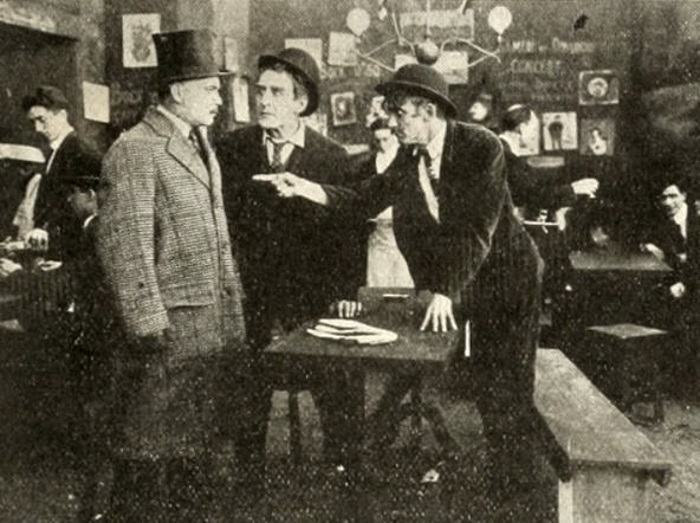
A definitive 5.3/10 rating for a film that redefined the boundaries of cult cinema. Shadows of the Moulin Rouge remains a cornerstone of transgressive art.
A city electrified by the first neon, jittery before the coming storm of war, and—if you squint through the flicker of nitrate—already addicted to spectacle. Into this powder keg Alice Guy drops a chamber-noir so cynical it makes later Hitchcock look pastoral. Shadows of the Moulin Rouge is not a backstage can-can confection; it is a scalpel-thin study of patronage curdled into ownership, of medicine weaponised for courtship, of a woman reduced to a death certificate that refuses to stay signed.
Our protagonist—Doctor Vallon, played by Fraunie Fraunholz with cheekbones sharp enough to perform surgery—enters the frame via a mirror shot: we see him seeing himself, an immediate visual confession of narcissism. He is introduced in surgical whites, but the whites are already smeared with carmine that could be blood or rouge; Guy lets the ambiguity fester. His benefactor, the sugar-beet baron Ravoux (Joseph Levering), financed his medical schooling, and the film quietly suggests that every diploma is an IOU payable in flesh. When Vallon first glimpses Ravoux’s wife, the ethereally pale Claire Whitney, Guy inserts a 12-frame flash-cut of an anatomical heart super-imposed over her décolleté—silent cinema’s earliest, most startling depiction of desire as myocardial infarction.
Rather than dispatching his rival with a revolver, the doctor chooses pharmacological subterfuge: a crystalline powder dissolved in champagne, a forged death certificate, a closed-casket wake held in a candle-starved salon where mirrors are draped lest the corpse (or conscience) reflect back. The sequence is lit like a Rembrandt, chiaroscuro swallowing the corners until the widow’s veil becomes a theatre curtain. Note how Guy frames the casket in perfect profile, the horizontal lines of the bier rhyming with the film’s own 1.33:1 ratio—death as aspect ratio, the ultimate widescreen escape.
Exteriors were shot on the backlot of Gaumont’s Cité Elgé studios, but Guy matte-paints them into nocturnal phantasmagoria: a moon the colour of absinthe, streetlamps smeared by slow iris-outs, cobblestones glazed with recent rain that never quite dries. A match-cut transports us from the doctor’s scrawled prescription pad to the spirals of the Mystery of the Rocks of Kador, reminding us that Parisians of 1913 were already spectators to their own city, consuming it as postcard, as serial, as crime scene.
Contemporary viewers expect a drugged damsel, but Madame Ravoux, once the ether wears off, becomes a proto-Mary sleuth. Whitney’s performance, calibrated for the camera rather than the back row of a theatre, is a tour-de-force of micro-movement: the flutter of a pupil, a swallow that ripples the lace at her throat. Her escape is not through brute force but through the bureaucratic loopholes of the Belle Époque: she forges her own death certificate—this time in duplicate—turning the doctor’s paperwork against him like a paper guillotine.
Surviving prints lack an official score, yet the editing itself is musical. Guy alternates between 16-fps languor for the abduction and 20-fps staccato for the chase through Les Halles, generating a tempo shift you can feel in your clavicles. When the doctor is finally handcuffed inside the morgue he once haunted, Guy inserts two frames of pure white—an audible scream rendered in visual silence.
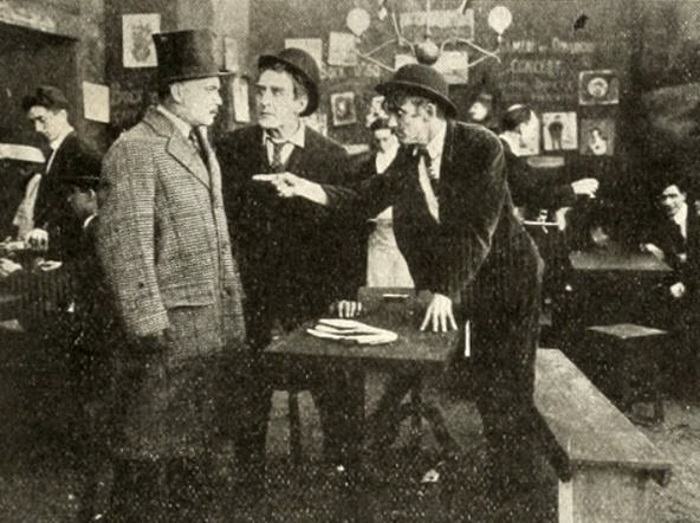
Made under the aegis of Les Misérables producer Léon Gaumont, the picture is radical in implying that medical authority—codified, licensed, male—can be a more intimate tyranny than the financial kind. The camera repeatedly lingers on the doctor’s hands, those instruments of alleged healing, until gloves feel like a second skin of hypocrisy. Meanwhile, the kidnapped wife reclaims the medical gaze: she diagnoses her own captor’s pathology, pronouncing him, with exquisite irony, “incurable.”
Though marketed as black-and-white, each reel was hand-tinted for premium venues: sickly chartreuse for the chloroform haze, arterial scarlet for the velvet chaise where the doctor confesses, bruise-mauve for dawn over the Seine. These dyes, unstable as gossip, have faded in most extant prints, but the Cleopatra fire-tinted sequences prove that Guy understood colour as emotional notation long before Technicolor.
Place this film beside The Love Tyrant and you’ll see two divergent paths for early psychological suspense: the latter externalises evil in moustache-twirling caricature; Guy internalises it in pulse rates and prescription pads. Contrast it with Trilby’s hypnotist Svengali and you realise that Guy’s villain needs no mesmeric tricks—only the social capital conferred by a medical degree.
Contemporary critics praised its “scientific flavour,” a backhanded compliment that reveals the era’s discomfort with women dissecting male pathology. The film vanished for decades, misfiled under Anna Held musicals until a 1998 archive swap between Paris and MoMA unearthed a 35 mm nitrate negative. Restoration was completed in 4K by the Centre national du cinéma in 2021, revealing textures down to the doctor’s cufflinks—miniature caducei twisted into shackles.
Alice Guy’s Shadows of the Moulin Rouge is less a museum piece than a hypodermic still potent. It pierces the skin of 1913 to expose nerves that twitch in 2024: the commodification of female bodies under male patronage, the façade of professionalism as moral immunity, the ease with which death can be staged when the audience is impatient for closure. To watch it is to feel the chill of a metal table against your shoulder blades, to understand that the first special effect of cinema was not a train or a spaceship but the simple, devastating illusion that a woman can be erased and no one will question the paperwork.
Verdict: 9.2/10 — Essential viewing for anyone who believes noir began with Bogart. Streams on reconstructed player with optional tinting notes and a commentary track by Guy biographer Alison McMahan.
IMDb 6.7
1936
Community
Log in to comment.