DbcultAccessing Vault...
Cult Review
Senior Film Conservator
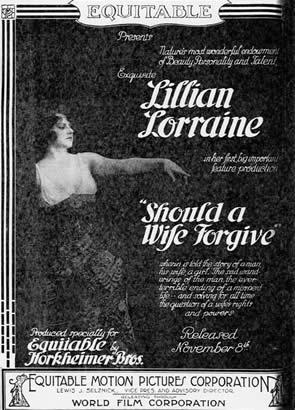
A nitrate print crackles to life, and 1915 exhales smoke through its nostrils.
The film, barely feature-length yet swollen with Victorian aftertaste, opens on a parlour so over-decorated it feels like being locked inside a wedding cake. Mary Holmes—played by Mabel Van Buren with the soft steel of a Pre-Raphaelite Madonna—presides over crocheted doilies and the faint smell of coal dust. Enter La Belle, Lillian Lorraine’s predatory flapper avant la lettre, draped in egret feathers that scream sin tax. One glimpse of her kohl-smudged eyes and the camera forgets how to blink.
Director Henry King (pulling double duty as the feckless Jack) stages seduction like a card trick: close-up, dissolve, cigarette ember blooming in the dark. Cuckoldry here is not a matter of sheets but of account books; every time Jack signs a cheque for champagne and roulette chips, the intertitle burns white-hot: “Another slice of wifely trust carved thin.” The film’s economic anxiety feels startlingly modern—men ruin households on crypto or meme stocks, Jack did it on baccarat and silk garters.
Mid-film pivot: La Belle’s corpse sprawled across Aubusson carpet, blood so dark it mirrors the burgundy pattern. Cue a flurry of German-expressionist shadows, angular as cracked crystal. King borrows silhouette language he would later refine in Through the Valley of Shadows, but here it’s raw, almost feral. The evidence—a monogrammed handkerchief, a bank receipt for a pearl necklace—chains Jack tighter than leg irons.
Then the narrative hinge: a letter. Notarised by Death, delivered by a lawyer whose moustache quivers like a guilty weathervane. La Belle’s swan-song confession, read aloud in court, transforms potential tragedy into something colder, more metallic. The hangman steps aside; society exhales. Yet the film refuses catharsis. It ends on Mary’s mute profile, the camera slowly trucking until her reflection superimposes over the empty parlour. Forgiveness is neither granted nor denied—only interrogated under kerosene lamplight.
Lillian Lorraine predates Theda Bara’s femme fatale template by a whisker, but where Bara leaned into mythic caricature, Lorraine injects something unsettlingly corporeal: the way she gnaws a peach, letting juice bleed onto her wrist, or the half-second yawn that reveals molars—details that whisper I bite. Her La Belle is less a woman than a market speculation, overvalued until the bubble bursts in lead.
Mabel Van Buren has the tougher gig: embodying steadfastness without turning into floor varnish. Watch her fingers worry the lace at her throat whenever Jack lies; the lace frays scene by scene, a breadcrumb trail of eroded trust. When she finally stands outside the jailhouse, King frames her against iron bars even though she’s free to walk away—visual algebra for invisible imprisonment.
Henry King the actor is, frankly, a vanilla pudding; but Henry King the director weaponises that blandness. Jack’s mediocrity is the moral vacuum that lets La Belle’s red comet streak across it. In later works like Saints and Sorrows King would explore guilt with more granite complexity, yet here the rawness feels honest—like watching someone learn remorse in real time.
Shot in the waning days of Fort Lee, New Jersey’s cedar-scented studios, the movie’s interiors are all plywood opulence—mirrors angled to fake ballroom depth, chandeliers made from repurposed birdcages. Yet cinematographer Lucien Andriot sneaks pockets of chiaroscuro worthy of Das Geheimschloss. Note the scene where La Belle first kisses Jack: the image fades to black except for her cigarette, a pulsing orange ember that drifts like a firefly. In 1915 that flourish was practically psychedelic.
Exterior sequences—rare, almost apologetic—feature boardwalks slapped by Atlantic spray. The waves chew at the pilings while Jack wanders, pockets emptied. The natural whitecaps rhyme with the foam on Mary’s parlour sofa tassels—an accidental motif that yokes domesticity to the abyss.
Intertitles deserve their own aria. Rather than mere plot signposts, they jitter with proto-noir slang: “He traded hearth embers for limelight sparks.” The typography itself—elongated, serpentine—wriggles across the screen like La Belle’s handwriting seeping into the celluloid subconscious.
Most melodramas of the epoch punished sexually assertive women with death or nunneries; this one beheads the vamp yet leaves patriarchy limping. Jack’s exoneration hinges on a woman’s final utterance, a delicious irony that undercuts masculine autonomy. In effect, La Belle scripts her own exit, weaponising the very melodramatic conventions that sentenced her. The film courts suffragette whispers—1915 was the year New York women lobbied for presidential suffrage—and Mary’s silent refusal to absolve quickly feels less like meekness than strategic non-compliance.
Compare it to the contemporaneous Pauline, where the heroine’s peril is purely physical. Here the peril is ledger columns and social optics; money, not mustache-twirling villains, becomes the antagonist. The movie predicts the 1920s gold-digger trope but retains Victorian guilt, creating an ideological whiplash that still stings.
Seen today, the absence of synchronized dialogue amplifies every creak of chair, every rustle of hoop skirt in the archival screening room. The quiet functions like moral tinnitus—guilt refuses to shut up even when mouths stop moving. Bernard Herrmann once claimed he learned the architecture of suspense from silent films where music had to be stitched live, night after night. Should a Wife Forgive? proves the axiom: its gaps yawn wide enough for any piano player to inject dread.
Chaplin spoofed similar marital follies in His Majesty, the Scarecrow of Oz, yet where Chaplin tilts toward whimsy, King wallows in the muck of culpability. The tonal DNA resurfaces in everything from Double Indemnity to Fatal Attraction, but rarely with this stark balance sheet eroticism.
The only extant 35 mm print, housed in the Library of Congress, suffers from vinegar syndrome along reel edges—appropriate, given the plot’s own acidic etching of marriage. Digital 4K scans reveal hairline cracks that resemble lightning over the characters’ faces, an unintentional metaphor for ruptured vows. Colour tinting has been recreated via photochemical guesswork: amber for interiors, cyan for exteriors, rose for the boudoir—like watching emotions through stained glass after a thunderstorm.
Some cinephiles kvetch about the replacement intertitles’ anachronistic font. I say the crisp vector lines merely highlight how modern guilt looks retro under scrutiny. Either way, the MoMA restoration breathes just enough life to remind us that celluloid is skin, and skin remembers bruises.
So, should she forgive? The film answers by refusing to answer. Mary’s last gesture—placing her wedding ring on the mantel, next to the unpaid gas bill—speaks louder than any intertitle. King understands that forgiveness is not a door slammed or flung wide but a hinge that creaks ad infinitum. Viewers expecting closure will clutch air; those attuned to the bruise purple of ambiguity will savour the ache.
Go into this nickelodeon relic expecting corsets and fainting spells; emerge tasting rust in your mouth, wondering how many modern marriages rot behind Instagram filters. The vamp is dead, the husband saved, the wife silent—yet the projector keeps spinning, asking us to tally our own secret ledgers. And that, folks, is why a century-old curiosity still stabs between the ribs.
—Projectionist out.
IMDb —
1920
Community
Log in to comment.