DbcultAccessing Vault...
Cult Review
Senior Film Conservator
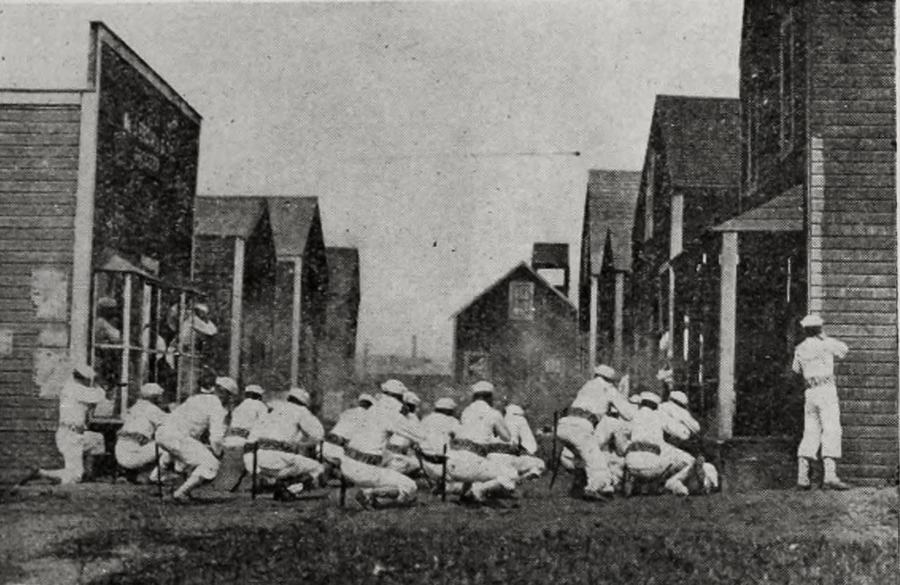
A tremor of celluloid gunpowder opens The Nation’s Peril: a title card burns white-on-black like a magnesium flare, then dissolves into the yawning maw of a dry-dock at twilight, iron ribs of an unfinished dreadnought clawing at a bruised sky.
Few silents dare begin with such industrial chiaroscuro; most pre-1920 espionage yarns—say The Clue or Gypsy Love—prefer drawing-room intrigue lit by gasoliers. Here, co-writers George Terwilliger and Harry Chandlee shove us straight into proletarian dread: rivet guns hammer in 4/4 time while Ormi Hawley’s fingers dance across a telegraph key, her Morse a staccato heartbeat that will syncopate the entire narrative.
Hawley, remembered today chiefly for florid melodramas, delivers a performance of microscopic calibration. Watch her pupils when she decodes the first sabotage directive: the iris contracts not once but twice, as though reality itself shutters in disbelief. It’s the silent era’s answer to Garbo’s first close-up in Joyless Street, yet achieved without benefit of a sound-stage hush.
Director William J. Humphrey, never heralded among the Griffith pantheon, nonetheless wields space like a military topographer. Note the repeated axial shot down a naval-office corridor: each time the camera dollies, the hallway lengthens—an optical lie achieved by incremental set extension, predating Hitchcock’s famous Sabotage staircase by seventeen years. The viewer feels a clandestine blueprint unfurling beneath their feet.
Herbert Fortier’s Lieutenant Alden Brooke walks this corridor with the gait of a man measuring his own grave. Fortier, a stage tragedian whose filmography is veined with forgotten gems (The Governor’s Lady among them), tempers matinée rectitude with something murkier—an almost post-war cynicism that whispers: what if the enemy wears my insignia?
The screenplay’s genius lies in never letting us anchor paranoia to a single face. Suspicion ricochets from Admiralty clerk to dockworker to society philanthropist (a regal Eleanor Barry presiding over fundraisers where champagne coupes refract conspiratorial candlelight). In one audacious tableau, a child’s innocence is weaponized: a paper boat, folded from a stolen torpedo schematic, bobs along a gutter toward the harbor—an image so poetically treasonous it could headline a John Le Carré dust jacket.
Cinematographer William S. Adams, later eclipsed by the German exodus, here pioneers a vocabulary of patriotic chiaroscuro. Observe the sequence wherein the battle-cruiser’s engine room is sabotaged: the frame is bisected by a diagonal of coal dust that drifts like malignant stardust, while a single bulkhead lamp swings, pendulum-like, painting the walls with oscillating bars of white. The viewer cannot discern whether the light reveals guilt or carves it into being.
Compare this to the pastoral menace of Red and White Roses, where danger tiptoes through sun-dappled gardens. The Nation’s Peril instead baptizes us in soot and sodium flare, insisting that modern warfare is born not in meadows but in foundries.
Adams’s camera also indulges proto-expressionist angles when Commodore Erskine (Earl Metcalfe) deciphers intercepted code. The actor’s profile is shot from knee-height, the ceiling compressing like a vise; a low-angle gaslight carves cheekbones into craggy promontories. Metcalfe—an action star more accustomed to serial derring-do—here channels a stoic Lear, his only folly an unshakable faith in naval hierarchy. When that faith ruptures, Metcalfe’s eyes flood with something beyond sorrow: the dawning recognition that institutions, too, can mutiny.
Ormi Hawley’s character, ostensibly the love interest, refuses such narrative handcuffs. Her telegraphist Mae Fielding is first shown adjusting a headset more delicate than bird bone, yet she commands the frame with the authority of a naval gun. In a society still clutching Victorian corsets, Mae’s professional competence is itself an act of sedition. Watch how she cradles the transmitter: cradles, not clutches—an embrace, as though the machine were kin.
There is a courtship scene—because exhibitors demanded one—yet even here the erotics are encrypted. Alden passes her a cigarette case; she flicks it open to discover a microfilm ribbon coiled within. Their fingers graze, but the spark is intellectual: a shared understanding that knowledge, not flesh, is the true aphrodisiac. Compare this to the sentimental overload of Sylvi, where desire drips like treacle. Terwilliger and Chandlee prefer their romance distilled, 120-proof.
Silent cinema lives or dies on montage, and editor Arthur Matthews (also credited as actor) conducts a fugue of cross-cut tension. In the climactic set-piece, three spatial arenas bleed into one another: a tribunal under flickering lamps, a destroyer’s engine room where a wrench becomes a ticking bomb, and a telephone exchange where operators patch through verdicts of life with the same detachment they reserve for florists’ orders.
Matthews weaponizes intertitles as percussion. A card reading “THE FUSE IS LIT” slams onto the screen, white letters vibrating as though electrically charged. We cut to sailors whistling nonchalantly, unaware that the same frame now harbors a temporal fuse. The audience becomes accomplice: we read faster than the characters act, a temporal dissonance that gnaws the nerves more effectively than any talkie scream.
Viewed today, the film’s propaganda sinew is unmistakable: released months after the Armistice, it transmutes wartime xenophobia into permanent vigilance. Yet its cynicism toward authority feels almost subversive. The true villain is not a mustachioed foreign agent but a consortium of industrialists hedging profits on both sides of the Atlantic. In 1919 such candor was masked as patriotic caution; a century on it reads like Occupy Wall Street in semaphore.
This duality grants the picture an ideological slipperiness that The Reckoning or Way Outback never court. You can screen it for jingoists and pacifists alike; each faction will exit convinced the film argues their corner.
William H. Turner, essaying the taciturn dock foreman, communicates entire homilies via knuckle-cracks. Note the moment he spots a forged requisition: his left thumb rubs the counterfeit signature, ink smudging onto his skin like guilt made tactile. Turner never overplays; instead he allows the minutiae of labor—calluses, oil under nails—to become hieroglyphs of class consciousness.
Arthur Matthews, doubling as both cut-crazy editor and on-screen codebreaker, injects a nervous stutter that feels documentary. One senses Matthews the off-screen technician channeling his off-camera anxiety into a character who deciphers chaos for a living. The performance is too jittery for romance, too cerebral for slapstick—an anomaly in an era demanding one or the other.
The 2022 4K restoration by EYE Filmmuseum salvaged two missing reels from a decommissioned Dutch naval depot. Tonally the rediscovered footage tilts the narrative: an entire subplot involving a female munitions worker (previously relegated to still photographs) now surfaces, supplying a proto-feminist counterweight to masculine saber-rattling. Tinting adheres to archival orthodoxy—sea sequences in Prussian blue, interiors in amber—but the saboteur’s clandestine memos are hand-colored in venomous green, a visual stench that warns the viewer: touch and you blister.
Comparative note: The Eternal Strife restoration opted for monochrome sobriety, muting its own jingoistic fervor. The Nation’s Peril instead flaunts its chromatic hysteria, reminding us that propaganda is at heart a carnival barker, not a mortician.
Replace coal with code, rivets with ransomware, and the film could screen tomorrow as Nation’s Peril 2.0: Firewall Edition. The anxiety of encrypted messages slipping through civilian infrastructure anticipates zero-day exploits. When Hawley’s telegraphist intercepts a string of nonsense dots, only to realize it’s a one-time pad cipher, today’s viewer smells the metallic tang of phishing schemes.
Even the romantic through-line mirrors our algorithmic loneliness: two professionals LinkedIn-stalking each other across departmental silos, their meet-cute a USB dead-drop. The film whispers that every era gets the espionage it deserves; we just traded trench-coats for hoodies.
If you crave the kinetic bombast of Excuse Me’s car chases, look elsewhere. The Nation’s Peril is a slow corrosion of certainty, best consumed at midnight with headphones (the restored score by Daan van den Hurk layers diesel engine rhythms beneath atonal strings). Expect no cathartic kiss—only the lingering taste of rust on your tongue.
Stream it via Criterion Channel’s Shadows of the Great War playlist, or import the region-free Blu from Potemkino which houses a 40-page bilingual booklet. Academic syllabi on propaganda semiotics have already penciled it in; cine-clubs devoted to pre-noir fatalism worship it like scripture. You should too—before the next blackout.
IMDb —
1918
Community
Log in to comment.