DbcultAccessing Vault...
Cult Review
Senior Film Conservator
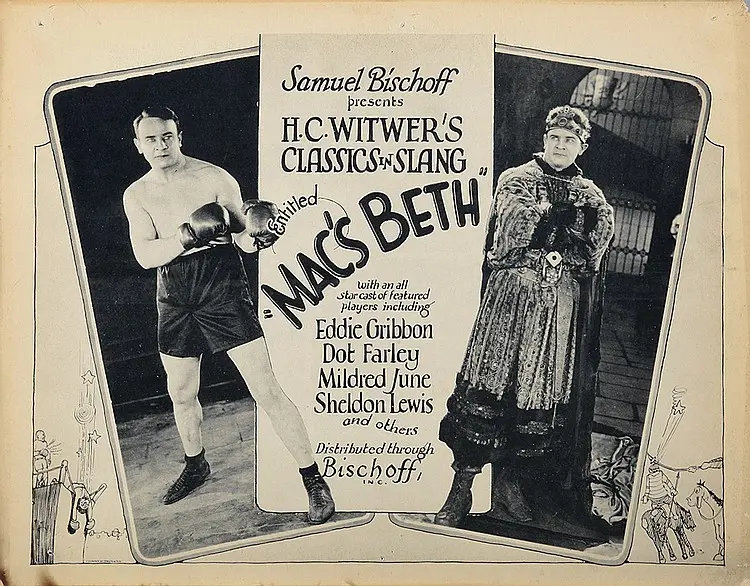
Is Mac's Beth a lost treasure of the silent era or a dated curiosity? Short answer: yes, it is a fascinating time capsule for those who enjoy fast-paced slapstick, but its reliance on 1920s-specific slang makes it a tough sell for the casual modern viewer. This film is specifically for enthusiasts of the 'Telephone Girl' series and students of early 20th-century American humor. It is certainly not for those who demand the psychological depth of something like Lord Jim or the atmospheric dread of Der Vampyr.
This film works because Mildred June possesses an undeniable screen presence that bridges the gap between physical comedy and genuine charm. This film fails because the central conceit—a pun on Shakespeare’s Macbeth—is stretched far thinner than the material can support. You should watch it if you want to see a masterclass in how silent cinema utilized intertitles to create a distinct, rhythmic voice that rivals modern dialogue-heavy sitcoms.
H.C. Witwer was the king of the 'slang' story, and Mac's Beth is a prime example of his influence on the silent screen. Unlike the more formal adaptations of the era, such as the 1917 version of Hamlet, this film revels in the vernacular of the street. The intertitles don't just provide information; they provide attitude. Gladys Murgatroyd doesn't just speak; she fires off verbal volleys that require the audience to keep pace with the shifting linguistic trends of 1924.
The comedy is derived from the collision of two worlds. On one hand, you have the high-brow aspirations of the theater, and on the other, the grit of the telephone exchange. When Gladys attempts to recite lines, her performance is intentionally clumsy, yet Mildred June plays it with such earnestness that you can't help but root for her. It’s a delicate balance. If played too broadly, it becomes annoying. If played too straight, the joke lands flat. June hits the sweet spot.
One specific scene involving a rehearsal in a cramped apartment highlights the film's strength. The use of space is claustrophobic, mirroring the social pressures Gladys feels. As she brandishes a prop dagger—a clear nod to the 'dagger of the mind'—the physical comedy from Eddie Gribbon provides a grounded counterpoint. Gribbon’s reactions are the audience's surrogate; he is the everyman confused by the sudden influx of 'culture' into his life.
Mildred June is the engine of this film. By 1924, she had perfected the persona of the 'working girl with a heart of gold and a brain of steel.' In Mac's Beth, she displays a range that goes beyond simple mugging for the camera. Watch her eyes during the switchboard sequences. There is a flickering intelligence there, a sense that she is always three steps ahead of the people on the other end of the line. It is a much more nuanced performance than what we see in contemporary shorts like A Kiss for Susie.
Dot Farley, as the comedic foil, is equally impressive. Farley was a veteran of the screen, and she knows exactly how to utilize her facial features to elicit a laugh without saying a word. Her chemistry with June is the highlight of the film’s second act. They represent two different generations of women in the 1920s: one clinging to the old ways of theatrical melodrama, and the other embracing the new, fast-paced world of modern communication.
Sheldon Lewis and Josef Swickard provide the necessary gravitas to keep the plot from floating away into pure absurdity. While their roles are smaller, they ground the film in a reality that makes the comedy more effective. When the stakes feel real, the laughs feel earned. It’s a lesson many modern comedies have forgotten. The film doesn't treat its characters as cartoons; it treats them as people caught in a cartoonish situation.
The direction is functional but effective. The pacing is erratic, almost caffeinated, which suits the subject matter perfectly. There is no time for contemplation. The film moves from one set-piece to the next with a frantic energy that mirrors the burgeoning 'Jazz Age.' The cinematography doesn't strive for the artistic heights of The Scarlet Road, but it is clean and focuses on the actors' expressions.
One interesting technical aspect is the editing during the 'Macbeth' parody sequences. The cuts become quicker, mimicking the internal chaos Gladys is experiencing. It’s a sophisticated use of montage for a comedy short. It suggests that the director understood that humor isn't just in the performance, but in the rhythm of the images. The juxtaposition of a 'regal' pose with a sudden, ungraceful fall is a classic trope, but it is executed here with surgical precision.
The set design also deserves a mention. The telephone exchange is rendered with a surprising amount of detail. It feels lived-in and busy. This contrast between the 'real' world of the exchange and the 'fake' world of the stage is central to the film’s theme. It reminds me of the satirical bite found in Cut It Out: A Day in the Life of a Censor, where the mechanics of a profession are used to mock the profession itself.
If you are looking for a deep, transformative cinematic experience, look elsewhere. Mac's Beth is not trying to change the world. However, if you want to understand the DNA of the American sitcom, this is essential viewing. It captures a specific moment in time when the working class was beginning to assert its cultural identity through humor.
The film is a reminder that people in the 1920s were just as obsessed with 'making it' and social status as we are today. Gladys is an influencer before the term existed. She uses her position at the switchboard to gain information and leverage, much like a modern social media maven. This relevance is what keeps the film from being a mere museum piece.
"Mac's Beth is a frantic, pun-heavy relic that succeeds on the sheer charisma of Mildred June, even when the script starts to fray at the edges."
Pros:
- Exceptional lead performance by Mildred June.
- High-energy pacing that prevents boredom.
- Clever use of intertitles to establish a unique voice.
- Interesting historical look at the 1920s telephone industry.
Cons:
- Some jokes are so buried in 1920s slang they are incomprehensible today.
- The supporting male characters are somewhat interchangeable.
- The ending feels rushed, a common issue with shorts of this era.
Mac's Beth is a charming, if slightly uneven, entry in the Mildred June canon. It doesn't have the emotional weight of Marie, Ltd. or the adventurous spirit of Peggy of the Secret Service, but it compensates with pure, unadulterated energy. It works. But it’s flawed. The film is a testament to the fact that while technology and language change, the desire to laugh at our own social awkwardness is eternal. It’s worth twenty minutes of your time, especially if you’ve spent the day dealing with your own modern-day 'switchboard' of emails and notifications. It is a loud, proud, and messy piece of silent history.
IMDb 6.5
1929
Community
Log in to comment.