DbcultAccessing Vault...
4.8/10
Senior Film Conservator
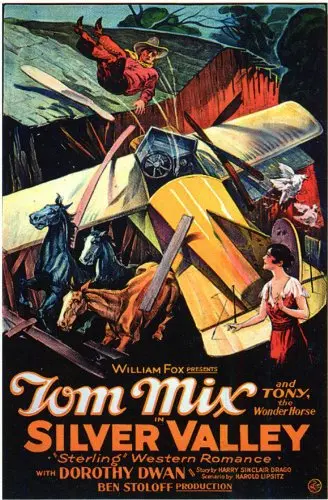
A definitive 4.8/10 rating for a film that redefined the boundaries of cult cinema. Silver Valley remains a cornerstone of transgressive art.
Short answer: Yes, but only if you have an appetite for the experimental eccentricity of late-silent cinema. Silver Valley isn't just another cowboy flick; it is a transitional artifact that captures the exact moment the Western genre began to look toward the future. This film is for those who enjoy seeing a genre in the middle of an identity crisis. It is most certainly not for viewers who demand modern logic or high-definition realism.
Direct Answer Analysis:
In the grand scheme of 1927 cinema, Silver Valley stands as a testament to the sheer physical bravery of the era's performers. If you are looking for a masterpiece of narrative depth, you might prefer The Night Horsemen. However, if you want to see a man dangle from a rope ladder attached to a biplane while chasing rustlers, Silver Valley is your holy grail. It is a lean, mean, 57-minute burst of adrenaline that proves Tom Mix was the original action hero. It works. But it’s flawed.
One cannot discuss Silver Valley without addressing the "jalopy." In an early scene that feels like a precursor to Chitty Chitty Bang Bang, Tom Tracey modifies his car with wings. It is a bizarre, steampunk-adjacent image that serves as a metaphor for the film itself. The car is the old world; the wings are the new. The way Tony the Horse reacts—snorting and backing away from this mechanical monstrosity—is one of the most honest moments in the film. Tony isn't just acting; he looks genuinely offended by the replacement of horsepower with actual engines.
This sequence sets a playful tone that the film eventually abandons for more serious stakes. Compared to the somber tones of The Combat, Silver Valley feels like it was made by a director who was simply having fun. Benjamin Stoloff, the director, understands that the audience came to see Tom Mix do something new. By 1927, the standard "cowboy on a horse" trope was becoming stale. Mix knew this. He was a businessman as much as a performer, and he knew that the sky was the next frontier.
Tom Mix was the antithesis of William S. Hart. While Hart wanted realism and dust, Mix wanted sequins and stunts. In Silver Valley, Mix is at his most charismatic. There is a specific moment when he puts on his aviator goggles—a gesture that signifies the death of the Victorian era. He doesn't look like a rancher; he looks like a movie star playing a rancher. This self-awareness is what makes the film endure.
His physicality is unmatched. When the rustlers strike and kidnap Sheila Blane (played with appropriate distress by Dorothy Dwan), Mix doesn't just ride after them. He schemes. The use of an aviator to locate the "rustler's roost" is a brilliant narrative device that allows the camera to capture sweeping shots of the California landscape. These aerial views were likely breathtaking for audiences in 1927, providing a perspective of the West that had never been seen before on such a scale.
The climax of the film involves Tom descending from a plane on a rope ladder to rescue Sheila. This isn't a trick of the lens. You can see the wind whipping Mix’s clothing and the genuine danger of the altitude. It is a sequence that rivals the best work in Miss Adventure or even the more dramatic beats of The Girl Who Came Back.
What makes this scene work is the lack of cutting. Stoloff keeps the camera wide enough to show the plane, the ladder, and the ground simultaneously. This creates a sense of spatial reality that modern action films often lose in the edit. When Tom scoops Sheila up, the tension is palpable. It’s a moment of pure cinematic joy, unburdened by the need for complex dialogue or subtext. It is primitive, yes, but it is also perfect.
Tony the Horse is more than just a mount; he is the moral compass of Silver Valley. Throughout the film, Tony’s reactions to the mechanical innovations serve as a stand-in for the traditional audience. When Tom returns from his flight to rout the rustlers on the ground, he eventually gets back on Tony. This is a crucial thematic beat. The plane is for the rescue, but the horse is for the fight. It suggests that while technology can help us see the problem, it still takes old-fashioned grit (and animal companionship) to solve it.
Compared to other animal-centric films like The Galloping Jinx, Tony’s role here is more nuanced. He isn't just doing tricks; he is expressing a character arc of jealousy and eventual reconciliation. It sounds absurd to suggest a horse has a character arc, but in the world of Tom Mix, Tony was a co-star with top billing for a reason.
Cons:
Silver Valley is a fascinating, if somewhat disjointed, piece of entertainment. It captures a world on the brink of change, where the cowboy is trading his lariat for a joystick. While it lacks the emotional weight of Stranded or the narrative complexity of Under the Rouge, it compensates with sheer, unadulterated spectacle. It is a popcorn movie from an era before popcorn was even a theater staple. Watch it for the stunts, stay for the horse, and forgive the paper-thin plot. It’s a wild ride that deserves to be remembered for its audacity.
IMDb 6.6
1933
Community
Log in to comment.