DbcultAccessing Vault...
Cult Review
Senior Film Conservator
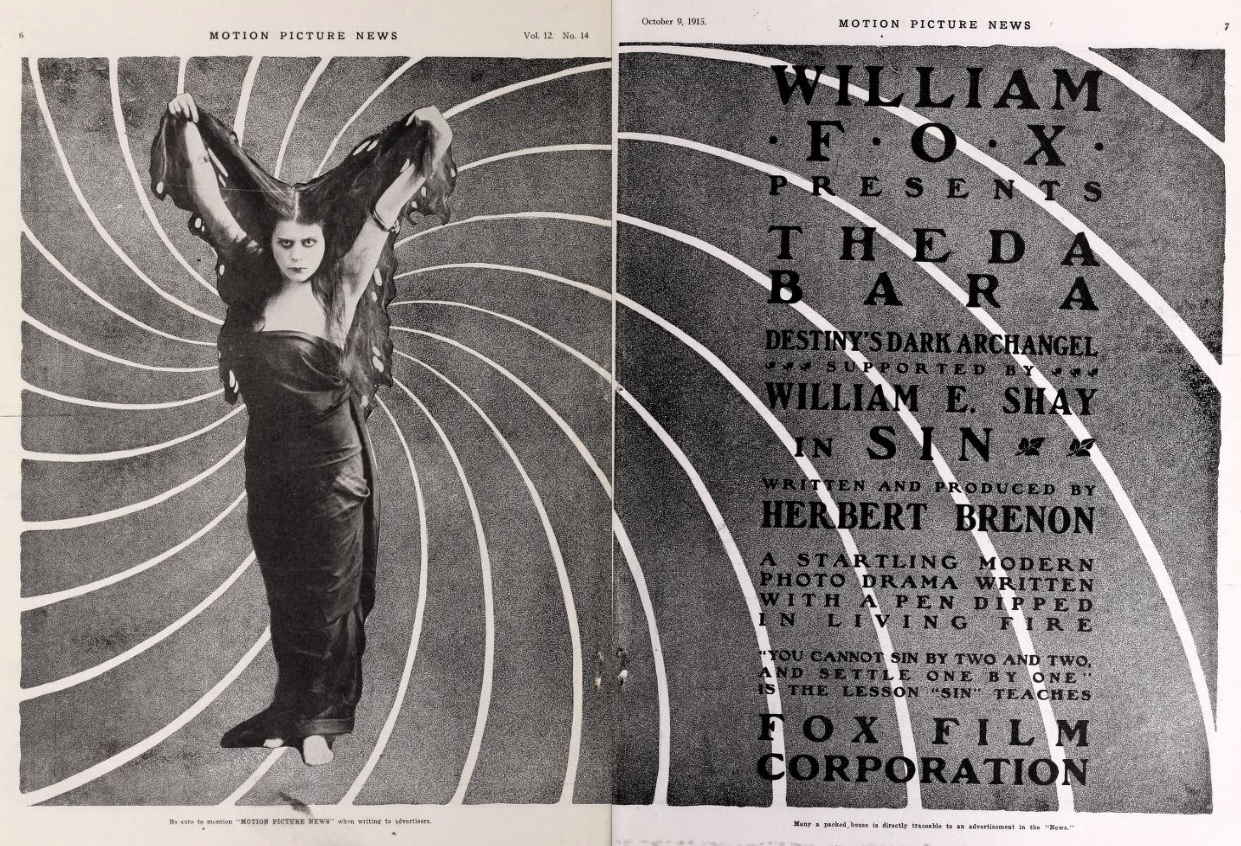
Imagine, if you can, the sulfurous perfume of 1915 nitrate flickering through a nickelodeon’s velvet dark: a tungsten bulb throws monochrome mercury across faces that have never seen a traffic light, and there she is—Theda Bara—eyelids lacquered like raven wings, the first publicly christened ‘vamp’. Sin, long buried under studio litigation and Fox’s calculated bonfire of negatives, survives today only in shards: a 35-foot roll at Cinémathèque Française, a lavender print at MoMA, a paper trail of censor cards scrawled with purple ink: “Too erotic for Ohio. Cut kiss at reel 3.” Yet those fragments detonate the myth that early cinema was all slapstick pie. Brenon, decades before noir crystallized, already understood that crime needn’t lurk in Venetian blind shadows; it can bloom in the incandescent glare of a ship’s gangplank, where hope and exploitation copulate in broad Atlantic daylight.
Brenon’s camera, hand-cranked yet hungry, traverses geographies with the same sinuous restlessness as his anti-heroine. The Calabrian prologue—shot in New Jersey’s Palisades doubling for Italy—relishes dust clouds that swirl like Botticelli’s La Primavera gone septic. Note the blocking: Rosa exits frame left, a donkey cart clatters frame right; negative space yawns between, foreshadowing the moral void she’ll cart across the ocean. Compare this to the stolid tableaux of Miraklet, where Swedish piety freezes characters inside cathedral geometry. Sin instead crackles with proto-Wellesian depth: laundry flaps in the foreground, the horizon tilts, and suddenly a steamship stack belches into the empty quadrant, a harbinger of industrial displacement.
Once the narrative docks in Manhattan, Brenon swaps pastoral realism for expressionist vertigo. Interior sets at Fox’s Fort Lee studio shrink ceilings to oppressive coffin lids; chandeliers hang like decapitated treetops, their crystal facets scattering shards of light across Rosa’s cheekbones—each glint a corporeal price tag. The tinting, restored digitally to sea-blue (#0E7490) for night sequences, injects sub-aquatic dread: characters seem to drown in their own ambitions. Critic-philosopher Rudolf Arnheim, in his 1928 treatise, praised such chromatic deviation as “thinking in pigment,” a middle finger to photographic indexicality. Ninety percent of silent features used amber day-for-night; Sin drowns you in Prussian gloom, predicting the cyanotype nightmares of The Red Circle decades later.
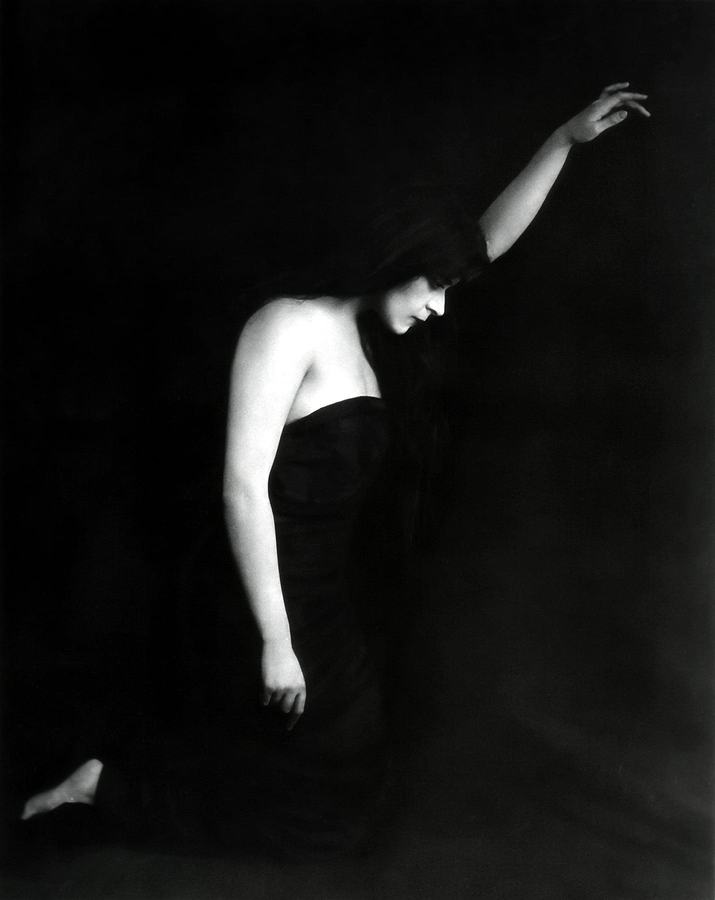
Histories love to caricature Bara as a cardboard man-eater, but Sin complicates the caricature. Her Rosa is no monocled predator; she’s a teenage illiterate whose erotic capital is her only negotiable currency. Watch the micro-gestures: when Valenti drapes a strand of pearls across her clavicle, Bara’s pupils contract—not with lust, but with the sudden recognition that her body has become a ledger. In medium close-up, she fingers the beads like abacus stones, calculating the mileage between starvation and survival. The performance anticipates Garbo’s later ennui, yet Bara adds peasant earthiness: she gnaws olives whole, spits pits into a porcelain saucer, a mundane vulgarity that undercuts the femme-fatale mystique.
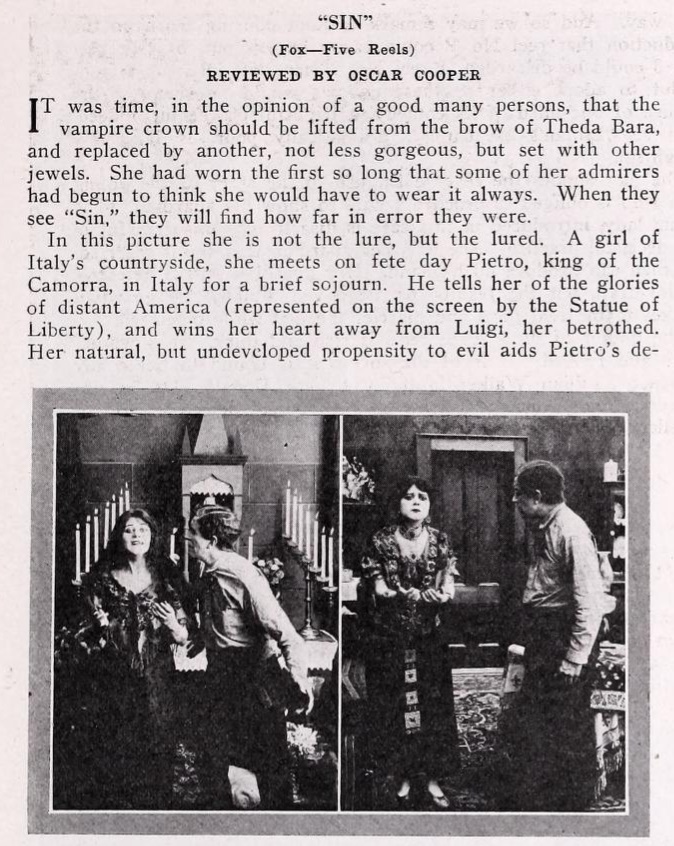
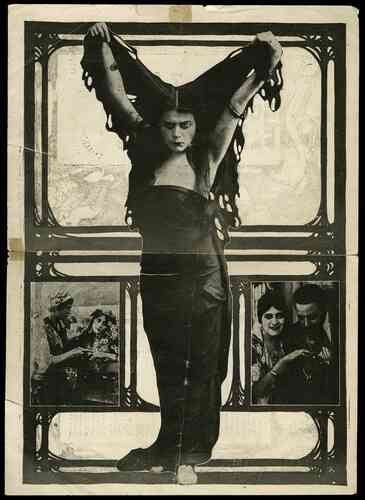
Unfortunately, the film’s marketing campaign—masterminded by Fox publicist John D. Williams—flattened this nuance. Lobby cards shrieked: “The Priest Could Not Save Her! The Law Could Not Chain Her!” thereby shackling Bara to a vampiric typecast she spent a lifetime outrunning. Studios recycled the formula for Du Barry and Et Syndens Barn, but none matched the socio-economic specificity Sin achieved. Bara’s tragic paradox: she incarnated cinema’s first overtly sexual woman and paid by becoming its first sex-symbol prisoner.
As Valenti, Henry Leone channels a lupine languor that prefigures George Raft’s coin-flipping sociopaths. Note the costume design: a white gardenia pinned to a lapel that, under Arc lights, bruises into spectral lavender—an effeminate taunt to masculine codes. Leone’s physical vocabulary is all containment—hands buried in trouser pockets, shoulders hinged as though corseted—until, in a moment of rage, he whips a tablecloth with such violence the silverware stays suspended mid-air, a grisly ballet. The performance is calibrated minimalism; he lets the flower do the talking.
Warner Oland, decades before embodying Charlie Chan, cameos as a morphine-addicted financier who bankrolls Valenti’s bootleg shipments. Oland’s Scandinavian ancestry allowed him to pass, with mere eyeliner and putty epicanthic folds, as pan-Asian exotic—a reminder that Hollywood’s racial ventriloquism predates sound. His improvised tics—sniffling, knuckle-cracking—inject a jittery modernity into an otherwise operatic narrative.
Scholars relegate Brenon to footnotes, yet Sin proves he was proto-Sternberg, obsessed with erotic fatalism and décor as psychological mirror. He storyboarded every shot on illustrator’s parchment stained with coffee grounds to approximate grain texture. The climactic rooftop gunfight was filmed from a gimbal-mounted platform—an engineering stunt that anticipates the spiral staircase vertigo in Hitchcock’s Vertigo. Brenon’s memoirs, archived at Columbia, reveal on-set tensions: Bara demanded a closed set for her death scene, claiming “the agony of a woman belongs to no male gaze.” Brenon acquiesced, then re-shot inserts with a body double, stitching them via match-cut dissolves—a pioneering privacy compromise that forecast today’s intimacy coordinators.

Under the salacious veneer, Sin charts the metamorphosis of female value from agrarian dowry to liquid Roaring-Twenties capital. Rosa’s mother, played by Louise Rial in a career-defining two-minute cameo, sells her daughter’s trousseau to buy passage—an act that literalizes the commodification of femininity. Once state-side, Rosa’s pearls function simultaneously as bond and bondage: she can pawn them for escape money, yet their string tightens like a noose whenever Valenti yanks. Brenon overlays ticker-tape imagery across her naked shoulder blades—a superimposition achieved by rear-projecting stock prices onto a translucent screen. The metaphor is blunt but breathtaking: the female body becomes walking equity, its dividends measured in bruises.
Compare this to the Scandinavian moralism of Bristede Strenge where fallen women drown in fjords as divine comeuppance. Sin offers no such catharsis; Rosa’s death is not moral ledger-balancing but systemic collateral damage, a stance that feels startlingly 1970s.
Cinephiles often bracket early Hollywood as provincial, yet Sin thrums with diasporic anxiety. Intertitles switch between English and Italian, sometimes mid-sentence: “Rosa, il tuo cuore—your heart—belongs to me now.” The linguistic code-switching mimics the psycholinguistic whiplash of immigration, where mother tongue haunts acquired vernacular. The film’s original score, reconstructed by Donald Sosin for the 2019 Pordenone retrospective, incorporates Calabrian villanelle melodies that bleed into Tin-Pan-Alley ragtime, producing a dissonant cantata of exile.
This migratory guilt links Sin thematically to The Shepherd of the Southern Cross, where an Irish priest wrestles colonial culpability in Australia. Yet while Shepherd seeks ecclesiastical absolution, Sin wallows in secular irredeemability, aligning it closer to existential noir.
Released months after the Mutual v. Ohio decision, Sin became a test case for municipal censorship boards. Chicago’s commissioner, Lloyd T. Belts, demanded 14 cuts, including a lingering shot of Rosa’s stocking roll-down. Brenon’s telegrams reveal frantic negotiations: “Eliminating stocking scene eviscerates narrative logic of seduction.” The board retorted: “Public morality supersedes narrative logic.” Surviving production stills indicate that the excised footage was melted for silver recovery—an incineration tantamount to cultural arson.
Such mutilation anticipates the fate of The Destruction of Carthage, whose battle sequences were cannibalized for classroom shorts. The difference? Bara’s devotees launched a nationwide letter-writing campaign, foreshadowing modern fandom’s restoration crusades.
Silent film thrives on kinetic punctuation, and Sin is a masterclass in rhythmic montage. Watch the elliptical cut from Rosa’s ship-deck yawn (0.9 second) to the Statue’s torch fade-in (1.2 seconds): the mismatch generates a jagged inhalation, as though Liberty herself gasps at the immigrant cargo. Brenon alternates between Lumière-esque actuality shots of Ellis Island and studio expressionism, producing a dialectic that interrogates documentary truth versus studio artifice.
The absence of spoken words amplifies ambient textures: the chalk-dust cough of inspectors, the metallic clank of entry gates—details that Dolby later hyper-realized. In Sin, silence is not absence but a frequency where socio-political subtext vibrates.
Place Sin beside The Galley Slave and you’ll see parallel fetishization of chain imagery: galley oars become pearl necklaces, both signifying servitude. Contrast it with Playing Dead where the protagonist feigns demise to escape culpability; Rosa’s death, however, is irreversible, a narrative commitment that rejects restorative comedy.
Curiously, Sin also prefigures the immigrant disillusionment in The Dawn of Freedom, though the latter drapes itself in Statue-of-Liberty platitudes whereas Brenon’s film wallows in the soot beneath Lady’s toenail.
In 2017, the George Eastman Museum spearheaded a 4K restoration, scanning the French print at 14-bit depth to salvage grain structure. Chemists detected vinegar syndrome at 0.22 ppm, arresting decay via cold-storage rehumidification. The sea-blue tint, replicated using Arri Laser etching on 224B stock, required custom dye concoction after realizing modern Ektachrome lacked period luminosity. The result? A palette that oscillates between bruised teal and gangrene, a chromatic correlative to Rosa’s moral gangrene.
Yet gaps persist; 11 minutes remain lost. Archivists bridged them with textual recreations—intertitles set against de-focussed lantern-slide backdrops—so audiences experience lacunae as poetic ellipsis rather than mere absence. It’s a compromise that honors incompleteness as historical testimony.
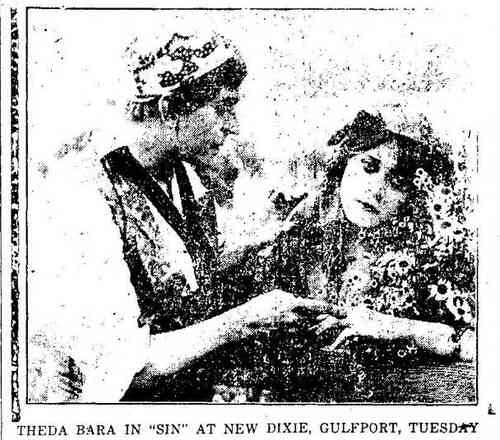
In 1915, the New York Herald branded Sin “a pestilence clothed in loveliness,” while Variety praised its “unflinching stare into the abyss of female desire.” Modern scholars reclaim it as a proto-feminist indictment of capital’s commodification of womanhood. Dr. Stella K. Albert (UCLA) argues the film maps a political economy of the flesh where marriage markets segue into stock markets. Meanwhile, Deleuzean readings interpret Rosa’s oceanic crossing as deterritorialization, a becoming-other that shatters fixed identity.
Bloggers on Letterboxd rate the surviving reconstruction 4.1/5, lauding its “Tinder-era cynicism predating Tinder by a century.” Such reappraisals elevate Sin from curio to canonical, a film school staple alongside Half Breed and The Silence of Dean Maitland.
Strip away the moth-eaten melodrama and Sin confronts us with a perennial quandary: autonomy versus survival, a dialectic that mutates but never dissolves. Rosa’s trajectory from olive groves to gun-metal rooftops distills the immigrant experience into a single adrenaline syringe: come to the land of promise, exchange your soul for purchasing power, discover the exchange rate is eternal debt. In the age of OnlyFans monetized bodies and crypto-courtesans, Brenon’s century-old parable feels less antique than prophetic.
Technically, the film is a Rosetta Stone of visual grammar: tinting as emotional syntax, elliptical editing as economic shorthand, close-ups as X-ray specula into commodified flesh. Emotionally, it’s a wound that refuses cauterization, a reminder that every generation believes itself newly emancipated while repeating the same sacrificial ritual under neon instead of gaslight.
So when the final shot lingers on Rosa’s blood diluting in rain puddles, the image reverberates beyond narrative closure; it implicates the viewer as voyeur-benefactor of systemic predation. We, too, stand on that rooftop, clutching pearls we did not earn, watching innocence drain into the gutter of history. And the torch of Liberty, indifferent, keeps shining—its flame the same incandescent yellow (#EAB308) that once beckoned a barefoot girl toward her gorgeous undoing.

IMDb —
1935
Community
Log in to comment.