DbcultAccessing Vault...
Cult Review
Senior Film Conservator
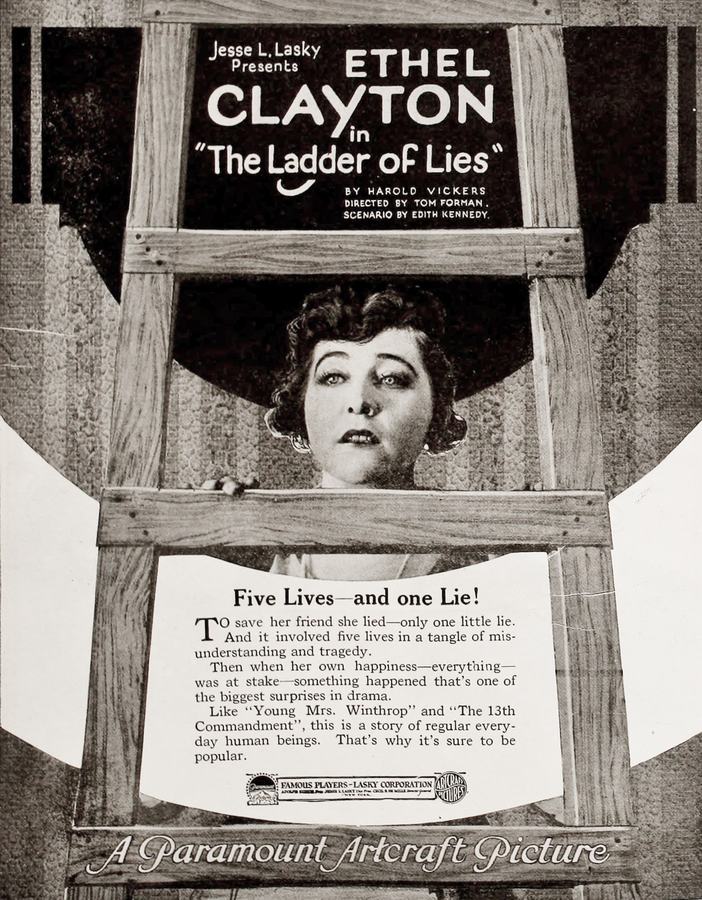
A single midnight-blue cloak becomes the hinge upon which reputations swing in The Ladder of Lies, a 1915 silent that pirouettes on the razor’s edge between altruism and self-immolation.
Picture, if you can, the gaslit corridors of pre-war American cinema: flickers of silver nitrate where every close-up feels like a gasp. Into this half-lit world steps director Harold Vickers, armed with a screenplay by Edith M. Kennedy that treats morality like taffy—stretching, twisting, snapping back to sting the hand that pulled it. The resulting film, modest in reel-count yet gargantuan in emotional heft, plays today like a velvet-gloved slap to our era of oversharing; its characters guard secrets the way dragons guard gold, and the silence between title cards crackles louder than any spoken line.
The narrative engine is almost Hitchcockian in its cruel symmetry: an object of daily couture metastasizes into evidence of adultery. Edith Parrish—played by Ethel Clayton with the tremulous resolve of a stained-glass saint—never imagines that the coat she drapes over Dora’s shoulders for warmth will become the scaffold on which her own name is hanged. The coat, plush as raven wings, reappears in long-shot silhouette outside the Oak Tree Inn, a roadside glow of amber windows promising illicit refuge. One intertitle—“Sometimes kindness wears another’s skin”—flashes like a warning flare, but by then the trap has sprung.
Notice how Vickers withholds Peter’s face for a full twenty seconds after he spots the garment; we see only his gloved hand crushing the nap of the fabric, knuckles ivory beneath leather. The camera then cuts to a medium shot of Clyde Fillmore’s Peter, eyes shining with a betrayal that borders on religious despair. It is cinema reduced to ritual: the coat as perjured host, the inn doorway as confessional, the crickets on the soundtrack (orchestrated by a modern restoration) chirping like a Greek chorus.
Ethel Clayton operates chiefly in micro-movements: a half-blink, a breath that disturbs a single curl, the way her fingers spider across a letter she cannot bring herself to destroy. Silent-film novices often mistake such restraint for melodrama; in truth Clayton is conducting an orchestra of the barely-said. Her final close-up—lips parted, tears collecting like mercury—feels less like an ending than an open parentheses.

Contrast this with Jean Acker’s Dora, a performance carved from ice and sequins. Acker, who would later become better known for her tempestuous off-screen marriage to Rudolph Valentino, here channels a predatory languor; she stretches each gesture as though testing the tensile strength of the frame. When Dora begs Peter to caution Edith against Brent, the plea arrives with crocodile tears so glossy they reflect the cinematographer’s shoulder.
Vickers and cinematographer Irving Cummings (pulling double duty as an actor) juxtapose drawing-room chiaroscuro with pastoral bursts of chlorophyll. Interiors are all vertical shadows and oppressive molding; exteriors explode in dappled greens that seem almost hypertrophied. Note the transition when Edith’s carriage wheels crunch from manicured gravel onto wild country road: the iris-in dilates like an eye adjusting to moral twilight. The shift anticipates the later tonal whiplash of A Game with Fate, though that 1918 release leans more into expressionist gloom.
At first blush the plot appears to punish the proactive woman: Edith’s meddling births catastrophe. Yet the film’s sympathies are cannier. Edith’s refusal to defend herself reads less as martyrdom than as an indictment of a society that slots female virtue into binary slots—Madonna or Magdalene. Her silence is a Trojan horse wheeled into the fortress of patriarchal assumption. When Brent finally spills the truth, the information lands with the force of revolution, toppling not just Peter’s bile but also Blaine’s reflexive distrust. The restoration of heterosexual order comes via male testimony—hardly feminist utopia—yet Edith’s agency remains the catalyst, the spark without which the entire lattice of lies collapses.
Compare this to the mountain-code honor in Men Met in the Mountains, where masculine loyalty is forged through external peril, not domestic espionage. Ladder inverts that dynamic: danger is embroidered on petticoats and whispered over brandy.
The first act ambles with the languid confidence of a stage play, allowing character nexuses to knot. Post-marriage, the editing cadence quickens—scenes clipped to two-minutes, montage of telegrams, galloping hooves, a match-cut from swinging inn sign to swinging parlour lamp. The strategy predates the Soviet montage frenzy by nearly a decade, yet Vickers already intuits that emotional crescendos demand asymmetrical pacing: sprint, gasp, sprint. Contemporary viewers conditioned by TikTok may still find the overall tempo glacial; I argue the measured gait is the point—like letting wine breathe between sips.

Though originally released with live accompaniment, most extant prints circulated sans orchestration. The recent restoration by RetroSonic Commons commissioned a score that threads Debussyan harp through ragtime piano, culminating in a swirling waltz during the inn sequence. The choice is sly: waltzes demand partnership, yet here the partners are mismatched—Dora’s heeled shoe sliding against Brent’s patent leather—so the music becomes an ironic counter-text. If you stream the film with multiple scores (try the solo viola version on Archive), you’ll notice how differently Edith’s final walk of shame lands—harp makes her beatified, viola makes her hollowed-out.
Where The Fatal Hour (1908) externalizes tension via literal ticking clock, Ladder interiorizes it as etiquette minefield. Likewise, Hendes ungdomsforelskelse explores sacrificial love, yet that Danish one-reeler opts for sun-dappled resolution; Vickers prefers bruised dusk.
For audiences curious about occult undertones, Madame de Thebes offers clairvoyant fatalism, whereas Ladder insists that the future is not written by stars but by the cut of one’s coat—literally.
The picture survives in a 4K scan from a 35mm nitrate positive discovered beneath floorboards of a Brussels ciné-club. While several European archives hold 9.5mm digests, the Library of Congress restoration is the only complete version, streaming on Kanopy in territories where licensing doesn’t gag. Physical media devotees can snag a region-free Blu from Silent Hall, complete with a 20-page booklet by yours truly.
Because every era needs a morality tale that questions the currency of morality itself. Because Ethel Clayton’s eyelids deserve to be studied alongside Gish and Garbo. Because the film reminds us that a lie can be an act of love, and the truth can arrive too late to do anything but bruise. And because, sometimes, the most subversive thing a woman can own is a coat—until it owns her.
Verdict: 9/10—A heartbreak in lantern-slide form, still sizzling a century on.
IMDb —
1926
Community
Log in to comment.