DbcultAccessing Vault...
Cult Review
Senior Film Conservator
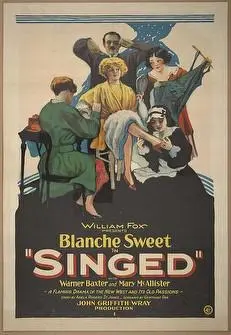
Is the 1927 silent drama Singed a hidden treasure worth excavating today? Short answer: yes, but only if you can stomach the toxic, transactional nature of its central romance. This film is a fascinating time capsule for those who enjoy gritty social climbing narratives and the 'nouveau riche' anxieties of the Roaring Twenties, but it is certainly not for anyone looking for a modern, healthy portrayal of partnership.
This film works because Blanche Sweet delivers a performance that bypasses the typical melodrama of the era, offering a raw, jagged portrait of a woman who buys her way into a heart that was never truly for sale. This film fails because the final act relies on a bizarrely violent 'accident' to force a reconciliation that the characters haven't actually earned. You should watch it if you are interested in the intersection of class warfare and gender roles in pre-Code cinema.
Singed is a film obsessed with the cost of moving upward. It begins in the dirt, where Dolly (Blanche Sweet) functions as the emotional and financial engine for Royce Wingate (Warner Baxter). There is a specific scene early on where Dolly hands over her money—money earned in the rough-and-tumble environment of the dance hall—to fund Royce’s oil interests. The way the camera lingers on her hands as she gives up her security for his dream is heartbreaking. It sets the stage for a story where love is treated as a capital investment.
Director John Griffith Wray does an excellent job of contrasting the visual language of the two worlds. The oil fields are chaotic, filled with deep shadows and a sense of physical danger. In contrast, the New York sequences are sterile and cold. When Royce becomes a 'financial power,' the sets expand into cavernous, lonely spaces. This shift mirrors the emotional distance growing between the leads. It’s a visual trick we see in other films of the era, such as Under the Rouge, where the setting reflects the moral state of the protagonist.
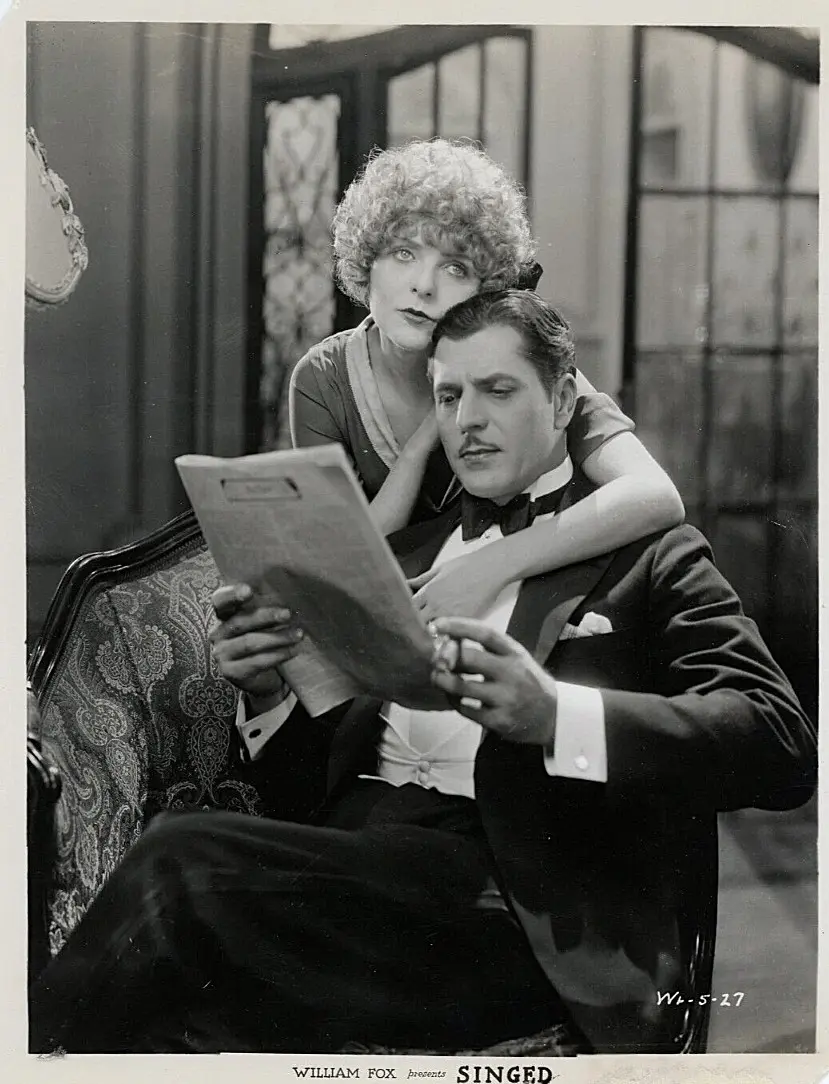
Blanche Sweet is the undisputed soul of this film. While Warner Baxter plays Royce with a certain stiff arrogance that suits a social climber, Sweet is doing something much more complex. She portrays Dolly as a woman who knows exactly who she is, even as she tries to become someone else for the man she loves. In the scenes where she is 'socially frowned upon' in New York, you can see the flicker of humiliation behind her eyes. She isn't just a victim; she’s a shareholder who is being denied her dividends.
Consider the moment she realizes Royce is planning to marry Amy, the society belle. The shift in Sweet's body language—from supportive partner to a woman scorched by betrayal—is terrifyingly effective. It’s a far more grounded performance than the hyper-theatrical acting found in something like The Night Horsemen. Sweet understands that in a silent film, the smallest twitch of the mouth can communicate more than a hundred intertitles.
The main conflict of Singed is the struggle between loyalty and social mobility. It asks whether a person can truly transcend their origins if they abandon the people who helped them rise. The film portrays the American Dream as a double-edged sword that cuts those who hold it too tightly.
The film takes a sharp, dark turn when Dolly threatens to throw acid in Royce’s face. This isn't just a plot point; it’s a manifestation of the 'singed' metaphor that gives the movie its title. She has been burned by his ambition, and she intends to burn him back. The sequence where Royce shoots the bottle out of her hand is technically impressive for 1927, but narratively jarring. It’s a moment of extreme violence used as a bridge to a 'happy' ending.
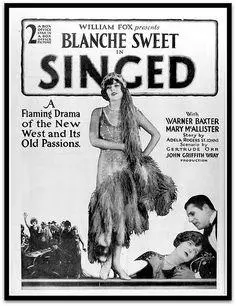
This is where the film loses its footing for a modern audience. Royce shoots her—accidentally, the film claims—and this act of near-homicide leads to their reconciliation. It’s ugly. But it’s real in the context of 1920s melodrama. The film argues that through this shared trauma, the social barriers are finally stripped away. It’s a hard pill to swallow. It makes the ending of The Girl Who Came Back look positively logical by comparison.
If you are a student of cinema history, yes. Singed offers a fascinating look at how early Hollywood viewed the 'new money' class. It doesn't shy away from the fact that Royce is essentially a gold-digger in reverse, using Dolly’s 'dirty' money to enter 'clean' society. The cinematography in the oil field scenes alone justifies a viewing. However, if you are looking for a story with a moral compass that matches a 21st-century perspective, you will likely find the ending repulsive.
The film is also a great companion piece to The Galloping Jinx, as both deal with men who are fundamentally 'irresponsible' but find themselves thrust into positions of power. Singed is the darker, more cynical brother of that narrative. It suggests that success doesn't change a man; it only reveals who he was all along.
Pros:
- Exceptional set design that highlights the class divide.
- A strong, non-traditional female lead who takes agency over her finances.
- High-stakes tension that builds effectively toward the climax.
- Warner Baxter’s portrayal of a charming but vacuous social climber.
Cons:
- The pacing drags slightly during the New York society parties.
- The 'Amy' character is underdeveloped and serves only as a plot device.
- The moral of the story is murky at best and problematic at worst.
Singed is a scorched-earth policy of a movie. It burns down the idea of the self-made man by showing the woman standing behind him with a checkbook and a heavy heart. While the ending is a lie that the film tells itself to satisfy the censors of the time, the journey there is filled with genuine tension and atmospheric brilliance. It’s a film about being burned by the very things we think will save us. It’s flawed, it’s messy, and it’s absolutely worth a look for those who like their history with a side of acid. The ending is a lie, but the performance of Blanche Sweet is the truth.
IMDb —
1918
Community
Log in to comment.