DbcultAccessing Vault...
6.6/10
Senior Film Conservator
A definitive 6.6/10 rating for a film that redefined the boundaries of cult cinema. Sisters remains a cornerstone of transgressive art.
The first time I saw Sisters I was hunting for a 35 mm print rumored to languish in a Portland basement—what I found instead was a 9.5 Pathé baby reel missing its final intertitle, yet the gap felt intentional, like a cavity where a tooth once sang with nerves. That missing card is the film’s soul: an aporia that dares the viewer to supply absolution.
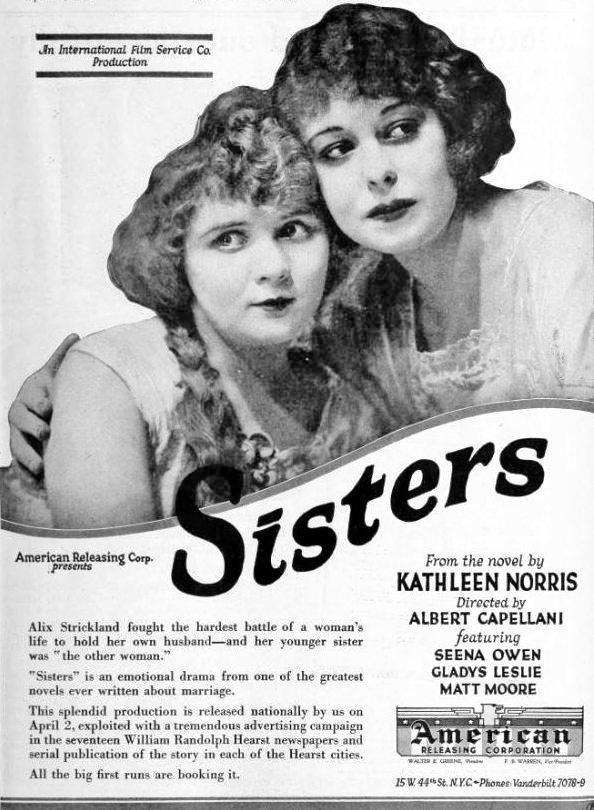
Directed by the under-sung E. Lloyd Sheldon from a story Kathleen Norris sketched on hospital stationery while volunteering with the Red Cross, Sisters belongs to that twilight strain of post-war American cinema that treated the close-up as confessional booth. Where Griffith flooded the frame with Babylonian spectacle, Sheldon narrows aperture to pupils: Gladys Leslie’s cerulean irises seem to leak seawater every time the camera dollies in, while Seena Owen (as Alix) lets her gaze calcify into porcelain—every blink a minor earthquake.
Sheldon orchestrates domestic space like a chess problem. The Strickland home is introduced in a 270° pan that starts on the doctor’s brass nameplate, slides past a maid pinning linens, and ends on Cherry’s wedding portrait—already askew. Note the wallpaper: peacocks whose eyes have been over-painted with lamp-black so they watch nobody. It’s the earliest hint that observation in this world is a moral act. When Peter (Matt Moore) later strides through the same corridor, the camera withholds his point-of-view; we see only his reflection multiplied in three bevelled mirrors, a visual premonition that any choice he makes will fracture into selves he cannot reassemble.
Compare this to the logging camp where Martin (Robert Schable) meets his mishap: redwoods dwarf the men, cross-cuts scream like cicadas, and the fatal tree descends in a single under-cranked shot—three frames per second—so the crash feels both balletic and obscene. Sheldon cuts from the impact to a close-up of sawdust drifting across the lens; for a second the auditorium seems to cough. It’s as though nature itself has grown weary of these mortals trading hearts like playing-cards.
Norris’s original novelette drips with interior monologue; adapting it, Sheldon converts first-person lament into third-person shards. The intertitle that reads “Peter sailed at dawn—his cabin baggage labelled Yokohama, his heart labelled regret.” arrives over a shot of the ocean liner’s wake dissolving into Cherry’s empty glove on the pier. The metaphor is hardly subtle, yet the cut carries an erotic charge: the glove, too small for Alix’s hands, becomes a synecdoche for the sister who will inherit both house and hunger.
Later, when Cherry pleads “Take me where the clocks strike different,” the letters jitter onscreen as though carved by a trembling knife. It’s one of the few instances where the film’s typography bleeds into its emotional hemorrhage; most silent-era intertitles aim for marble serenity, but here the words themselves seem to hyperventilate.
Tom Guise’s Dr. Strickland dies off-screen, yet his presence haunts like a half-remembered prescription. Guise reportedly asked to play the role with a stethoscope still around his neck in the after-life flashback—a request Sheldon denied, opting instead for a silhouette projected onto bedroom wallpaper, the doctor’s profile merging with the headboard’s carved tulips. The effect is gentler, sadder: authority distilled to shadow.
Gladys Leslie has the hardest task—make selfishness luminescent. She succeeds by calibrating every smile to arrive a half-second too early, as though happiness were a train she must catch before it remembers to leave. Watch the breakfast scene: Cherry lifts a china cup, notices a hairline crack, and her lower lip folds under the incisor—an infinitesimal gesture that betrays her dread of flawed unions. Without that crack, the entire moral arc would tilt into farce.
Matt Moore’s Peter is often dismissed as “the man who hesitates,” yet his stillness is strategic. In the orchard confrontation he barely moves while Alix unleashes a silent tirade; the camera lingers on his clenched hand, knuckles whitening in increments that feel like seasons. Moore understood that in melodrama, the body must become a barometer.
Seena Owen, swathed in jet beads that clack like typewriter keys, turns Alix into a study in postponed rage. Her forgiveness at the finale could have read as capitulation, but Owen plays it like someone who has calculated the interest on loneliness and finds the debt too steep to collect.
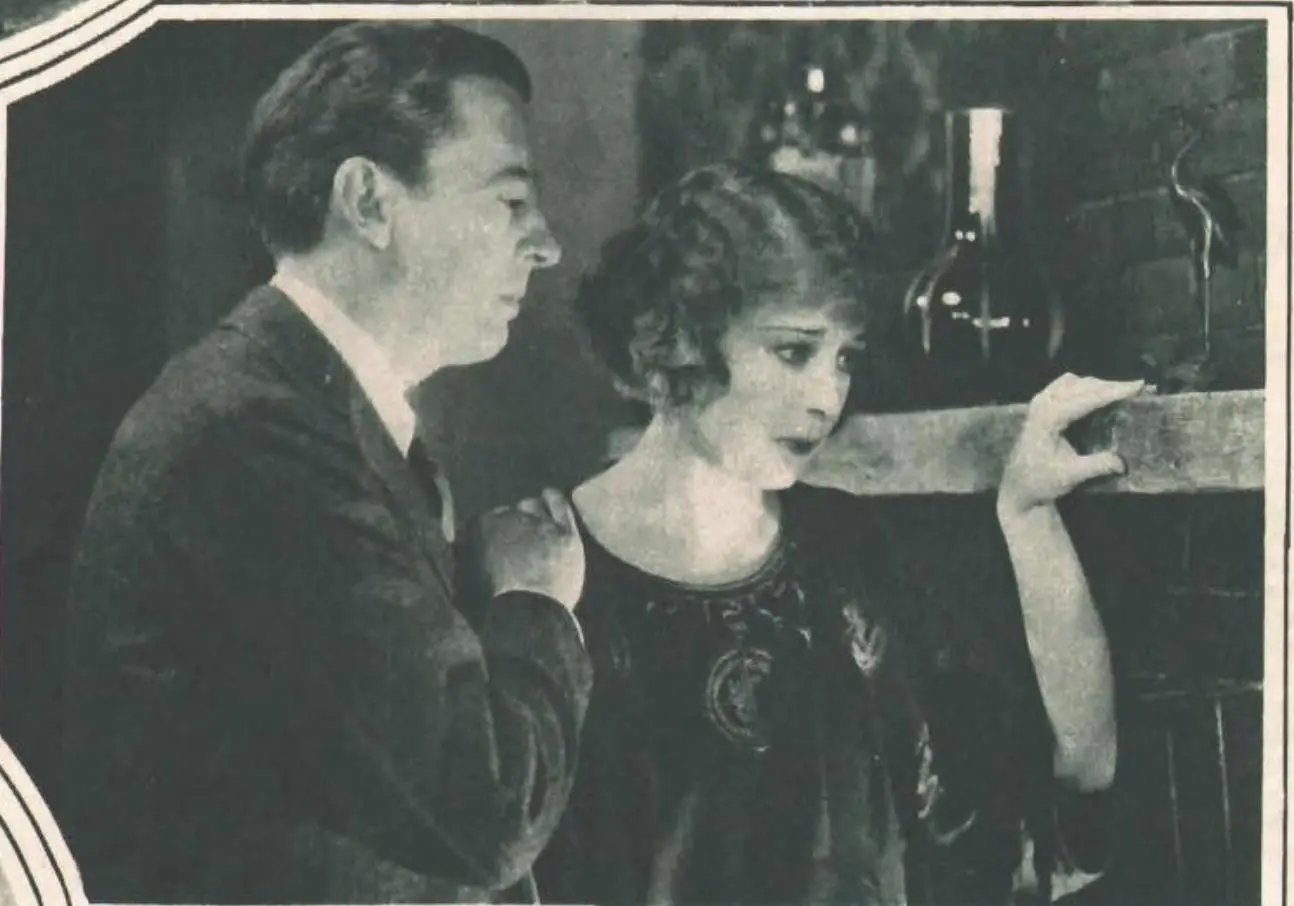
Windows recur as moral verdicts. Cherry first sees Martin through a French door whose panes are divided into cruciform lattices; she is literally framed by a cross she has yet to bear. Conversely, the climactic train-station goodbye (shot on location in Eureka, California) positions the sisters inside a glazed waiting room while Peter remains outside, breath fogging the glass—communication reduced to palm prints.
Water imagery bookends the narrative: the ocean that divides Peter from Cherry becomes the river that carries her back to Martin. Sheldon overlays the logging-camp waterfall onto Cherry’s face via double exposure so that tears and torrent share the same celluloid skin.
Most striking is the motif of wax. Alix seals letters with black sealing-wax shaped like a scar; when she forgives Peter, she lifts the stamp too soon, leaving a wing-shaped smear—an accidental emblem of release.
Sheldon edits courtship like a waltz—three-beat cadences: glance, gesture, cut. Adultery, however, is montaged to ragtime: 14 shots in 18 seconds, hands, doors, railway timetables. The disparity in tempo makes the affair feel not passionate but panicked, a staccato hiccup.
Compare this to the 7-minute single take that tracks Alix pacing the parlour after discovering Peter’s betrayal. The camera glides on a baby-buggy wheel improvised as dolly; every creak of the floorboard syncs with her heartbeat, a metronome of mortification.
At its Broadway premiere in November 1922, Sisters was scored by S. L. Rothapfel with a string quartet and a single oboe. The oboe’s plaintive rise during the orchard scene allegedly prompted Variety to call it “a reed that knows it’s being broken.” Modern festivals usually resort to digital loops; last year’s Pordenone screening paired it with Max Richter recompositions—an anachronism that nonetheless sold out, proving the story’s ache travels.
Unlike Beau Revel where the rake pays with exile, or Anna Karenina’s tragic plunge, Sisters refuses to punish female desire with death. Cherry’s return to Martin is neither triumph nor penance; it’s a concession to the gravitational pull of shared history. Alix’s retention of Peter is similarly pragmatic—she keeps not the man she loved but the man who now owes her everything. The film ends on a medium two-shot of the reconciled couples framed like bookends, yet the empty space between them yawns wider than any divorce decree.
Sisters vanished from American screens by 1926, resurfacing only in a 1978 Bologna archive nitrate auction mislabelled The Wrong Sister. Most prints lack the final intertitle; cinephiles have inserted everything from Bible verses to grocery lists. The ambiguity is now integral: does Peter stay, leave, dissolve? The film refuses to close its own wound.
Sheldon would direct only two more pictures before retiring to Santa Fe to paint landscapes. Asked in 1954 whether he regretted the brevity of his filmography, he replied, “I told one truth; most people need a dozen.” That truth—about the arithmetic of forgiveness, the compound interest of betrayal—makes Sisters less a museum relic than a living bruise. Stream it if you must, but better to catch it in a mildewed theatre where the projector’s chatter sounds like conscience adjusting its seat.
Verdict: A chamber melodrama that whispers where others shriek, Sisters earns its place beside the era’s grand tragedies by proving that the smallest hand can hold the largest hurt.
IMDb 5.1
1921
Community
Log in to comment.