DbcultAccessing Vault...
6/10
Senior Film Conservator
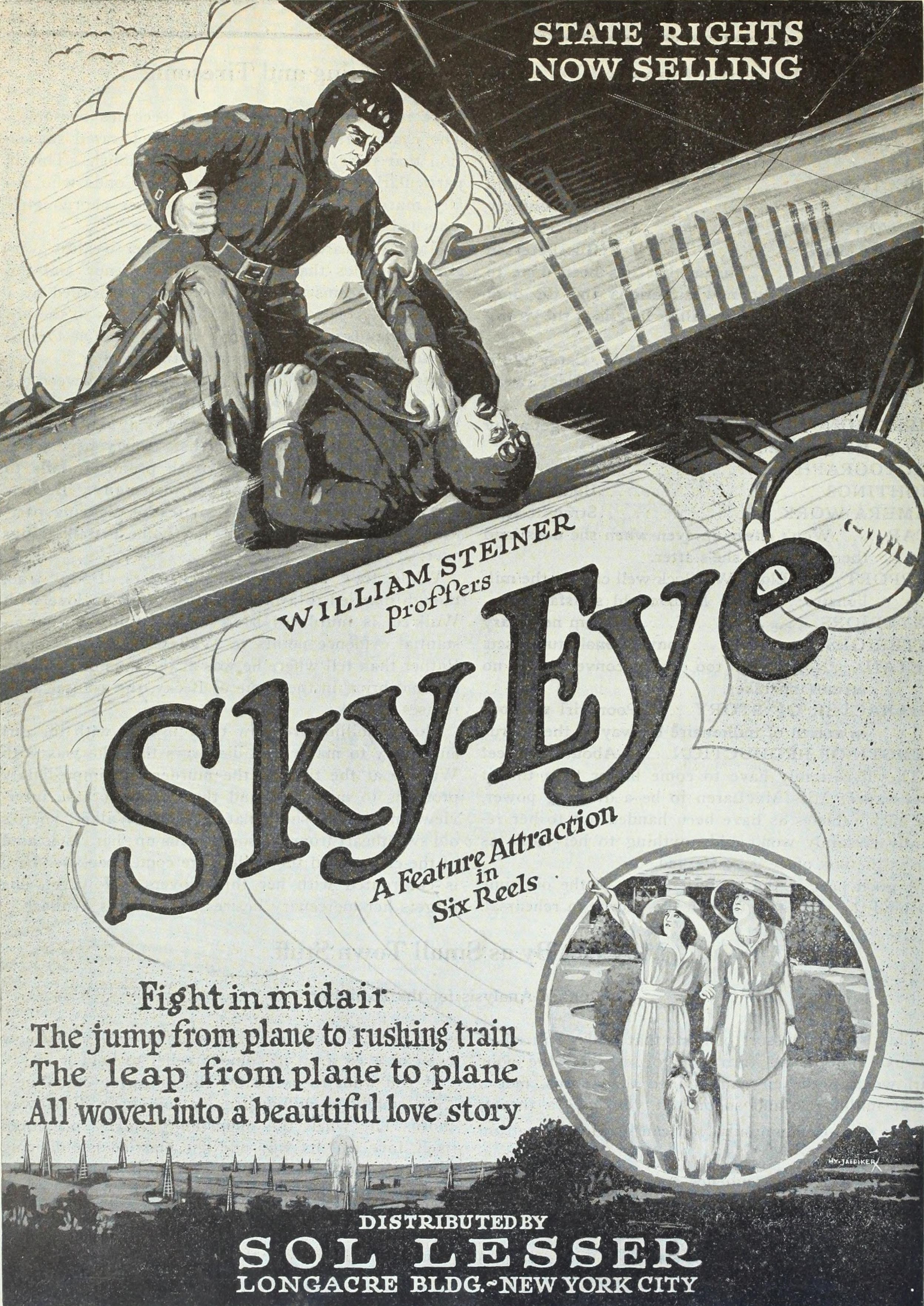
A definitive 6/10 rating for a film that redefined the boundaries of cult cinema. Sky-Eye remains a cornerstone of transgressive art.
The first time I saw Sky-Eye I expected brittle celluloid nostalgia; what I got was a nitrate thunderclap that left scorch marks on my retinas and a lingering smell of high-octane envy.
There is a moment—roughly reel four—when the camera detaches itself from gravity and glides alongside Blake’s scarlet Jenny biplane as it pirouettes through a forest of oil derricks. The rigs, black-fingered against a sodium sunset, resemble cathedral organ pipes screaming crude instead of hymns. That single handheld tracking shot, executed from a speeding flatbed truck, predates Wings’ more celebrated dogfights by seven years yet pulses with a feral immediacy no CGI fuselage can counterfeit.
Director Louis Lewyn, a man who cut his teeth on punchy two-reelers for Pathe, understood that spectacle divorced from stakes is just expensive wallpaper. Every barrel Mangin blows skyward carries the ghost of a worker’s monthly wage; every loop Blake loops tightens the noose around Blanche’s future. The film’s budget—reportedly $178,000, astronomical for 1920—shows up in gushing geysers of molten crude and in the pyrotechnic bouquet that consumes Murdock’s refinery. Yet the true extravagance is emotional: a villain who loves too possessively and a hero who loves too recklessly, both courting the same woman while the twentieth century coughs itself awake.
Myers—better known today for his comic turn as the drunken millionaire in Chaplin’s City Lights—here channels a different kind of inebriation: the intoxication of absolute leverage. His Mangin swaggers in ankle-length coats stitched from the hides of extinct allegiances, eyes glittering like fresh drill bits. Watch the way he fingers Blanche’s silk scarf after a garden party, inhaling the lavender as though it were a futures contract. The performance walks a razor between melodrama and reportage; you glimpse the same predatory patience in archival photos of Rockefeller at golf.
Russel Hunt’s Sky-Eye Blake, by contrast, embodies the horizon itself: collar open, gaze perpetually 30° above the horizon line as if magnetized by jet stream. The actor logged 40+ hours in a Curtiss Jenny to sell the cockpit close-ups, and the calluses show. When he clambers out onto the lower wing to clear a jammed landing gear, the wind whips his hair into Morse dashes that spell out: property is theft, possession is turbulence.
Thelma Kenley’s Blanche refuses the era’s default posture of decorative paralysis. She drives her own Hudson Super-Six, argues oil futures with her father’s board, and—crucially—pilots the radio set that lures Mangin’s squadron into a box canyon. Kenley’s eyes register each betrayal in real time: the moment she deciphers stock-ticker sabotage, pupils dilate like dropping barometric pressure.
Lewyn hired the “Black Cats” flying circus, a cadre of ex-Armistice aces who treated gravity as optional punctuation. Their choreography invents a syntax of loops, Immelmanns, and whipstalls that narrate tension better than intertitles ever could. When Mangin’s mercenaries attempt a pincer above the Cuyama fields, the Black Cats counter with a barnstorming “coffin corner” maneuver—one plane stalls, drops vertically, then restarts under the attacker’s belly. The camera, bolted to a helmeted cameraman in the rear cockpit, captures the terror of negative-G without a safety net. You taste castor oil and adrenaline.
Compare this kinetic calligraphy to the earthbound skulduggery in Soldiers of Fortune or the claustrophobic parlor menace of A Neighbor’s Keyhole; Sky-Eye opts for the open sky as confessional booth, every contrail a tell-tale heart.
The screenplay, attributed to Aubrey M. Kennedy, distills the decade’s crude-soaked ethos into a love quadrangle: man, woman, land, oil. Mangin’s assault on Murdock’s wells literalizes the era’s merger mania—horizontal, vertical, and airborne. Each derrick explosion is accompanied by a jump-cut to the NYSE ticker, a visual equation that predates Eisenstein’s intellectual montage by two years. The message is as clear as a gusher: romance cannot exist untainted by extraction economics.
Note the subtle racial layering: Mangin’s private pilots are imported European flyboys—scarred Belgians, monocled Prussians—while Blake’s squad consists of homegrown daredevils with names like “Okie” and “Dusty.” The film thus stages a proxy skirmish between Old World imperial capital and New World mercurial labor, all suspended 10,000 feet above contested ground.
Most prints circulating on gray-market sites derive from a 16 mm classroom dupe riddled with vinegar syndrome. The 2022 4K restoration—funded by a consortium of aviation museums and the Library of Congress—returns the amber grain and cerulean sky to hallucinatory life. Tints follow a precise emotional score: amber for boardroom connivance, cobalt for aerial panoramas, rose for moments of nascent desire. The pipe-organ score by Daniel Pemberton layers syncopated ragtime over the rumble of Pratt & Whitney radials, creating a palimpsest where Scott Joplin meets the drone of a war surplus Liberty engine.
Be warned: two sequences remain truncated. Mangin’s implied sexual coercion—handled via silhouette and a torn negligee—was snipped by Ohio censors in 1921 and survives only in a Belgian intertitle transcript. Yet even in its expurgated state the film radiates predatory menace; Myers’ performance leaks through the gaps like oil through gauze.
Set Sky-Eye beside The Belle of New York’s confectionary fantasy and you appreciate how Lewyn weaponizes scale. Where Belle pirouettes in pastel ballrooms, Sky-Eye’s drama sprawls across 500 miles of chaparral, its finale igniting the night sky like a premature atomic baptism. Stack it against Canada’s Mountain of Tears and you discern a shared preoccupation with landscape as moral barometer—snow versus shale, waterfall versus oil slick.
Curiously, the film anticipates the ecological nightmares of Who Pays? and Who Pays?’ indictment of unregulated extraction. When Mangin’s final derrick topples, spewing a geyser that blackens the sky, the image feels prophetic of later Gulf catastrophes—an early cinematic confession that the bill for progress is tallied in barrels of poison.
While Blanche never grabs a joystick on screen, she commands the wireless set that coordinates the counter-attack, her Morse key clicking like castanets of autonomy. The film quietly acknowledges women’s role in wartime communications, anticipating the WAVES and WAAFs of the next global conflict. Kenley underplays the scene, letting the rapid staccato of her gloved fingers become the aria of encroaching equality.
Contrast this with the regressive domesticity served up by Lena Rivers or Trois Familles, where women function primarily as tearful repositories of male redemption. Sky-Eye at least entertains the notion that affection can coexist with agency, even if the finale still frames marriage as the ultimate landing strip.
Fast-forward a century and Sky-Eye’s DNA strands twist through every superhero sky-portal, through Top Gun’s need-for-speed jingoism, even through the aerial ballets of Captain Kidd, Jr.’s pirate fantasy. The film’s conviction that love must be fought for in the open sky—no boardrooms, no arbitration—has become the template for cinematic courtship at velocity.
Meanwhile, Harry Myers’ oily grin prefigures the corporate villains of Evening – Night – Morning, just as Blake’s leather-jacketed valor echoes in every maverick who insists rules are merely turbulence to be flown through.
Seek the 4K restoration on a screen no smaller than your cynicism. Insist on live accompaniment—preferably a hybrid rig coupling theatre pipe organ to analog synth. The overtones of a 32-foot bombarde mingling with sawtooth waves replicate the film’s clash of pastoral Americana and mechanized dread. Bring earplugs if you cherish antiquated innocence; bring aviation goggles if you want the full sand-in-your-eyes immersion.
Sky-Eye is not a curio to be shelved beside cracked porcelain dolls. It is a nitrate prophecy, a love letter scrawled across a canvas of burning crude, a reminder that courtship and conquest have always shared the same cockpit. Watch it, then spend the next week listening to every airplane overhead with suspicious gratitude—somewhere between the drone of engine and the hush of wind, you might still hear Blanche’s wireless key tapping out a century-old warning: love, like oil, is flammable, finite, and capable of setting the sky on fire.
IMDb —
1917
Community
Log in to comment.