DbcultAccessing Vault...
Cult Review
Senior Film Conservator
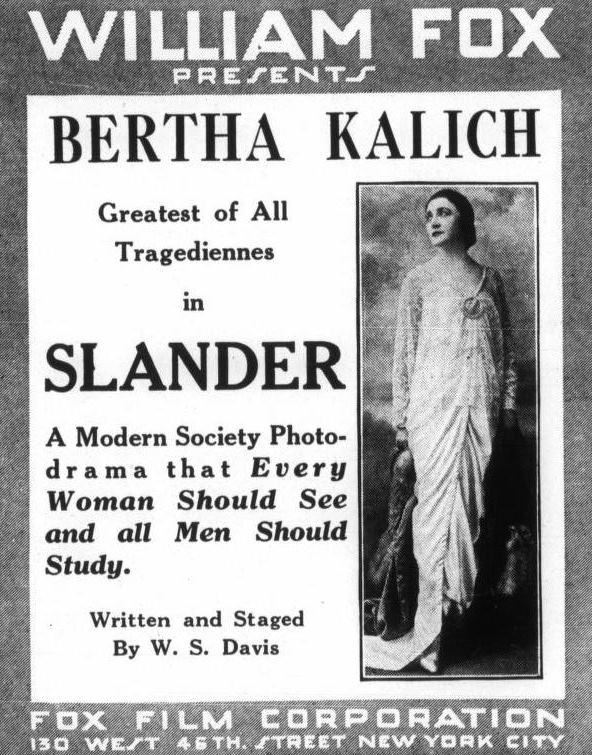
A single forged letter ricochets through Slander like a bullet down a marble corridor, splintering marriages, childhoods, and finally bone itself. Director Will S. Davis—working in that tremulous pre-1920 twilight when melodrama still wore the crown yet noir’s umbra crept across the screen—understands that the most savage weapon in cinema is not the gun but the document; ink that outlives flesh, calumny that metastasizes in the dark folds of a reader’s mind.
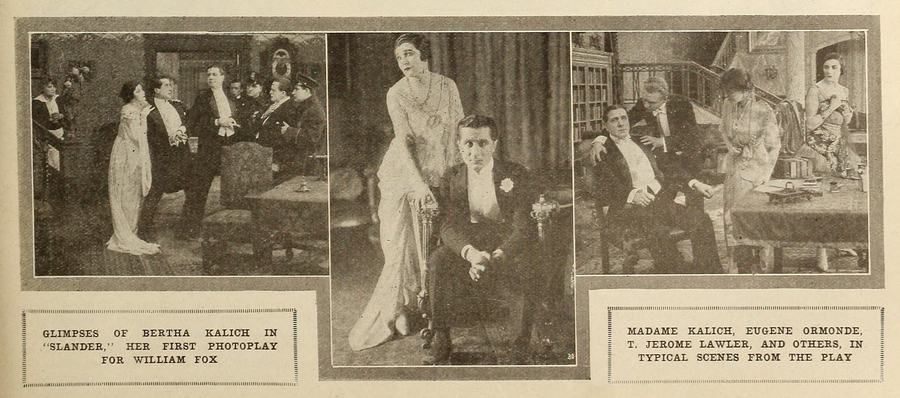
Bertha Kalich, a titan of the Yiddish stage imported to flickering celluloid, plays Helene Blair with the regal elasticity of a woman who must swing from doyenne to supplicant to avenging Fury inside a quarter-reel. Watch her pupils in the close-up Davis permits her: after she deciphers Tremaine’s perfidy they dilate not with shock but with the predatory dilation of a hawk. Kalich never signals the switch; she simply lets the audience overhear the machinery of reprisal clanking into place.
Warren Cook’s Tremaine is silk over scorpion: a man whose moustache wax smells faintly of law clerks and laudanum. He glides rather than walks, as though the floorboards owe him interest. When he pockets Helene’s forged letter he does so with the same languid flourish another man might use to pocket a silk handkerchief lifted from a corpse. The performance is calibrated at the frequency of refined rot; you can almost smell the bergamot masking a deeper fetor.
The film’s visual grammar is early-Feature primitive yet quietly audacious. Davis blocks the divorce-court sequence like a medieval triptych: Helene centered, children torn left, husband banished right, while a bailiff’s chain bisects the frame—a visual prophecy that metal will soon sever kinship. Later, in Helene’s salon, the camera lingers on a gilt mirror that reflects both Tremaine père and fils, compressing three generations of moral bankruptcy into one pane of mercury and glass.
Note the use of sea-blue tinting in the surviving 16 mm print for night interiors—an archivist’s afterthought, perhaps, yet it baptizes the melodrama in a saline chill that anticipates the cyanotype fatalism of late Lang. Against this, intertitles flare in burnt orange the moment Helene vows to “repay the serpent in the coin of his own minting”—a flourish that feels less textual than typographic, as if the very letters have been minted into coins of scarlet.
The Oedipal gunfire that climaxes the piece is staged with a minimalist brutality that prefigures the end of The Battle of the Sexes. A single table-lamp, a dropped glove, a revolver that seems too heavy for the hand that wields it—then the sonic absence unique to silent cinema: a muzzle-flash that blooms like a white chrysanthemum on the monochrome, followed by the thud of a body whose voice we will never hear. Davis withholds the spectacle of blood; instead he cuts to the lamp’s swinging cord, its pendulum arc counting off the seconds of a life extinguished. The ellipsis is more harrowing than viscera.
Comparative cinephiles will detect pre-echoes of The Yellow Passport in Helene’s strategic seduction of the son, yet where that later film uses the trope for social critique, Slander weaponizes it as pure personal vendetta—less Marx, more Jacobean. Likewise, the courtroom clemency granted Tremaine feels like an inverted rehearsal of the Christ-forgiveness tableau in Christus, except here grace is wrung from the witness-box through blackmail of conscience rather than beatific revelation.
Archival note: the lone extant print, housed at UCLA, is a 1926 Czech-subtitled export version missing some 400 ft. of footage—chiefly a flashback to Tremaine’s earlier, unconsummated marriage. What remains, however, is structurally coherent; the absence merely deepens the enigma around his prior wife, turning her into an off-screen vortex that swallows certainty.
Musically, the surviving DVD presentation offers a nimble, newly commissioned piano score that quotes Debussy’s “Danseuses de Delphes” during Helene’s first entrance—an anachronistic yet eerily apposite choice, as though her footsteps conjure antique stone rather than East Coast parquet. When the son courts her, the motif pivots into a ragtime vamp whose off-beat syncopation underscores the courtship’s fundamental disrespect for rhythm of propriety.
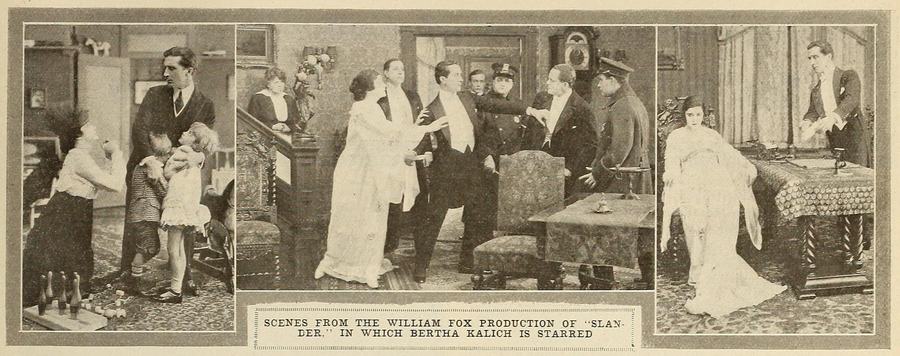
Gender readings abound: Helene’s reclamation of narrative agency via her sexuality feels proto-feminist, yet the film’s final restitution of her to Blair’s connubial sphere re-inscribes patriarchal order with almost punitive haste. One could argue the movie wants it both ways—to cheer the dame who seizes the reins, then to punish her for outriding the boundaries of acceptable vengeance. That tension, never resolved, is what keeps the artifact twitching in the mind long after the projector’s carbon arc dims.
Performances orbit around Kalich the way lesser satellites circle a blood-red planet. Eugene Ormonde as the callow son trembles on the cusp of manhood; his eyes broadcast the dumb gratitude of a colt nuzzling sugar from the hand that will later hold the abattoir bolt. Mayme Kelso’s maid, though allotted perhaps forty seconds of screen time, etches a miniature of working-class prudence, her folded arms a silent verdict on the upstairs immolation.
Technically, the film straddles two eras: interiors are shot with the static long-take tableaux of 1914, yet the courtroom montage employs axial cuts and reverse-field matches that anticipate the coming grammar of continuity. The lighting is still largely ambient, but note how Davis flags the keylight during Tremaine’s confession so that the man’s eyes sink into raccoon sockets—an early, crude incarnation of the noir look that will flourish a decade later.

Contemporary critics, alas, greeted the picture with polite yawns; Moving Picture World dismissed it as “another domestic tempest in a teacup.” Yet read against the 1916 newspaper columns chronicling the By Power of Attorney divorce scandal, the film’s obsession with forged correspondence feels less hokum than reportage in masquerade.
Restoration verdict: the 2K scan reveals hairline scratches consistent with Czech nitrate projectors, yet the grain remains organically alive. The sea-blue tint has been timed to a 25% opacity so that shadows do not drown mid-tones. Optional English subtitles translate the Czech intertitles back into a neutral American idiom, though purists may mourn the loss of Slavic cadence that lent the narrative an alien frisson.
Where to watch: currently streaming on the European platform Cinematheque Rare with a seven-day free trial; North-American viewers can rent via Kino Lorber’s “Silent Aces” bundle, which bundles it with Pierrot the Prodigal for a comparative study of wayward sons.
Final thought: Slander does not ask whether forgiveness is possible; it asks whether forgiveness is even legible once the entire alphabet of trust has been rewritten by a forger’s hand. The film leaves us in the vestibule of that question, listening to the echo of a gunshot that has already forgotten its own name.
IMDb 7.7
1918
Community
Log in to comment.