DbcultAccessing Vault...
Cult Review
Senior Film Conservator
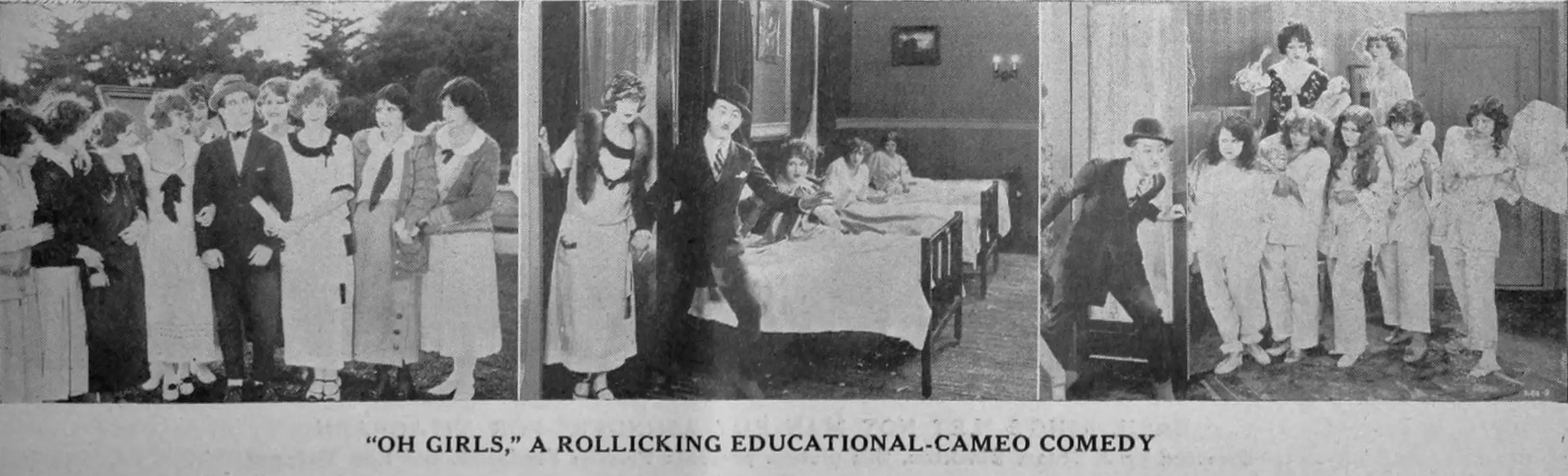
The year 1924 was a peculiar epoch in the evolution of the silver screen—a time when the industry was simultaneously flirting with the high-concept gravity of The Hidden Law and the sprawling, patriotic fervor of The Birth of Patriotism. Yet, beneath the veneer of these prestige productions, a parallel universe of pure, unadulterated kineticism was thriving. This was the realm of the 'Mermaid Comedy,' a brand synonymous with Educational Pictures, and 'Oh! Girls!' stands as a quintessential artifact of this frantic tradition. It is a film that eschews the moralizing weight found in contemporaries like The Morals of Hilda, opting instead for a breathless celebration of adolescent rebellion and physical drollery.
At the heart of this two-reeler is the Waverly school for girls, a setting that serves as both a sanctuary and a prison for Virginia Vance’s character. The plot is deceptively simple: Sidney Smith, playing the quintessential lovestruck swain, intends to spirit Virginia away into the sunset of matrimony. However, standing in their way is Cliff Bowes, the 'not-too-bright' guardian whose very presence is a masterclass in the art of the 'human pinball.' While films like Sacred Silence utilized silence to build tension, 'Oh! Girls!' uses it to amplify the rhythmic cacophony of a well-timed fall.
The brilliance of the film lies not in its narrative complexity, but in its architectural choreography. The Waverly school is not merely a backdrop; it is an obstacle course. Every window, ladder, and hallway becomes a vector for a potential gag. Unlike the rugged, unforgiving landscapes of Code of the Yukon, the domestic and institutional spaces here are malleable, subject to the whims of Sid’s desperation and Cliff’s clumsiness. The juxtaposition of the rigid school environment with the fluid, chaotic movements of the cast creates a visual friction that remains remarkably engaging even a century later.
Virginia Vance occupies a unique space in the 1920s comedy landscape. Often overshadowed by the likes of Mabel Normand, Vance possesses a sharp, reactive timing that is on full display here. In 'Oh! Girls!', she isn't the passive prize to be won, a trope frequently seen in Fair But False. Instead, she is an active participant in her own elopement, a co-conspirator who navigates the school’s corridors with a mix of anxiety and audacity. Her performance provides a necessary grounding for the more hyperbolic antics of Cliff Bowes.
The chemistry between Vance and Sidney Smith is palpable, characterized by a frantic urgency. Smith, a veteran of the slapstick scene, brings a wiry energy to Sid. He is the engine of the film, constantly pushing the action forward, even when the logic of the scene threatens to collapse. When compared to the more somber romantic dynamics in The Crucible of Life, the relationship in 'Oh! Girls!' feels refreshingly modern in its shared goal of institutional disruption.
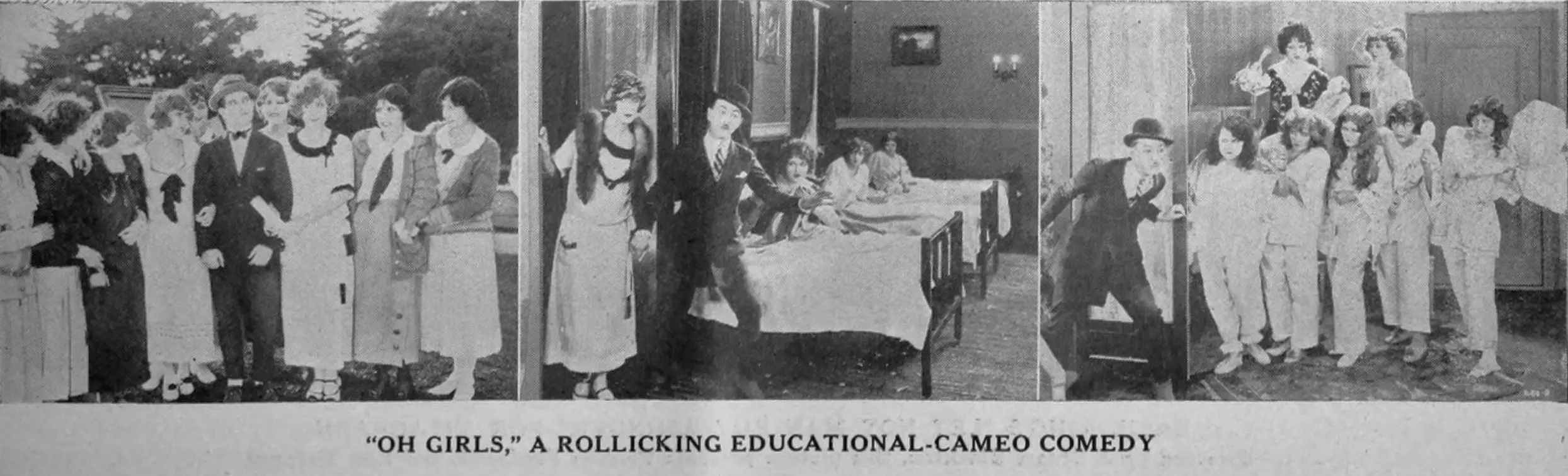
Cliff Bowes’ portrayal of the guardian is perhaps the film’s most enduring element. By 1924, the trope of the 'dim-witted authority figure' was well-established, yet Bowes breathes new life into it through sheer physical commitment. His performance is a fascinating contrast to the more nuanced character studies found in David Garrick. Bowes doesn't just fail to stop the elopement; he fails spectacularly, often becoming the architect of his own demise. His movements are a flurry of limbs and bewildered expressions, a stark contrast to the stoic heroism found in The Reclamation.
What makes Bowes’ character so effective is the lack of malice. He isn't a villain in the traditional sense, but rather a man perpetually outpaced by the world around him. This lack of antagonistic weight allows the film to maintain its light, effervescent tone. Even when the stakes involve the social scandal of a schoolgirl elopement—a theme handled with much more gravity in A Factory Magdalen—the presence of Bowes ensures that the audience is never more than a few seconds away from a laugh.
Technically, 'Oh! Girls!' is a marvel of its time. The editing is crisp, designed to maximize the impact of every gag. In an era where some films were still struggling with the transition from stage-like setups to cinematic language—see the somewhat stilted pacing of Christus—this short comedy moves with the precision of a Swiss watch. The use of title cards is sparse but effective, allowing the physicality of the actors to carry the narrative weight. The lighting, though standard for the period, effectively highlights the expressive faces of Vance and Bowes, ensuring that no nuance of their comedic timing is lost to the shadows.
The film also benefits from a certain 'anything goes' philosophy that permeated 1920s shorts. There is a sequence involving a ladder that defies both gravity and common sense, echoing the surrealist tendencies that would later define the genre. It is this willingness to push the boundaries of reality that separates a 'Mermaid Comedy' from the more grounded, often bleak realism of something like Tainted Money (1924).
When we look back at the cinematic output of 1924, it’s easy to get lost in the heavyweights. We analyze the moral quandaries of A World of Folly or the international intrigues of Der Rächer von Davos. However, films like 'Oh! Girls!' provide a necessary counterweight. They remind us that the early movie-going experience was as much about visceral joy as it was about narrative depth. While 'Twas Henry's Fault might have explored the domestic friction of the time, 'Oh! Girls!' explodes that friction into a full-blown comedic riot.
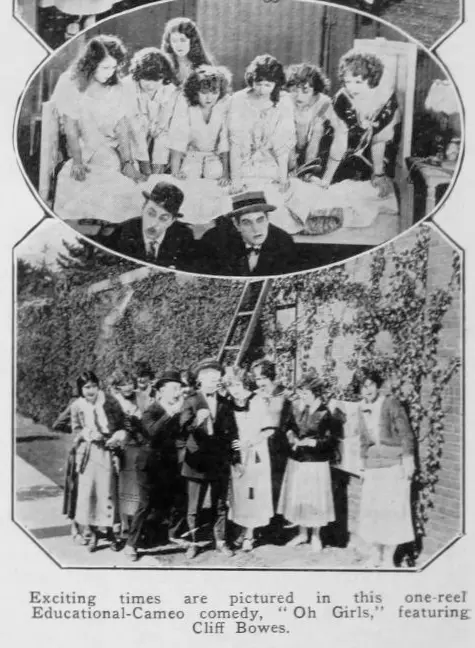
The inclusion of Merta Sterling in the cast adds another layer of comedic pedigree. Sterling, often known for her 'tough woman' or eccentric roles, provides a perfect foil to the more conventional beauty of Vance. Her presence adds a touch of the grotesque to the proceedings, a common element in silent slapstick that often goes unremarked by modern critics. This diversity of comedic styles—from Vance’s charm to Bowes’ stupidity and Sterling’s eccentricity—makes for a rich, multifaceted viewing experience.
In the grand tapestry of film history, 'Oh! Girls!' might be considered a minor thread, but it is a brightly colored one. It captures a moment in time when the world was shaking off the dust of the Great War and embracing a more frantic, irreverent form of entertainment. It is a film that demands to be seen not as a museum piece, but as a living, breathing example of the power of physical comedy. It lacks the pretension of the era’s 'art' films, yet it possesses an inherent artistry in its execution.
If you find yourself weary of the slow-burn dramas and heavy-handed allegories of the early 20th century, 'Oh! Girls!' is the perfect antidote. It is a reminder that sometimes, the most profound thing a film can do is make you laugh at the sight of a man falling off a roof in the name of love. It is a short, sharp shock of cinematic joy that remains as potent today as it was in 1924. While it may not offer the philosophical depth of The Hidden Law, it offers something arguably more valuable: a pure, unadulterated escape into a world where the only thing that matters is the next gag.
Ultimately, the legacy of 'Oh! Girls!' is found in the DNA of every romantic comedy that followed. The tropes established here—the bumbling guardian, the resourceful lovers, the institutional setting—would be refined and recycled for decades. But there is something raw and vital about this early iteration that later versions often lack. It is the sound of a medium finding its voice, or more accurately, finding its laugh. For anyone interested in the roots of screen comedy, this film is an essential, if fleeting, stop on the journey through the silent era.
Rating: A vibrant 8/10 for its sheer energy and the comedic prowess of the Vance-Bowes duo.
IMDb —
1929
Community
Log in to comment.