DbcultAccessing Vault...
Cult Review
Senior Film Conservator
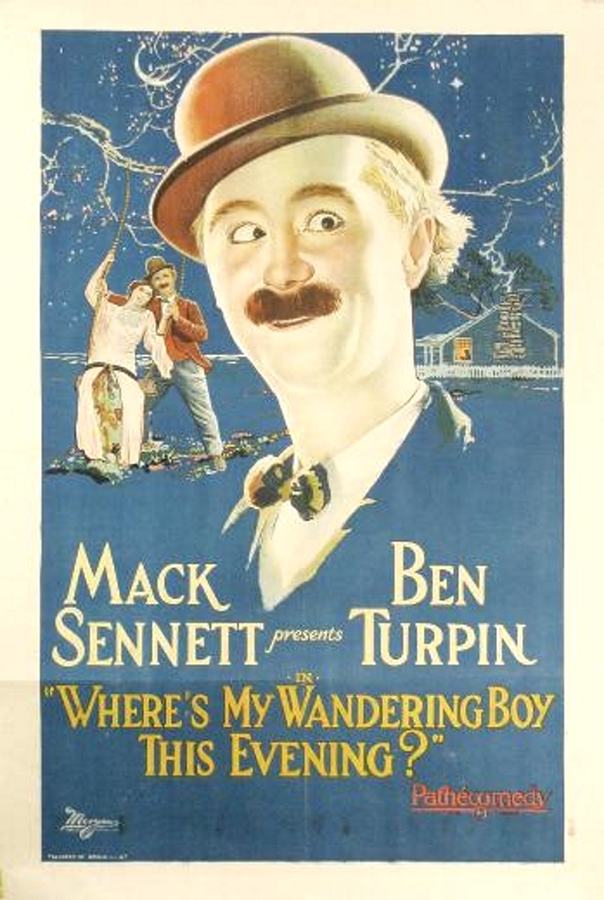
In the pantheon of silent cinema, the year 1923 stands as a pivotal moment where the raw, unbridled energy of the early nickelodeon era began to fuse with a more sophisticated sense of narrative structure. Where's My Wandering Boy This Evening? emerges from the Mack Sennett studio not merely as another assembly-line comedy, but as a fascinating artifact of cultural transition. It takes a title steeped in the saccharine sentimentality of 19th-century temperance songs and subjects it to the high-velocity deconstruction of the Sennett 'fun factory.' To watch this film today is to witness a collision between the old world’s moral anxieties and the new world’s obsession with kinetic spectacle.
The casting is a masterstroke of physical incongruity. Ben Turpin, whose eyes seem to be perpetually searching for two different exits at once, provides a center of gravity that is inherently unstable. Unlike the athletic grace of Buster Keaton or the balletic precision of Charlie Chaplin, Turpin’s comedy is rooted in a fundamental biological rebellion. His wandering boy is not just spiritually lost; he is physically disoriented, a state that mirrors the dizzying pace of the early 20th-century urban sprawl. When we compare his performance here to the more grounded roles seen in The City Chap, we see how Turpin elevates the 'country bumpkin' trope into something almost surrealist.
Supporting Turpin is the legendary James Finlayson. Before he became the perennial antagonist to Laurel and Hardy, Finlayson was honing his 'double-take' and 'slow burn' under Sennett’s tutelage. In this film, his interactions with Turpin create a friction that drives the comedic engine. Finlayson’s face is a topographical map of frustration, a stark contrast to the blissful ignorance radiating from Turpin’s squint. This dynamic is far more aggressive than the social interplay found in Cecil B. DeMille’s Male and Female, showcasing how slapstick could strip away class pretension through sheer physical violence.
The film’s portrayal of the city is one of predatory geometry. The boy’s journey from the pastoral safety of his mother’s home to the treacherous streets is a visual descent into a labyrinth of traps. Sennett’s directors—though often uncredited or working as a collective—understood that the environment itself must be a character. The sets in Where's My Wandering Boy This Evening? are designed to collapse, explode, or betray the characters at any given moment. This sense of a world that is fundamentally 'unsafe' reflects a post-war cynicism that was beginning to permeate even the most low-brow comedies of the era.
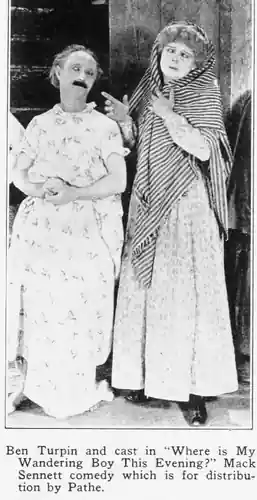
There is a sequence involving a high-society gala that serves as a biting parody of the era's melodrama. While films like The House of Intrigue played these settings for tension, Sennett uses them for total subversion. The presence of Priscilla Bonner and Madeline Hurlock adds a layer of genuine beauty that makes the inevitable descent into pie-throwing or furniture-smashing all the more jarring. It is the juxtaposition of the elegant and the absurd that gives the film its lasting power.
"The wandering boy is not merely a figure of pity, but a vessel for the chaotic energy of a world that has forgotten its own center."
One cannot discuss a Sennett film without mentioning the technical ingenuity of the stunts. The camera work here, while appearing primitive to the modern eye, was at the cutting edge of what was possible in 1923. The use of under-cranking to accelerate movement creates a hyper-reality that feels almost like an early form of animation. This kineticism is something we see explored in different contexts in documentary-style works like Panama and the Canal from an Aeroplane, where the camera’s movement itself is the attraction. Here, the movement is harnessed to serve the gag.
Then there is Teddy the Dog. In the silent era, animal actors were often given more screen time and better character arcs than the human bit players. Teddy’s ability to react to the unfolding madness with a stoicism that rivals Buster Keaton is a highlight of the film. He provides a moral compass in a narrative that is otherwise spinning out of control. His inclusion reminds us of the cross-species camaraderie often found in films like Comradeship, though here it is played for laughs rather than pathos.
While it is easy to dismiss Where's My Wandering Boy This Evening? as mere fluff, there is an undercurrent of genuine social anxiety. The 'wandering boy' was a trope used to warn of the dangers of the city—alcohol, gambling, and 'loose' women. By turning this warning into a farce, Sennett is essentially mocking the moral guardians of his time. The film functions as a satirical bridge between the heavy-handed moralizing of The Saleslady and the nihilistic humor of the later sound era. It suggests that the city isn't just a place of sin, but a place of magnificent, hilarious chaos where the only sin is taking yourself too seriously.
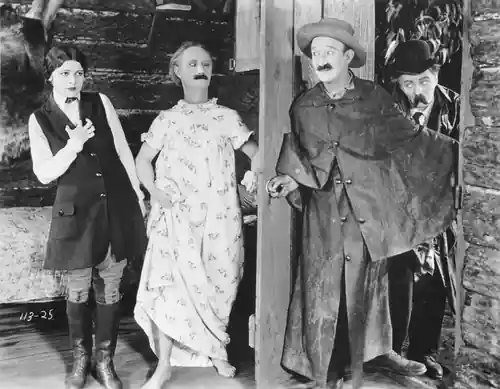
The performance of Dot Farley as the mother is particularly noteworthy. She embodies the melodramatic excess of the Victorian stage, her grief so over-the-top that it becomes a comedic element in its own right. This meta-commentary on acting styles is a recurring theme in Sennett’s work, notably in his parodies of grand epics like Carmen. By making the mother’s anguish ridiculous, the film frees the audience to enjoy the boy’s 'corruption' as a series of fortunate accidents.
Visually, the film benefits from the stark chiaroscuro that was a hallmark of the era's cinematography. The indoor scenes, particularly the dens of iniquity the boy wanders into, are lit with a murky intensity that suggests danger, only to be punctured by a bright, white-light gag. This interplay of light and shadow is reminiscent of the more serious European efforts like Weltbrand, though utilized here for entirely different emotional ends. The clarity of the print preservation allows us to appreciate the subtle textures of the costumes and the grittiness of the location shooting in early Los Angeles.
The pacing is relentless. Unlike Once Aboard the Lugger, which allows its scenes to breathe, this film is edited with a rhythmic violence. Every shot is a setup for a payoff, and every payoff is a setup for a larger catastrophe. It is a masterclass in the 'Sennett tempo,' a style of filmmaking that demanded total attention from the audience and left them breathless by the final reel.
In the broader context of film history, Where's My Wandering Boy This Evening? serves as a reminder of a time when cinema was still discovering its own power to subvert. It doesn't have the political weight of Gira política de Madero y Pino Suárez, nor the exoticism of The Pagan God, but it possesses a raw, populist energy that is undeniably infectious. It is a film that celebrates the resilience of the human spirit—or at least, the resilience of the human body when faced with falling bricks and speeding cars.
The ensemble cast, including the underappreciated Billy Gilbert and Ford West, creates a tapestry of eccentricity that feels surprisingly modern. Even when compared to other 1923 releases like Bringing Home Father or The Tamer, the Wilder, this film stands out for its sheer commitment to the bit. It is a testament to the fact that while technology changes, the sight of a cross-eyed man failing to navigate a revolving door is a timeless piece of art. It is a quintessential Sennett production: loud, fast, and brilliantly stupid.
Ultimately, the 'wandering boy' finds his way, but the journey is far more interesting than the destination. The film invites us to wander with him, to lose our sense of direction in the pursuit of a good laugh, and to realize that in the world of Mack Sennett, being lost is the only way to truly be found. It remains a vital piece of silent comedy history, a vibrant explosion of celluloid that continues to resonate with anyone who has ever felt a little bit cross-eyed in a straight-eyed world.
IMDb —
1922
Community
Log in to comment.