DbcultAccessing Vault...
2.2/10
Senior Film Conservator
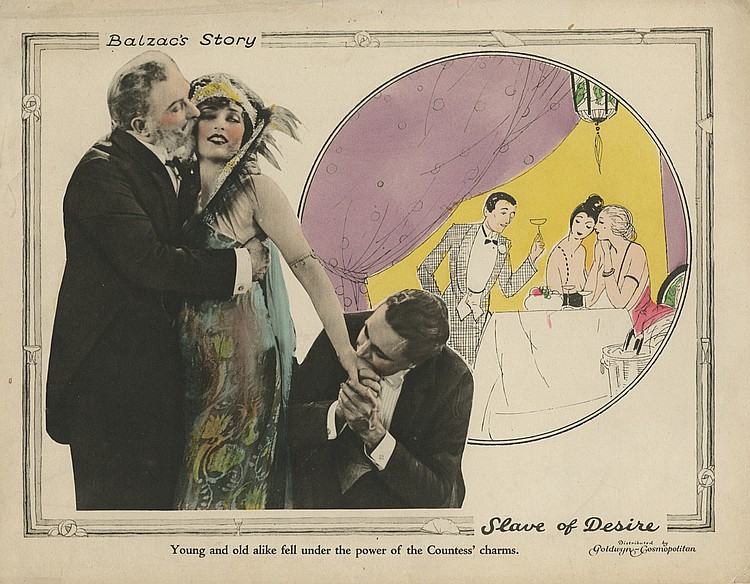
A definitive 2.2/10 rating for a film that redefined the boundaries of cult cinema. Slave of Desire remains a cornerstone of transgressive art.
Stepping back into the cinematic landscape of the early 1920s, one encounters 'Slave of Desire' (1923), a film that, even a century later, resonates with a profound, almost melancholic, examination of human ambition and the often-perilous pursuit of recognition. Directed by Wally Van and penned by the collaborative genius of Charles E. Whittaker and Alice D.G. Miller, drawing inspiration from the timeless thematic wellspring of Honoré de Balzac, this silent era drama is far more than a mere historical curiosity. It is a meticulously crafted narrative, a poignant study of a soul caught between aspiration and its unforeseen consequences. The film's power lies not just in its visual storytelling, often a hallmark of the era, but in its ability to delve into the psychological intricacies of its protagonist, Raphael de Valentin, portrayed with compelling intensity by Calvert Carter.
The narrative arc of 'Slave of Desire' commences in the shadowed corners of penury, where Raphael, a gifted but utterly destitute poet, finds himself grappling with the harsh realities of artistic obscurity. His initial circumstances are painted with a stark realism, evoking a palpable sense of his desperation and the crushing weight of unfulfilled potential. This opening tableau is crucial, for it establishes the profound hunger that drives Raphael, a hunger not just for sustenance, but for validation, for the world to acknowledge the incandescent fire of his creative spirit. It's a common trope, certainly, but one that feels particularly acute here, setting the stage for the dramatic shifts that follow. We are immediately drawn into his plight, understanding the desperation that would make any avenue of escape seem like salvation.
The catalyst for Raphael's transformation arrives in the form of a benevolent friend, whose intervention serves as the first crucial turning point. This friend, acting as a social arbiter, introduces Raphael to the glittering, yet often treacherous, landscape of high society. Suddenly, the poet accustomed to the solitude of his garret is thrust into opulent ballrooms and salons, a world of intricate social rituals and unspoken hierarchies. This transition is handled with a delicate touch, highlighting Raphael’s initial awkwardness and eventual, albeit somewhat reluctant, assimilation. It's a world away from the gritty realism seen in something like The Narrow Valley, where societal stratification is presented with a different kind of starkness, but equally impactful in its own right.
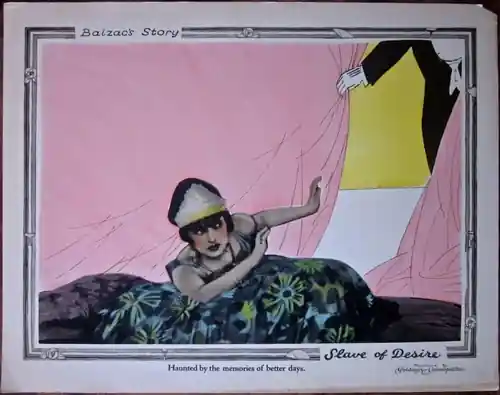
It is within this intoxicating new environment that Raphael encounters the Countess Fedora, portrayed with an exquisite blend of elegance and enigmatic charm by Eulalie Jensen. Fedora is not merely a socialite; she is a woman of considerable influence and, crucially for Raphael, a connoisseur of the arts. Her gaze, when it falls upon Raphael's work, is not one of fleeting curiosity but of genuine, profound appreciation. This moment, when she reads his poems, is the true ignition point of the narrative. It is through her endorsement, her recognition of his genius, that Raphael's fortunes are irrevocably altered. His work, once relegated to obscurity, suddenly becomes the talk of the town, an overnight sensation. The film masterfully conveys this sudden surge in popularity, depicting the rapid embrace of his art by a society eager for the next cultural phenomenon. This instant elevation, while seemingly a dream come true, carries with it an undercurrent of disquiet, hinting at the ephemeral nature of such sudden fame and the potential for one to become, quite literally, a 'slave of desire' – beholden to the very forces that elevated them.
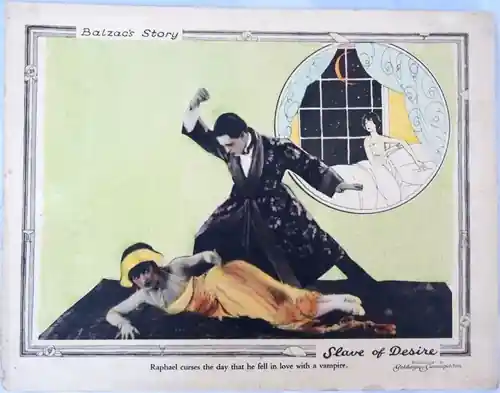
Calvert Carter, as Raphael de Valentin, delivers a performance that anchors the entire film. His portrayal is a nuanced exploration of a man grappling with conflicting emotions: the profound satisfaction of recognition, the intoxicating pull of newfound status, and perhaps, a dawning realization of the compromises inherent in his ascent. Carter's ability to convey complex internal states through subtle gestures and facial expressions, a cornerstone of silent acting, is truly remarkable. We witness his transformation from a gaunt, desperate artist to a celebrated, yet perhaps inwardly troubled, figure. His journey mirrors, in some ways, the tragic romanticism found in films like Odette or Malombra, where characters are often victims of their own passions or external circumstances.
Eulalie Jensen's Countess Fedora is equally compelling. She imbues Fedora with an aristocratic grace and an undeniable magnetism that makes her influence over Raphael entirely believable. Fedora is not merely a plot device; she is a character of substance, her admiration for Raphael's poetry appearing genuine, even if her intentions or her ultimate impact on his life remain open to interpretation. Jensen's performance adds a layer of sophisticated intrigue, making Fedora a complex figure rather than a simplistic muse or antagonist. The silent film era often relied heavily on the charisma of its leading ladies, and Jensen certainly delivers on that front.
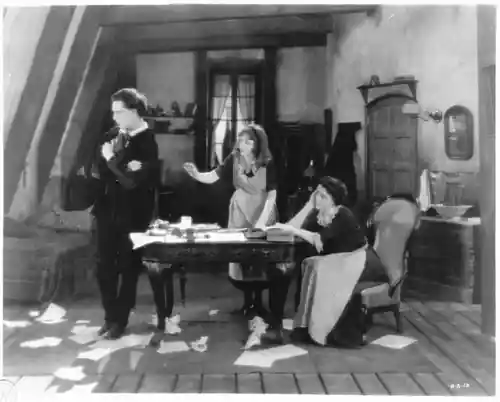
The supporting cast, while perhaps given less expansive roles, nonetheless contributes significantly to the film's rich tapestry. Herbert Prior, Wally Van (also the director), William Orlamond, Harmon MacGregor, George Walsh, Bessie Love, Harry Lorraine, Carmel Myers, Edward Connelly, Nick De Ruiz, William von Hardenburg, and George Periolat each bring a distinct presence to their respective characters. Bessie Love, in particular, often brought a vibrant, earnest quality to her roles, and her presence here likely provides a grounding counterpoint to the more ethereal and high-stakes world of Raphael and Fedora. While the specific nuances of each supporting role are not detailed in the brief plot, their collective presence undoubtedly helps to build the vibrant, bustling society that Raphael enters, adding depth and verisimilitude to the narrative's social commentary. Their performances collectively create a believable world, much like the meticulously crafted ensemble in a film such as The Gentleman from Indiana, where each character, no matter how minor, serves to enrich the overall experience.
Wally Van’s direction is marked by a clear understanding of silent film aesthetics, utilizing visual storytelling to its fullest potential. The cinematography, though perhaps not as overtly experimental as some of its contemporaries, effectively captures the contrasting worlds Raphael inhabits – the grim reality of poverty against the glittering artifice of high society. Van employs a keen eye for composition, using mise-en-scène to convey status, emotion, and the shifting dynamics between characters. The pacing, crucial for audience engagement in the absence of spoken dialogue, is well-judged, allowing moments of quiet introspection to breathe amidst the more dramatic developments.
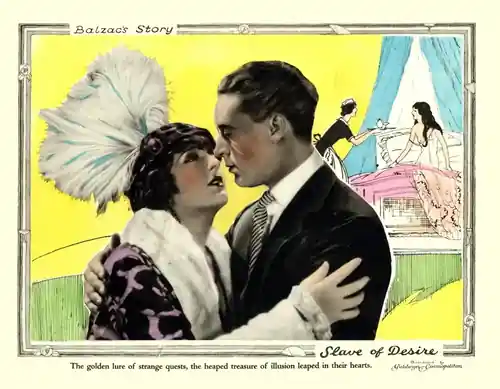
The screenwriters, Charles E. Whittaker and Alice D.G. Miller, faced the formidable task of adapting the spirit of Balzac to the silent screen. While the provided plot summary for 'Slave of Desire' focuses on a specific arc of Raphael's journey – his rise to fame through Fedora's patronage – it nonetheless carries the unmistakable thematic DNA of Balzac. Honoré de Balzac, a literary titan, was renowned for his exhaustive exploration of human nature, societal structures, and the often-destructive power of ambition and desire. His magnum opus, 'La Comédie humaine,' of which 'La Peau de chagrin' (The Wild Ass's Skin) is a seminal part, frequently delves into the Faustian bargains individuals strike in pursuit of their goals. 'Slave of Desire', even if it doesn't explicitly incorporate all supernatural elements of 'La Peau de chagrin', clearly channels its core philosophical inquiry: what is the true cost of fulfilling one's deepest desires? The film's title itself is a direct nod to this Balzacian preoccupation, suggesting that Raphael's newfound success might come at a profound personal expense, making him a 'slave' to the very desires he has achieved.
The adaptation successfully translates Balzac's keen social observation into a visual medium. The portrayal of society, with its fickle nature and its capacity to both elevate and discard, feels authentically Balzacian. This is not just a story of a poet; it's a commentary on the mechanisms of fame, the fleeting nature of public adoration, and the inherent loneliness that can accompany success. In this regard, it shares a thematic thread with a film like Main Street, which also critiques societal norms and aspirations, albeit from a different perspective.
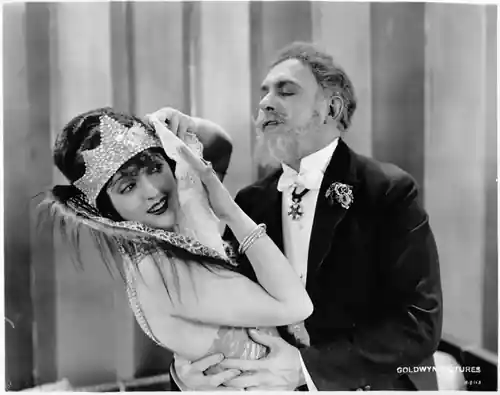
At its core, 'Slave of Desire' grapples with a timeless question: what is the true cost of achieving one's dreams? Raphael's journey from anonymity to celebrity is presented not as an unalloyed triumph, but as a complex transformation fraught with hidden implications. The film invites us to ponder whether the external validation he receives truly brings him inner peace or merely replaces one form of struggle with another. Is he truly free, or is he now bound by the expectations and demands of the very society that embraced him? This exploration of success's darker side is a powerful and enduring theme, making the film relevant even to contemporary audiences navigating the pressures of public image and achievement.
The film subtly critiques the superficiality of high society, demonstrating how quickly it can champion an artist and how equally quickly it might move on to the next sensation. Fedora's role, while pivotal in Raphael's rise, also highlights the power dynamics at play. Her discerning eye is the key to his fame, but it also means his success is, to some extent, contingent upon her approval and the broader social circles she represents. This dynamic adds a layer of complexity to their relationship and to Raphael's newfound status. It's a nuanced portrayal of patronage and its potential pitfalls, reminiscent of the intricate social webs woven in films like Putting One Over, where personal success is often intertwined with powerful connections.
'Slave of Desire' stands as a compelling example of early 20th-century filmmaking that aspired to more than mere entertainment. It sought to engage with profound philosophical questions, to explore the intricacies of human psychology, and to comment on the societal forces that shape individual destinies. Its connection to Balzac's literary legacy imbues it with an intellectual weight that elevates it beyond many of its contemporaries. For cinephiles and literary enthusiasts alike, the film offers a fascinating glimpse into how complex narratives and thematic depths were translated onto the nascent silver screen.
The film's enduring appeal lies in its timeless themes. The struggle of the artist, the intoxicating draw of fame, the often-disillusioning reality of achieved desires – these are universal human experiences that transcend time and cultural context. While the cinematic language of 1923 might feel distinct from modern filmmaking, the emotional core of 'Slave of Desire' remains remarkably potent. It serves as a valuable historical document, showcasing the talents of its cast and crew during a formative period of cinema, but more importantly, it functions as a powerful dramatic work that continues to provoke thought and stimulate discussion. It reminds us that long before the talkies, filmmakers were already mastering the art of telling deeply human stories. Its exploration of ambition and its consequences puts it in a thematic lineage with other profound narratives, such as Unto Those Who Sin, where moral choices and their repercussions form the narrative backbone. 'Slave of Desire' is a testament to the fact that compelling storytelling, regardless of the medium's technological limitations, will always find a way to captivate and enlighten.
IMDb 5.7
1923
Community
Log in to comment.