DbcultAccessing Vault...
Cult Review
Senior Film Conservator
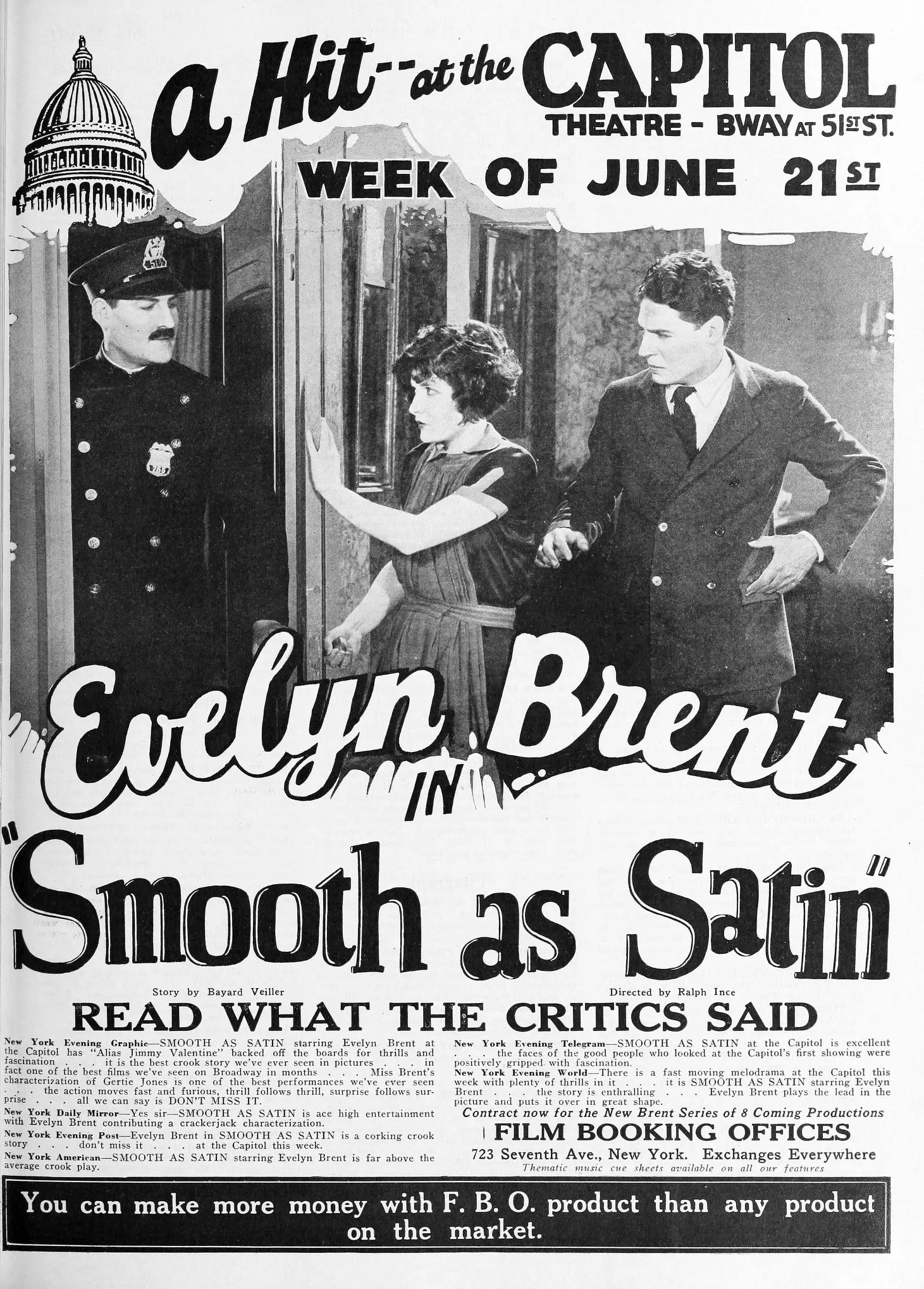
Ah, the allure of the silent era! There's a particular magic in those flickering frames, an unspoken language conveyed through gesture, expression, and the sheer narrative force of visual storytelling. And few films encapsulate this charm quite like Smooth as Satin, a captivating crime drama that pirouettes between thrilling heists, unexpected romance, and a profound quest for redemption. Directed with a keen eye for human folly and aspiration, this picture, penned by the talented duo Fred Myton and Bayard Veiller, isn't just a relic of a bygone cinematic age; it's a vibrant tapestry of human nature, painted with broad strokes of daring and delicate threads of devotion. It invites us, the modern audience, to lean in, to interpret, and to be utterly swept away by its intricate dance of fate and free will.
Our story unfurls in the opulent, yet vulnerable, confines of a lavish residence, where Gertie Jones, portrayed with beguiling cunning by Mabel Van Buren, operates under the guise of domestic servitude. But Gertie is no ordinary maid; she is a veritable Raffles, her nimble fingers and sharp mind set on the grand prize locked within the household's safe. The tension is palpable as she meticulously executes her plan, each silent movement a testament to her seasoned expertise. However, the best-laid schemes, even those of a professional thief, often go awry, and Gertie's meticulously orchestrated nocturnal endeavor takes an unforeseen turn. Imagine her surprise, a delightful jolt for the audience, when she discovers another shadow already lurking by the very safe she intends to rifle. This is Jimmy Hartigan, brought to life with a rogueish charm by Bruce Gordon, caught in the exact same precarious act.
The immediate confrontation is a masterclass in silent film acting, a silent ballet of suspicion, recognition, and grudging respect. Two kindred spirits of the underworld, each attempting to outmaneuver the other, find themselves in a most peculiar stalemate. It's a moment pregnant with possibility, a crossroads where two individual narratives of crime converge into a single, unpredictable path. The sheer audacity of the premise is what hooks you instantly. Here are two characters, both morally ambiguous, both driven by an impulse to acquire wealth through illicit means, forced to acknowledge each other's presence in the most compromising of situations. It speaks volumes about the universality of human ambition, whether it's directed towards noble pursuits or, as in this case, towards the contents of a rich man's safe. The chemistry between Van Buren and Gordon, even in these initial, fraught moments, is undeniable, hinting at the deeper connection that will soon blossom from this most unusual of introductions.
In a stroke of pragmatic brilliance, Gertie, ever the opportunist, proposes an audacious solution: a fifty-fifty split of the take. It's a proposition born of necessity, yet it carries the implicit weight of an emerging partnership, a tentative alliance forged in the crucible of shared criminal enterprise. Jimmy, perhaps initially taken aback by her brazenness, is on the verge of acquiescing when fate, in its most inconvenient form, intervenes. The shrill wail of police sirens shatters the nocturnal quiet, transforming their clandestine operation into a desperate scramble. This sudden intrusion elevates the stakes dramatically, shifting the narrative from a calculated heist to a thrilling escape.
What transpires next is a pivotal moment, a testament to the incipient connection between these two rogues. Jimmy Hartigan, with a selflessness that belies his criminal profession, makes a snap decision that will forever alter their trajectories. He takes full responsibility for the crime, shielding Gertie from arrest, a gesture of unexpected gallantry that resonates deeply. It's a moment of profound moral complexity, where a 'bad' man performs an inherently 'good' act, sacrificing his immediate freedom for another. This act of protection, this silent vow, lays the groundwork for the burgeoning romance that will define their journey. It's not just about escaping justice; it's about a nascent loyalty, a bond forged under duress. This scene, in its understated power, reminds one of the thematic undercurrents explored in films like The Branded Woman, where societal condemnation often forces individuals into an unexpected solidarity, or even prompts a re-evaluation of personal ethics. The emotional weight of Jim's sacrifice is palpable, setting the stage for Gertie's equally daring reciprocal act.
True to the unwritten code that now binds them, Gertie orchestrates a daring jailbreak, a sequence that crackles with suspense and ingenuity. Her resourcefulness is on full display as she meticulously plans and executes Jim's liberation, proving herself not just a partner in crime, but a formidable force in her own right. Their escape leads them to the relative anonymity of the countryside, a pastoral refuge far removed from the city's watchful eyes. Here, in a twist of delicious irony and narrative charm, an overeager magistrate, mistaking them for an eloping couple, pronounces them man and wife. This accidental matrimony is a pivotal turning point, sealing their fate not just as criminal accomplices, but as legally bound partners, adding a layer of poignant serendipity to their tumultuous tale. It's a moment that could easily veer into farce, but the film handles it with a delicate touch, emphasizing the genuine, if unconventional, bond forming between them.
This unexpected union sparks a profound desire within both Jim and Gertie to forsake their larcenous pasts. The allure of a 'straight' life, of legitimate existence, suddenly seems more appealing than the constant peril of their former ways. They decide to return to the city, armed with $10,000 in stolen cash – their last ill-gotten gains – intending to invest it and build a respectable future. This decision, fraught with inherent risk, speaks to a universal human yearning for stability and acceptance, even for those who have strayed far from the path. It's a testament to the transformative power of love and shared aspiration, demonstrating that even hardened criminals can dream of a life beyond the shadows. However, the path to redemption is rarely smooth, and their aspirations are quickly dashed. They entrust their newfound capital to Bill Munson, a seemingly trustworthy associate, only for him to abscond with their entire investment. This betrayal is a crushing blow, not just financially, but emotionally, highlighting the precariousness of their position and the difficulty of truly escaping one's past. The world, it seems, isn't quite ready to let them go straight without a fight.
Munson's duplicity plunges Jim and Gertie back into the very cycle they desperately sought to escape. Jim is swiftly rearrested by a relentless detective, his dreams of a legitimate future crumbling around him. The emotional weight of this moment is immense, as we witness the crushing disappointment and despair that washes over him. It's a stark reminder that consequences often linger, even when intentions shift. Yet, Gertie, ever the indomitable spirit, refuses to let their dreams die. Her love for Jim, fortified by their shared experiences and unexpected marriage, fuels a renewed determination. She sets off on a relentless pursuit of Munson, a woman on a mission, embodying resilience and unwavering loyalty.
This sequence of Gertie's solo quest is particularly compelling, showcasing her agency and intelligence. She navigates the city's underbelly, her previous life skills now repurposed for a cause she truly believes in. Her recovery of the money isn't just a financial victory; it's a symbolic reclamation of their future, a defiant act against the forces that seek to pull them back into the abyss. The tension builds as she races against time, knowing Jim's fate hangs in the balance. The narrative here echoes the relentless pursuit and high stakes found in films like Trapped by the London Sharks, though here, the motivation is deeply personal and romantic rather than purely criminal. The film deftly explores the sacrifices made for love, reminiscent of the complex moral quandaries in a film like Married in Name Only, where relationships are tested by external pressures and internal conflicts. Gertie's unwavering resolve solidifies her as a truly memorable character, far more than just a supporting player in Jim's story.
The narrative reaches its electrifying crescendo aboard a penitentiary-bound train, carrying a despondent Jim towards a future he desperately wishes to escape. Gertie, clutching the recovered $10,000, boards the train, her heart pounding with a desperate hope. She confronts the detective, offering the money as a desperate plea for Jim's freedom, a final, audacious gamble. The detective, bound by duty and the letter of the law, initially refuses, his face a mask of resolute professionalism. The tension in this confined space is immense, the stakes impossibly high, as Gertie's last hope seems to dissipate before her eyes. It's a poignant depiction of the clash between rigid justice and the yearning for mercy, a theme that resonates across all eras of storytelling.
But then, fate, in its most dramatic and terrifying form, intervenes once more. The train plunges into a tunnel, only for the structure to collapse, trapping them in a claustrophobic, life-threatening disaster. This sudden, cataclysmic event transforms the adversaries into allies, as the primal instinct for survival overrides all previous animosity. In a breathtaking display of courage and resourcefulness, Jim and Gertie, drawing upon their street-honed instincts and perhaps a newfound sense of shared purpose, spring into action. They heroically save the detective's life, pulling him from the debris, their actions speaking louder than any plea for clemency. This act of selfless bravery, performed by the very individuals he was sworn to imprison, compels a profound reevaluation within the detective. His rigid adherence to the law is softened by the undeniable evidence of their humanity and courage. The experience in the tunnel is a crucible, forging not just survival, but a new understanding of justice.
In the

IMDb 7
1935
Community
Log in to comment.