DbcultAccessing Vault...
6.3/10
Senior Film Conservator
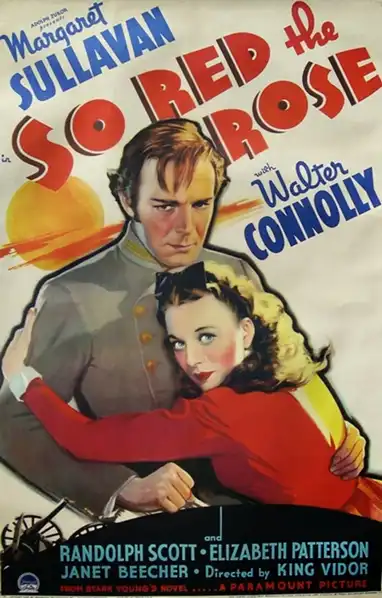
A definitive 6.3/10 rating for a film that redefined the boundaries of cult cinema. So Red the Rose remains a cornerstone of transgressive art.
If you're looking for a standard Civil War flick with cannons going off every five minutes, So Red the Rose is going to put you to sleep. It’s a weird, fragile little movie that spends most of its time staring at porches and fancy dresses. You’ll probably hate it if you need a plot that actually moves, but if you like films that feel like they’re drifting through a hazy, dying afternoon, it’s worth a look.
Margaret Sullavan is doing some real heavy lifting here. She has this way of looking at a doorway, waiting for someone to walk through it, that tells you more about the war than any of the scenes where Randolph Scott is just standing around looking stern in a uniform. It’s a performance of small, sharp gestures. She’s entirely believable, even when the script around her feels like it’s made of wet paper.
There is this moment where the house goes quiet—really quiet—and you realize the movie has stopped caring about the war entirely. It just wants to exist in that specific, suffocating room. It’s unsettling. It’s not quite as charming as Glorious Betsy, but it has a colder, more lonely atmosphere.
The pacing is a bit of a mess. Sometimes a scene will linger on a single reaction shot until it feels like the actors forgot the camera was still rolling. It’s not necessarily a bad thing, but it’s strange. You can feel the director, King Vidor, trying to keep a lid on all this melodrama, but the edges keep fraying anyway.
The plantation scenes feel strangely hollow. Like they built the set but forgot to put real life inside it. Maybe that was the point? To show that everything they were clinging to was already a ghost story before the first shot was even fired.
I couldn't help but think about how much this movie wants to be important. It leans into its own tragedy with a bit too much perfume. But then, Sullavan does something with her eyes, and you stop caring about the weak dialogue. It’s an uneven watch, for sure. But the parts that land? They land hard.
IMDb 4.9
1918
Community
Log in to comment.